
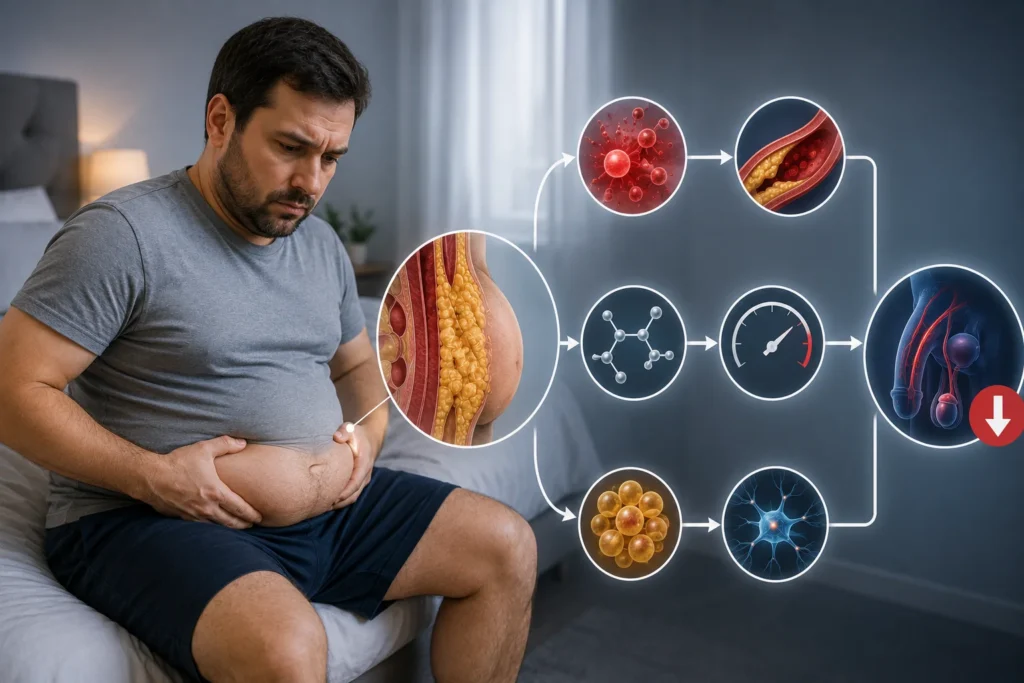
You’ve probably noticed the extra bit around your middle creeping in over the years, and you’ve probably told yourself it’s just a cosmetic thing. A tighter belt, a shirt that doesn’t sit right, no big deal. But here’s the question a lot of men quietly wonder about and rarely ask out loud: could that same belly be the reason things aren’t working the way they used to in bed? It turns out that question deserves a real answer, because the connection between your waistline and your sex life is closer than most people assume.
How Belly Fat Actually Affects Your Body Below The Belt
Fat isn’t just padding sitting there doing nothing. The fat that collects around your stomach behaves more like an active organ than a passive layer, and it’s constantly sending out signals that ripple through the rest of your body, including the systems responsible for getting and keeping an erection.
Visceral Fat vs. Regular Fat, and Why It Matters
Not all fat is created equal, and this is the part that surprises most guys. The fat you can pinch under your skin is one thing, but the fat wrapped around your internal organs, known as visceral fat, is a different beast entirely. It pumps out inflammatory chemicals and stress hormones around the clock, and over time that steady drip damages the lining of your blood vessels. Since an erection depends almost entirely on healthy blood vessels opening up on command, damaged plumbing means a weaker response when it counts. Picture your blood vessels like garden hoses. A healthy hose expands easily when the water turns on. A stiff, damaged one struggles to deliver the same flow, no matter how hard you turn the tap.
The Testosterone-Estrogen Swap Nobody Warns You About
Here’s something most men never learn until it’s already a problem: the link between belly fat and testosterone comes down to a single enzyme in fat tissue that converts testosterone into estrogen. The more belly fat you’re carrying, the more of this conversion happens, which means your testosterone quietly drops while your estrogen creeps up. Lower testosterone doesn’t just mean less muscle or less energy. It directly affects libido, arousal, and the physical mechanics of an erection. Add in the fact that excess abdominal fat also tends to raise cortisol, your stress hormone, and you’ve got a hormonal environment working against you from two directions at once.
What The Research Says About Waistline and Erectile Function
This isn’t just a theory floating around wellness blogs. Researchers studying obesity and erectile dysfunction have looked at this connection from multiple angles, and the data keeps pointing the same direction.
The Waist Circumference Number Doctors Actually Watch
A waist measurement above 40 inches has repeatedly shown up in research as a meaningful marker for elevated risk of sexual dysfunction, independent of your overall body weight. That’s worth sitting with for a second, because it means two men with the exact same weight on the scale can carry very different risk levels depending on where that weight sits. Studies using visceral fat scoring systems, including large population datasets like NHANES, have found a consistent link between higher visceral fat markers and a greater likelihood of reporting erectile difficulty, even after adjusting for age and other health conditions.
Metabolic Syndrome and Blood Vessel Damage
Belly fat rarely travels alone. It tends to show up alongside high blood pressure, elevated blood sugar, and abnormal cholesterol, a cluster doctors call metabolic syndrome. Research out of Italy studying men with central obesity found a clear, stepwise relationship: as waist circumference climbed, total testosterone dropped, and erectile function declined right along with it, independent of psychological factors. In other words, this isn’t just “stress” or “being tired.” There’s a measurable physical mechanism at play.
How To Tell If Your Weight Is Behind Your ED
You don’t need a lab coat to notice the early clues. Some common signs that your midsection might be playing a role include:
- Erections that used to come easily now take more effort or fade faster
- Lower energy and less interest in sex overall
- Noticing your waistband has grown even if the number on the scale hasn’t moved much
- Feeling more sluggish, moodier, or foggier than you used to
- Other signs of low testosterone, like reduced muscle tone or slower recovery from workouts
None of these on their own confirm anything, but together they paint a pattern worth paying attention to instead of ignoring. Belly fat is only one item on the list of possible causes of erectile dysfunction, so it’s worth ruling out other contributors like medication side effects, sleep apnea, or circulation issues before assuming weight is the sole factor.
What You Can Do About It
The encouraging part of all this is that fat-related erectile dysfunction tends to be one of the more reversible types, because you’re addressing a cause rather than just covering up a symptom.
Weight Loss Numbers That Actually Move The Needle
You don’t need to transform into a different person to see results. Research consistently shows that weight loss improve erectile dysfunction outcomes in a fairly predictable way, with somewhere between 5 and 10 percent of body weight lost through consistent exercise and better eating habits translating into meaningfully better sexual function for men carrying excess abdominal fat. That’s a realistic, achievable target rather than some extreme before-and-after transformation. Strength training in particular helps, since building muscle improves how your body handles insulin and supports healthier testosterone levels.
When Diet and Exercise Alone Aren’t Cutting It
Sometimes you do everything right on paper, cleaner meals, regular workouts, better sleep, and the number on the scale barely budges, or your energy and performance still lag behind where you’d expect. That’s usually a sign something else needs attention, whether it’s a hormonal imbalance, insulin resistance, or a metabolic issue that diet alone can’t fully correct. This is exactly the situation where a natural erectile dysfunction treatment plan pays off instead of guessing your way through another six months of frustration.
What A Root-Cause Approach Looks Like
Rather than treating the symptom in isolation, a whole-body evaluation looks at your actual bloodwork, hormone levels, and metabolic markers to figure out what’s really driving things. If you’re local to Central Oregon, Erectile Dysfunction Treatment in Bend, OR can include testing for testosterone, thyroid function, blood sugar regulation, and inflammation, then building a plan around what your body specifically needs rather than a generic weight-loss checklist. Working with a Naturopathic Doctor in Bend, OR means you’re getting a strategy built around your own numbers, not a one-size-fits-all plan pulled off a shelf.
Conclusion
So, can belly fat cause erectile dysfunction? The research says yes, and not through some vague, indirect connection either. Visceral fat actively damages blood vessels, shifts your hormone balance toward less testosterone and more estrogen, and often travels alongside metabolic conditions that compound the problem further. The upside is that this particular cause of ED responds well to real, targeted change. Losing even a modest amount of weight, especially around the middle, can restore function for a lot of men. And if the scale isn’t moving despite genuine effort, that’s not a personal failure, it’s a signal that your body needs a closer look rather than more willpower.
FAQs
Does losing belly fat guarantee my erectile dysfunction will improve?
Not guaranteed, but the odds are strongly in your favor. Studies show meaningful improvement in a large portion of men who lose even a modest percentage of body weight, though results depend on how long the issue has been present and whether other factors are contributing.
Can I have a normal BMI and still have belly fat affecting my erections?
Yes, and this catches a lot of men off guard. Visceral fat can build up around your organs even when your overall weight looks fine on a chart, which is why waist circumference is often a more useful measurement than BMI alone.
How long does it take to see improvement after losing weight?
Some men notice changes within a few weeks of consistent exercise and diet changes, while hormonal shifts tied to more significant weight loss can take a few months to fully show up in sexual function.
Is this type of erectile dysfunction different from age-related ED?
They can overlap, but fat-related ED tends to have a more identifiable hormonal and vascular cause, which often makes it more responsive to lifestyle and metabolic treatment compared to ED driven purely by aging.
Should I get bloodwork done before starting a weight loss plan for ED?
It’s a smart move. Bloodwork can reveal whether testosterone, thyroid function, or blood sugar issues are part of the picture, which helps you build a plan that addresses the actual cause instead of guessing.
Further reading
- Obesity: Unhealthy and unmanly, Harvard Health Publishing. Discusses research linking larger waist size and excess weight to higher ED risk.
- Erectile dysfunction: A sign of heart disease?, Mayo Clinic. Explains shared blood vessel risk factors, including obesity, behind ED and heart disease.
- Symptoms & Causes of Erectile Dysfunction, NIDDK (NIH). NIH list of ED causes, including overweight and obesity and related health conditions.
Want to talk this through for your own health? Book a visit with Dr. Drew Collins, ND at 601 NW Harmon Blvd in Bend, or call (858) 333-5196.