
Does HRT cause weight gain? The best evidence says no. A Cochrane review of 28 randomized trials with 28,559 women found no meaningful difference in weight or BMI between women taking estrogen, with or without a progestogen, and women who were not. Weight tends to creep up at menopause regardless, and HRT neither causes that gain nor stops it.
Quick answer: Randomized trials show menopausal hormone therapy does not cause weight gain. Estrogen alone and estrogen with progestogen both added well under a tenth of a kilogram compared with placebo. Some trials found slightly less belly fat and less muscle loss on HRT. It is not a weight loss treatment. Midlife weight gain comes mostly from aging and changing body composition.
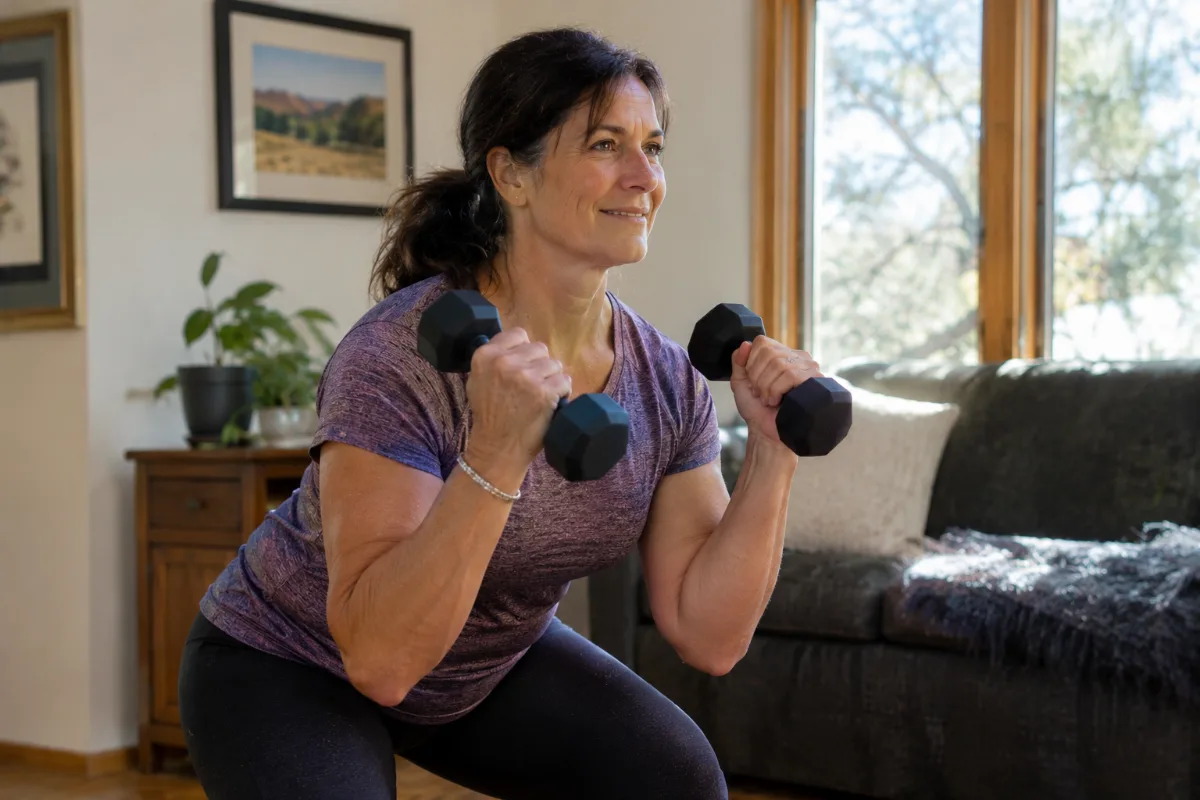
Does HRT cause weight gain? What the trials found
The fear is common enough that researchers built a whole review around it. The Cochrane review by Kongnyuy and colleagues pooled 28 randomized controlled trials and 28,559 women. Its plain language summary says it directly: some women avoid HRT because they think it causes weight gain, and the trials do not support that.
The numbers are small enough to be almost funny. Women on estrogen alone gained 0.03 kg more than women not on it. Women on estrogen plus a progestogen gained 0.04 kg more. Neither difference was statistically significant, and BMI did not differ either. For scale, 0.04 kg is about the weight of three tablespoons of water.
Two honest caveats. The review could not pool enough data on waist-to-hip ratio, fat mass or skinfold thickness to say anything about fat distribution, so “no effect on weight” is not the same as “no effect on shape.” And the Cochrane version is from 2000, with searches last run in 2005, so it does not include newer work. The newer work has not reversed it, though. The Menopause Society’s hormone therapy page states that “HT is not associated with weight gain,” and the NHS says there is little evidence that most types of HRT make you put on weight.
So why do so many women swear their jeans got tighter after starting? Timing, mostly. Women usually start HRT right in the years when weight and body fat are already rising. The scale moves, the new prescription is the obvious suspect, and nobody has a placebo version of themselves to compare against. That is exactly the comparison the trials provide.
Does estrogen cause weight gain?
Not in the trials. Estrogen alone added 0.03 kg on average in the Cochrane analysis. The NHS lists estrogen’s common side effects as headaches, breast tenderness, nausea, mood changes, leg cramps and a few others, and weight gain is not on that list. Most of those effects settle within a few weeks.
The more interesting question is where fat goes. In a Women’s Health Initiative substudy (Chen and colleagues, 2005), 835 women had body scans over three years. Those randomized to estrogen plus progestin lost 0.04 kg of lean tissue, compared with 0.44 kg on placebo. Their trunk-to-leg fat ratio also fell slightly while the placebo group’s rose. Less upper-body fat, more muscle kept.
The authors called those effects small, and they are. These were women averaging 63 years old, nearly 14 years past menopause, so the results may not map neatly onto a 51-year-old in her first year of symptoms.
Falling estrogen, rather than estrogen therapy, is the better candidate for midlife fat change. The SWAN body composition data below show fat gain speeding up right as the ovaries wind down.
Does progesterone cause weight gain?
In menopause hormone therapy, the best trial data say no. The PEPI trial (Espeland and colleagues, 1997) randomized 875 postmenopausal women to placebo, estrogen alone, or estrogen with one of three progestin regimens, including cyclic oral micronized progesterone. After three years, the progestin regimens did not affect weight gain. Cochrane’s pooled estrogen-plus-progestogen figure was 0.04 kg.
The NHS lists progestogen side effects as period changes, headaches, breast tenderness, nausea, tiredness, mood changes, skin changes and acne, again without weight gain, and again usually fading after a few weeks. Some women describe feeling puffy or bloated on progesterone. That is worth reporting to whoever prescribes it, because the type, dose or schedule can often be changed.
A lot of searches about progesterone and weight are really about birth control or pregnancy. Those involve different hormones, doses and life stages, and the menopause trials here do not answer them.
| Study | Who was studied | What it found on weight |
|---|---|---|
| Cochrane review, 2000 | 28 trials, 28,559 women | No significant effect on weight or BMI from estrogen alone or estrogen with progestogen |
| PEPI trial, 1997 | 875 postmenopausal women, 3 years | HRT users gained about 1 kg less than placebo; progestin type made no difference |
| WHI body composition substudy, 2005 | 835 women, mean age 63, 3 years | Slightly less lean mass loss and less upper-body fat on estrogen plus progestin |
| SWAN body composition, 2019 | 1,246 women followed through menopause | Fat gain sped up and lean mass fell during the transition, while weight rose at a steady pace |
Does HRT help with weight loss?
No, and we would not start hormones for that reason. Cochrane’s plain language summary is titled “Hormone replacement therapy has no effect on body weight and cannot prevent weight gain at menopause,” and the pooled weight difference sat close to zero.
There are hints of a modest buffer. In PEPI, women on hormones gained about 1.0 kg less than women on placebo over three years, and their waists grew less. The trial’s authors saw that as solid evidence that hormone use slows age-related weight gain. One kilogram over three years is real, but nobody would call it weight loss.
Newer research is looking at HRT alongside weight loss medication. A Mayo Clinic study published in January 2026 looked back at 120 people who took tirzepatide for at least a year and found postmenopausal women also using hormone therapy lost about 35 percent more weight than those who were not. The researchers were careful about it. The study was observational, so it cannot show hormones caused the difference, and women on HRT may have already had healthier habits or slept better once their hot flashes eased. A randomized trial is planned.
That last point, sleep, is where we think HRT earns its keep for a lot of women. Night sweats and 3 a.m. wake-ups make every other healthy habit harder, and they ripple into mood as well, which we cover in our post on perimenopause and anxiety. Whether better sleep on HRT translates into better weight control has not been tested directly. It is a reasonable guess, and still a guess.
What actually drives midlife weight gain
Body composition, more than the number on the scale. In 2019, Greendale and colleagues published SWAN data in JCI Insight on 1,246 women whose fat and lean mass were measured by scan as they went through menopause. Before the transition, fat mass grew about 1.0 percent a year. During the transition, the rate jumped to 1.7 percent a year, about 0.45 kg of fat annually, while lean mass dropped about 0.2 percent a year.
Weight itself kept rising at a steady 0.3 percent a year. It did not speed up. What changed was what the weight was made of.
The timing matters. Those changes started about two years before the final period and leveled off within roughly two years after it. So the window when many women start HRT is the same window when fat gain is fastest, which explains a great deal of the blame HRT gets.
In PEPI, most of the weight gain in both groups happened between ages 45 and 54, and women who were more physically active gained less. That gives you the practical levers. The US Physical Activity Guidelines call for 150 to 300 minutes of moderate aerobic activity a week plus muscle-strengthening work at least two days a week. For women losing lean mass during the transition, we would argue the strength work is the half not to skip.
Can hormone imbalance cause weight gain?
Yes, and it is worth ruling out before blaming either menopause or its treatment. Cleveland Clinic names three common hormonal routes to weight gain:
- Hypothyroidism, where low thyroid hormone slows metabolism
- Cushing’s syndrome, a rare condition in which too much cortisol causes rapid weight gain in the face, belly, upper back and chest
- Menopause itself, as hormonal changes slow metabolism
Polycystic ovary syndrome, diabetes and low testosterone in men also sit in the same family of conditions. If weight is climbing fast, alongside fatigue, feeling cold, a rounder face or very irregular periods, ask for testing rather than assuming it is your age. HRT will not fix an untreated thyroid problem.
Do bioidentical hormones cause weight gain?
The evidence here is thinner, and we would rather say so than pretend otherwise. “Bioidentical” means hormones made to match the chemical structure of the ones your body produces. Some bioidentical products are FDA-approved. Others are compounded, custom-mixed by a pharmacy, and Cleveland Clinic notes the FDA has not reviewed or approved those mixtures. You can read more about bioidentical versus synthetic hormones in a separate post.
On weight specifically, Cleveland Clinic lists weight gain among the common side effects of bioidentical hormones. We could not find a randomized trial that isolated compounded bioidentical hormones and measured weight against placebo. What we do have is PEPI, where cyclic oral micronized progesterone, a bioidentical progesterone, did not affect weight gain any more than the synthetic progestin did.
Our reading: the molecule matters less than the dose, the route, how closely it is monitored, and what your body is already doing during the transition. Anyone promising a specific hormone product will melt pounds off is getting ahead of the evidence.
Myth: HRT makes you gain weight.
Fact: Across 28 randomized trials, estrogen with or without progestogen added only 0.03 to 0.04 kg compared with no hormones, a difference that was not statistically significant.
Myth: Starting HRT will help you lose the menopause weight.
Fact: Cochrane found HRT cannot prevent weight gain at menopause. In PEPI, hormone users gained about 1 kg less over three years, which is a slower gain, not a loss.
Myth: If the scale is steady, nothing is changing.
Fact: SWAN found fat mass growth sped up and lean mass fell during the transition while weight rose at the same steady pace.
Frequently asked questions
Why did I gain weight after starting HRT?
Most likely because HRT usually starts in the same years when midlife weight and fat gain are already happening. SWAN found fat gain speeds up from about two years before the final period. Randomized trials compare women on HRT with women on placebo in those same years, and they find no meaningful difference in weight. If your gain was sudden or large, ask about thyroid and other causes.
Does HRT cause bloating or water retention?
Some women describe bloating or feeling puffy after starting hormones, especially progestogens, though the NHS side effect lists focus on headaches, breast tenderness, nausea and mood changes. Early side effects often settle within a few weeks. If bloating persists, talk to your prescriber, because adjusting the type, dose or schedule of the hormone can sometimes help. Persistent bloating with pelvic pain needs its own evaluation.
Does HRT reduce belly fat?
Possibly a little. In the Women’s Health Initiative body composition substudy, women on estrogen plus progestin had a small drop in their trunk-to-leg fat ratio, while women on placebo had a small rise. PEPI found waists grew less on hormones. The researchers described the effects as small, so HRT is not a belly fat treatment, but it does not appear to add any.
Is oral or transdermal HRT better for weight?
There is no strong evidence that one route is better for weight. The Cochrane review pooled many regimens and found no weight effect overall, and it did not have enough data to compare body fat by route. Route can matter for other health reasons, which is a conversation to have with your prescriber based on your own history and risks.
How much weight do women gain during menopause?
It varies widely, but the SWAN body composition study found weight rose about 0.3 percent a year during the transition, roughly 0.25 kg annually, while fat mass grew faster, about 1.7 percent a year. In PEPI, most gain happened between ages 45 and 54. More physical activity was linked to less gain, which is the most useful lever most women have.
If worry about weight is the main thing holding you back from treating hot flashes, poor sleep or other menopause symptoms, it is worth a proper conversation. Dr. Drew Collins, ND, at Proactive Choice reviews your symptoms, history and hormone labs and walks through what the evidence says for your situation, including bioidentical hormone replacement in Bend. You can book a free 15-minute call at +1 (858) 333-5196.
Sources
- Kongnyuy EJ, Norman RJ, Flight IHK, Rees MC. Oestrogen and progestogen hormone replacement therapy for peri-menopausal and post-menopausal women: weight and body fat distribution. Cochrane Database of Systematic Reviews, 2000 (CD001018).
- The Menopause Society. Hormone Therapy.
- NHS. Side effects of hormone replacement therapy (HRT).
- Chen Z, et al. Postmenopausal hormone therapy and body composition: a substudy of the estrogen plus progestin trial of the Women’s Health Initiative. American Journal of Clinical Nutrition, 2005.
- Relias Media. Effect of postmenopausal hormone therapy on body weight and waist and hip girths (summary of Espeland MA, et al., PEPI trial, Journal of Clinical Endocrinology and Metabolism, 1997).
- Greendale GA, et al. Changes in body composition and weight during the menopause transition. JCI Insight, 2019.
- Mayo Clinic News Network. Study links combination of hormone therapy and tirzepatide to greater weight loss after menopause, 2026.
- US Office of Disease Prevention and Health Promotion. Physical Activity Guidelines for Americans: top 10 things to know.
- Cleveland Clinic. Hormonal imbalance.
- Cleveland Clinic. Bioidentical hormones.
Medically reviewed content from Proactive Choice. This article is for education and is not a diagnosis. Talk with a licensed clinician about your own symptoms and treatment options.
Want to talk this through for your own health? Book a visit with Dr. Drew Collins, ND at 601 NW Harmon Blvd in Bend, or call (858) 333-5196.