
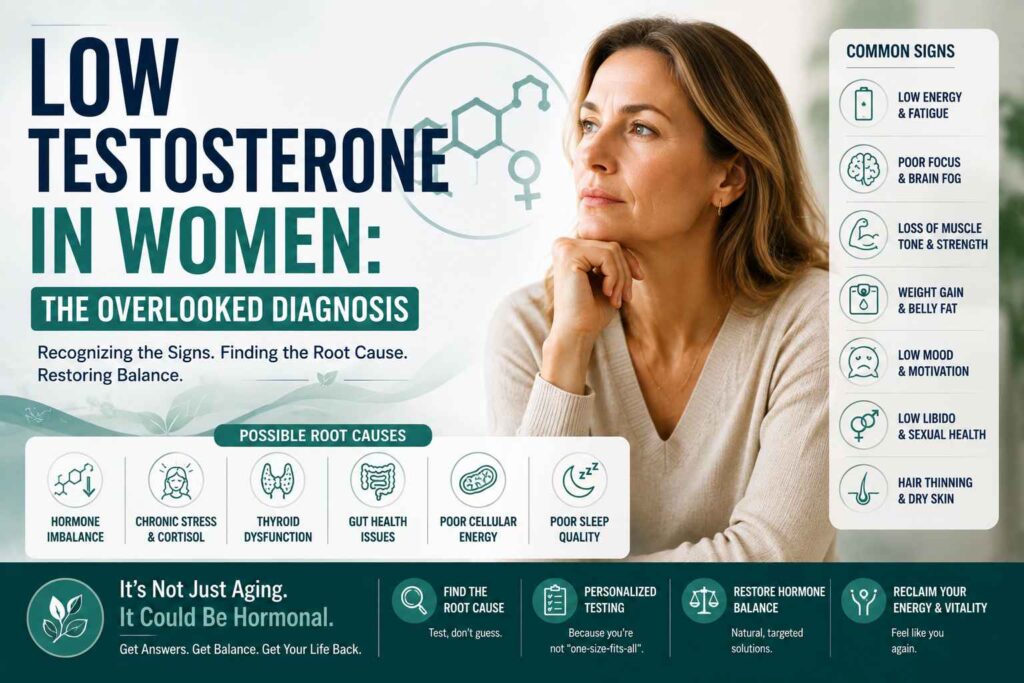
Testosterone is generally discussed as a male hormone, which is a reasonable shorthand and a poor guide to physiology. Women produce testosterone throughout life, in quantities substantially lower than men but considerably higher than oestrogen. Measured in absolute terms, testosterone is the most abundant biologically active sex hormone in the female body.
Despite that, it is rarely measured in women, and when symptoms of deficiency appear they are usually attributed to something else: stress, depression, ageing, relationship problems, or simply “being busy.”
This article covers what testosterone does in women, what low levels actually cause, what the evidence supports for treatment, and where the honest limits of that evidence sit. That last part matters, because this is an area where clinical enthusiasm has at times outrun the data.
What Testosterone Does in the Female Body
In women, testosterone comes from three sources: direct production by the ovaries, direct production by the adrenal glands, and peripheral conversion of precursor hormones including DHEA and androstenedione in fat, skin, and other tissue. Roughly half of circulating testosterone in women originates from that peripheral conversion.
Its documented roles include:
- Sexual desire and arousal. Testosterone acts on brain regions governing motivation and reward, and influences genital blood flow and sensitivity.
- Muscle mass and strength. It supports muscle protein synthesis and the maintenance of lean tissue.
- Bone density. Testosterone contributes directly to bone maintenance and also serves as a substrate for local conversion to oestrogen in bone tissue.
- Energy and motivation. Through dopaminergic pathways, influencing drive and initiative rather than alertness as such.
- Mood and cognition. Receptors are present throughout the brain, including in regions governing mood regulation and spatial cognition.
- Body composition. Influencing the balance between lean mass and fat, and fat distribution.
If low testosterone symptoms sound familiar, testing is the first step. Learn about hormone replacement for women in Bend with Dr. Drew Collins, ND.
Why Levels Decline
Unlike oestrogen, which drops sharply around menopause, testosterone declines gradually and earlier. Levels in a woman in her forties are typically around half of what they were in her twenties, and that decline is largely age-related rather than menopause-related.
Factors that accelerate or worsen the decline:
- Surgical removal of both ovaries, which causes an abrupt drop of roughly half of circulating testosterone
- Adrenal insufficiency or long-term corticosteroid use, which reduces adrenal androgen output
- Oral oestrogen therapy and combined oral contraceptives, which raise sex hormone binding globulin substantially, reducing the free, biologically available fraction. This effect can persist for some time after stopping.
- Hypothalamic suppression from very low energy availability, common in endurance athletes and in restrictive dieting
- Pituitary disorders, which reduce the signalling that drives ovarian and adrenal production
- Chronic illness and chronic stress
The binding globulin point is worth emphasising, because it is a common and reversible cause. A woman on a combined oral contraceptive can have a normal total testosterone alongside a very low free fraction, which is the fraction that matters.
Symptoms of Low Testosterone in Women
These symptoms are non-specific, which is precisely why the diagnosis is missed and also why it should not be made on symptoms alone.
Reduced Sexual Desire
Usually the most prominent. The characteristic description is not distress about a relationship or difficulty with arousal during sex, but the absence of spontaneous interest arising at all. Women often describe it as a switch that has been turned off rather than a problem with the experience itself.
When this causes personal distress, it may meet criteria for hypoactive sexual desire disorder, which is the condition with the strongest evidence base for testosterone treatment in women.
Persistent Fatigue and Loss of Drive
Distinguishable from sleepiness. Women describe having the capacity to do things but not the impulse. Initiative declines. Projects that would previously have been started are not. This overlaps considerably with depression, which is one reason careful assessment matters.
Difficulty Maintaining Muscle
Training producing less result than it used to, strength plateauing or declining despite consistent effort, and slower recovery between sessions. This is often noticed first by women who train regularly and have a clear baseline.
Body Composition Change
Increased central fat and reduced lean mass, sometimes without weight change. Clothes fitting differently at the same number on the scale.
Low Mood and Reduced Confidence
Flatness, reduced motivation, and a sense of diminished resilience. Again, overlapping heavily with depression and with perimenopause.
Bone Density Loss
Not something you feel. It shows up on a DEXA scan, sometimes earlier or more severely than expected, particularly after oophorectomy.
Cognitive Complaints
Reduced mental sharpness and difficulty with sustained concentration are frequently reported, though the evidence linking these specifically to testosterone in women is weaker than for libido.
The Testing Problem
Here is where honesty is required, because the situation is genuinely unsatisfactory.
Most standard laboratory testosterone assays were designed and validated for the male range. At the much lower concentrations found in women, these immunoassays lose accuracy considerably. A result from a standard assay in the female range should be treated as approximate.
More reliable measurement uses liquid chromatography tandem mass spectrometry, which performs accurately at low concentrations. If testosterone is being measured in a woman, this is the method worth asking about.
What should be measured:
| Marker | Why it matters |
|---|---|
| Total testosterone (by mass spectrometry) | Total circulating hormone, bound and unbound |
| Sex hormone binding globulin | Determines how much is biologically available |
| Free or bioavailable testosterone | The active fraction; calculated or directly measured |
| DHEA-S | Adrenal androgen production and precursor availability |
| Oestradiol, FSH, LH | Overall reproductive axis context |
| Full thyroid panel, ferritin, vitamin D, B12 | Rules out the far more common causes of the same symptoms |
Timing: for menstruating women, ideally in the follicular phase, and in the morning, since testosterone follows a daily rhythm.
The critical caveat, and professional bodies are explicit about this: there is no validated threshold below which a woman is considered testosterone deficient. Unlike male hypogonadism, no diagnostic cutoff has been established. This means treatment decisions rest primarily on symptoms and clinical judgement rather than on a number, and it means anyone quoting a definitive “low” value for women is asserting more precision than exists.
Our broader guide to which hormone tests actually matter covers how these pieces fit into a wider assessment.
What the Evidence Supports for Treatment
An international consensus position published by multiple endocrine and menopause societies reviewed the available randomised trial evidence and reached conclusions worth stating plainly.
Supported: Testosterone therapy at physiological female doses has demonstrated benefit for hypoactive sexual desire disorder in postmenopausal women. Trials show improvements in sexual desire, arousal, orgasm frequency, and associated distress. This is the one indication with consistent randomised controlled trial support.
Not established: Evidence is insufficient to recommend testosterone for improving general wellbeing, mood, cognition, bone density, muscle mass, or fatigue in women. That does not mean it never helps individuals. It means the trial evidence does not currently support routine use for those purposes, and a clinician offering it for those reasons should tell you so.
A practical complication: in many countries, including the United States, there is no testosterone product approved specifically for women. Treatment therefore involves either off-label use of a male product at a reduced dose, or a compounded preparation. Compounded products vary in consistency, and the consensus position advises against them where regulated alternatives exist. This is a real limitation, not a technicality, and it should be part of the conversation.
Monitoring and Risks
If testosterone therapy is used, the goal is restoring levels to the normal premenopausal female range, not exceeding it. Supraphysiological dosing is where adverse effects arise.
Potential effects include acne, increased facial or body hair, scalp hair thinning, and with excessive or prolonged high dosing, voice deepening and clitoral enlargement, which may not fully reverse. Lipid changes can occur, particularly with oral preparations, which is one reason transdermal delivery is preferred.
Reasonable monitoring involves baseline levels, a repeat measurement after several weeks, and periodic checks thereafter, alongside review of symptoms and side effects. Long-term safety data in women, particularly regarding breast tissue and cardiovascular outcomes, remains limited. That is a genuine gap and worth weighing.
What to Address First
Before testosterone becomes the focus, several things are more likely to be the answer and are easier to fix:
- Thyroid function, using a full panel. The symptom overlap is nearly complete.
- Iron status. Ferritin, not just haemoglobin. Low iron produces fatigue, low mood, and hair loss.
- Sleep. Including screening for sleep apnoea, which is underdiagnosed in women.
- Depression. Which causes reduced libido, low motivation, and fatigue, and which responds to treatment.
- Medication review. SSRIs, combined oral contraceptives, and beta blockers all affect libido. Contraceptives specifically raise binding globulin.
- Energy availability. Chronic under-eating relative to training load suppresses the whole hormonal axis.
- Oestrogen status. Vaginal dryness and discomfort reduce desire through a straightforward mechanism, and local oestrogen treats it effectively. Our bioidentical hormone replacement page covers the wider hormone picture.
Working through this list is not a delay tactic. It is where most of the answers are, and it is also what makes a testosterone result interpretable if you get there.
Frequently Asked Questions
What are the symptoms of low testosterone in women?
The most consistently reported is loss of spontaneous sexual desire. Others include persistent fatigue and reduced drive, difficulty maintaining muscle despite training, body composition change, low mood, and reduced confidence. All of these have other common causes, which is why testing and differential assessment matter.
What testosterone level is considered low in a woman?
No validated diagnostic threshold exists for women, unlike for men. Values in the lower part of the reference range are suggestive when accompanied by symptoms, but the diagnosis rests on clinical assessment rather than a cutoff.
Is testosterone therapy safe for women?
At physiological doses with appropriate monitoring, short and medium term safety appears reasonable, with the main issues being acne and unwanted hair growth. Long-term data, particularly on breast and cardiovascular outcomes, are limited. Excessive dosing risks irreversible effects including voice change.
Will testosterone help my energy and mood?
The trial evidence does not support recommending testosterone specifically for energy, mood, or cognition in women. Some women report improvement, but this has not been demonstrated in controlled trials, and thyroid function, iron status, sleep, and mood disorder should be evaluated first.
Does birth control lower testosterone?
Combined oral contraceptives substantially raise sex hormone binding globulin, which reduces free testosterone. This is a recognised effect and can persist for a period after stopping. It is worth considering when interpreting results in women on hormonal contraception.
The Bottom Line
Low testosterone in women is a real clinical entity that gets overlooked, and it is also a diagnosis that has been overapplied in some settings. Both things are true. The useful approach is proper testing with an accurate assay, careful exclusion of the more common causes of the same symptoms, and treatment decisions grounded in what the evidence actually supports.
At Proactive Choice in Bend, Oregon, Dr. Drew Collins, ND, assesses the full hormonal picture rather than a single hormone, discusses low testosterone treatment only where the evidence supports it, and is straightforward about what the evidence does and does not show. Read more about our approach to hormone optimization for women over 40.
Book a hormone panel with Proactive Choice for a complete assessment.
This article is for general education and does not replace individual medical advice. Testosterone therapy in women requires clinical supervision and monitoring.
For a broader look at this kind of care, see Hormone Doctor in Bend, OR.
Further reading
- Coalition issues international consensus on testosterone treatment for women, Endocrine Society. The global position statement on when testosterone therapy is supported for women.
- Testosterone therapy in women: Does it boost sex drive?, Mayo Clinic. Possible benefits, side effects, and safety questions of testosterone use after menopause.
- Should Women Get Treatment for Low Testosterone?, Cleveland Clinic. What testosterone does in women and where the evidence for treatment stands.
Want to talk this through for your own health? Book a visit with Dr. Drew Collins, ND at 601 NW Harmon Blvd in Bend, or call (858) 333-5196.