Let’s skip the awkward preamble and get straight to it. Erectile dysfunction affects more men than most people talk about openly, and most of those men have been handed the same solution: a small blue pill and a reminder to “reduce stress.” That approach works for some. For others, it’s a band-aid on a problem that goes much deeper.
Shockwave therapy has entered the conversation as something genuinely different. Not a medication. Not a hormone. Not a procedure that requires surgery or recovery time. Just targeted acoustic energy delivered to the tissue where blood flow matters most, with the goal of actually repairing the underlying problem rather than working around it.
So does it work? The honest answer, backed by a growing body of clinical research, is yes, for the right patients and under the right clinical conditions. Here’s what you need to know.
Clinically Reviewed By: Dr. Drew Collins, ND, Proactive Choice Bend Oregon
Dr. Drew Evan Collins, B.S., N.D., graduated from Bastyr University in 1984 with his Doctorate in Naturopathic Medicine after completing his undergraduate studies at the University of Oregon. He has served as adjunct clinical faculty at Bastyr University, Southwest College of Naturopathic Medicine, and National College of Naturopathic Medicine. A licensed naturopathic physician, acupuncturist, and member of the American Academy of Ozone Therapy, Dr. Collins has spent over four decades working with men on integrative approaches to sexual health, hormonal optimization, and regenerative medicine at Proactive Choice in Bend.
What Shockwave Therapy for ED Actually Is
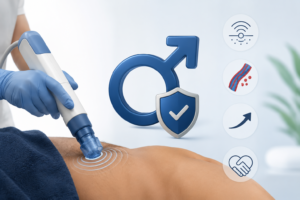
The name “shockwave” sounds more dramatic than the reality of the treatment. There’s no electricity, no shocking sensation, and nothing that should make you nervous. Shockwave therapy, in the context of erectile dysfunction, refers to the application of low-intensity acoustic sound waves to penile tissue using a handheld applicator. Think of it like focused vibration at a frequency your tissue can use as a biological signal.
This technology has been used in orthopedic medicine for decades to heal tendons, dissolve calcifications, and stimulate tissue repair in joints and soft tissue. Applying it to vascular tissue in the context of ED is a natural extension of the same regenerative mechanism.
Low-Intensity vs. High-Intensity Shockwave: Understanding the Difference
Not all shockwave devices are the same, and this distinction matters when you’re evaluating treatment options. High-intensity focused shockwave is used in applications like kidney stone fragmentation and certain cancer treatments. It’s destructive by design. Low-intensity shockwave therapy (LiSWT), which is what’s used for erectile dysfunction, works on a completely different principle. The energy levels are set low enough to stimulate cellular activity and tissue remodeling without damaging the structures being treated.
When you read studies on shockwave therapy for ED, they’re almost universally referring to LiSWT. The energy levels are calibrated to trigger a healing response, not a destructive one.
How Shockwave Devices Deliver Treatment
The device used in treatment is a handheld applicator that delivers acoustic pulses to specific regions of penile tissue, typically the corpus cavernosum and the crural roots, depending on the protocol. Sessions are non-invasive, conducted without anesthesia, and most men describe the sensation as a mild tapping or buzzing pressure, not pain. The treatment itself typically takes between 15 and 25 minutes per session.
The Science Behind How It Works
To understand why shockwave therapy works for ED, you first need to understand what actually causes ED in the majority of men. Around 70 to 80 percent of erectile dysfunction cases have a vascular root cause. The problem isn’t desire, it isn’t testosterone (at least not primarily), and it isn’t psychological. It’s blood flow. The small arteries and capillaries in erectile tissue have become compromised, often due to atherosclerosis, chronic inflammation, or the accumulation of microplaques, reducing the volume and pressure of blood that reaches the tissue during arousal.
Shockwave therapy addresses this directly.
Angiogenesis: Growing New Blood Vessels Where It Counts
The primary mechanism that makes shockwave therapy effective for ED is angiogenesis, the biological process of forming new blood vessels. When low-intensity acoustic waves are delivered to penile tissue, they create a cascade of cellular events. Endothelial cells that line blood vessel walls become activated. Vascular endothelial growth factor (VEGF) is released. New capillaries begin to form. Over a series of weeks following treatment, the tissue develops an improved vascular network with better perfusion capacity.
More blood vessels, built properly, means more blood delivered to where it needs to go. For men whose ED is fundamentally a plumbing problem, this is the kind of fix that addresses the actual infrastructure.
Breaking Down Micro-Plaques and Restoring Tissue Health
Acoustic waves also have a mechanical effect on microplaques, tiny calcified deposits that form in penile arteries over time and restrict blood flow. The shockwave energy can break these deposits apart, similar to how the same technology clears calcifications in tendons and kidney stones. This mechanical clearing, combined with the angiogenic response, gives the tissue a meaningful structural upgrade rather than just a temporary functional boost.
What the Clinical Research Actually Shows
Clinical studies on low-intensity shockwave therapy for ED have shown consistently positive results in men with vasculogenic erectile dysfunction. Multiple randomized controlled trials have demonstrated statistically significant improvements in erectile function scores, including the International Index of Erectile Function (IIEF), with results persisting for 12 months or longer in a meaningful percentage of participants. A notable feature of the research is that some participants who previously responded poorly to PDE5 inhibitors showed improved responsiveness after completing shockwave protocols, suggesting the treatment restores enough baseline vascular function to make medications work again.
The evidence base is strongest for mild to moderate vasculogenic ED. Results in men with severe vascular compromise or predominantly neurogenic ED are less consistent.
Who Is Shockwave Therapy For?
The Ideal Candidate Profile
The men who tend to benefit most from shockwave therapy are those dealing with mild to moderate ED with a vascular component, men who are frustrated with the limitations of oral medications but don’t want a more invasive intervention, men who want to address the root cause rather than relying on a pill before every sexual encounter, and men who are interested in a treatment that can produce lasting results rather than a temporary fix.
Age is not a disqualifying factor. Men in their 40s through their 70s have responded well in clinical settings, provided the underlying mechanism of their ED is vascular rather than structural or primarily neurological.
When Shockwave May Not Be the Right First Step
Shockwave therapy is not the right fit for everyone. Men with Peyronie’s disease (penile curvature caused by scar tissue) may need a different protocol or a combined approach. Men with primarily hormonal causes of ED, particularly low testosterone, often see better results when hormonal optimization is addressed first or alongside shockwave treatment. Men with significant cardiovascular disease should have a thorough cardiovascular evaluation before starting any ED treatment.
Vasculogenic ED vs. Other Causes: Why the Distinction Matters
ED has multiple possible root causes: vascular, hormonal, neurogenic, psychogenic, and medication-related. Shockwave therapy is designed to address the vascular component. If your ED is primarily driven by low testosterone, anxiety, antidepressant side effects, or nerve damage, shockwave therapy alone may produce limited results. A proper diagnostic evaluation before treatment ensures you’re addressing the right mechanism for your specific situation.
What to Expect During Shockwave Treatment for ED

The Session Itself: What Happens Step by Step
You arrive for your appointment, and no special preparation is required beforehand. The provider applies a coupling gel to the treatment area, similar to what’s used in an ultrasound. The handheld applicator is then moved across specific regions of penile tissue following a standardized protocol. The acoustic pulses are delivered in a controlled pattern designed to cover the key vascular zones responsible for erectile function.
Most men find the sensation mild. Some describe it as a light tapping or mild vibration. There’s no anesthesia required, no recovery time needed, and no restrictions on activity afterward. You can drive yourself home and go about your day normally.
How Many Sessions Does It Take?
Most clinical protocols involve between six and twelve sessions, typically scheduled two to three times per week over three to six weeks. Some men notice improvements partway through their treatment series. For others, the full benefit becomes apparent over the weeks following the completion of treatment as the angiogenic process continues to develop. Follow-up sessions may be recommended at three to six months for some patients to maintain and build on results.
Shockwave Therapy vs. Other ED Treatments
Compared to PDE5 Inhibitors Like Viagra and Cialis
Medications like sildenafil and tadalafil work by relaxing smooth muscle in blood vessel walls to allow more blood flow during arousal. They’re effective, widely used, and generally safe. But they require pre-planning, some men experience side effects including headaches, flushing, and vision changes, and crucially, they do nothing to address the underlying vascular damage. Once you stop taking them, you’re back where you started.
Shockwave therapy works upstream of all of that. It rebuilds the vascular infrastructure itself. For men who want to get off the pill cycle or who find medications unreliable or inconvenient, shockwave therapy offers a fundamentally different kind of result.
Compared to Testosterone Replacement Therapy
Testosterone replacement therapy (TRT) is highly effective for men whose ED has a significant hormonal component, particularly when combined with low libido, fatigue, reduced muscle mass, or other signs of androgen deficiency. But TRT addresses a different mechanism than shockwave therapy. The two are not competing options. They’re often complementary. A man with both low testosterone and vascular compromise may benefit most from addressing both simultaneously.
Combining Shockwave With Other Regenerative Approaches
Some men, particularly those with more significant vascular compromise or those seeking optimal results, respond especially well to shockwave therapy in combination with other regenerative treatments. Platelet-rich plasma (PRP) injections deliver concentrated growth factors directly to erectile tissue and can work synergistically with the angiogenic process initiated by shockwave treatment. The combination is sometimes referred to as a “P-Shot plus shockwave” protocol in regenerative men’s health practices.
Why More Men in Bend Are Choosing Shockwave Over Pills
Bend is a community of active, health-forward people. Men here tend to want solutions that fit their lifestyle and address problems properly, not temporary workarounds that require planning intimacy around a medication schedule. Shockwave therapy fits that mindset. It’s a relatively brief treatment series, it produces results that persist well beyond the treatment window, and it works with the body’s own biology rather than overriding it with a pharmaceutical signal.
For men who have been quietly managing ED on their own for years, or who tried medications and found them unsatisfying, the availability of this kind of care close to home removes a significant barrier to actually getting help.
Finding Shockwave Therapy for Erectile Dysfunction Near Me in Bend OR
If you’ve been searching for shockwave therapy erectile dysfunction near me, the most important factor beyond convenience is clinical expertise. Shockwave therapy for ED requires proper patient selection, appropriate protocol selection, and the right equipment calibrated correctly. A provider who also understands the full picture of men’s sexual and hormonal health is in the best position to determine whether shockwave therapy is the right approach for you, whether it should be combined with other treatments, and how to track your progress meaningfully.
At Proactive Choice in Bend, shockwave therapy is offered within the context of a comprehensive men’s health clinic that evaluates your full hormonal, vascular, and metabolic picture before making any treatment recommendations.
What to Expect at Proactive Choice
Your first appointment starts with a thorough conversation about your health history, symptom timeline, current medications, and treatment goals. Dr. Collins takes the time to understand what’s been tried, what’s worked and what hasn’t, and what you’re actually hoping to achieve. Lab work covering testosterone levels, metabolic markers, cardiovascular risk factors, and relevant hormonal markers gives a complete clinical picture.
From there, a personalized treatment plan is built. If shockwave therapy is the right fit, your protocol is designed around your specific presentation rather than a generic template. Sessions are scheduled at a pace that works with your life, and follow-ups track your progress throughout the course of treatment.
The goal at Proactive Choice isn’t just to get you through a series of sessions. It’s to help you understand what was driving your ED, address it properly, and leave you in a fundamentally better state than you arrived in.
Conclusion
Shockwave therapy for erectile dysfunction is not a fringe concept or an experimental long shot. It’s a clinically supported, non-invasive treatment with a meaningful evidence base for men dealing with vasculogenic ED. It works by actually repairing the vascular infrastructure that makes erections possible, growing new blood vessels, clearing micro-obstructions, and restoring tissue health in a way that no pill can replicate.
If you’re in Bend and you’ve been looking for shockwave therapy erectile dysfunction near me that goes beyond handing you a prescription and sending you on your way, Proactive Choice offers that level of care. The right evaluation, the right treatment, and a provider who stays engaged with your results from start to finish.
Frequently Asked Questions
Is shockwave therapy for ED painful?
Most men describe the experience as mild tapping or light pressure rather than pain. The energy levels used in low-intensity shockwave therapy for ED are carefully calibrated to stimulate tissue without causing discomfort. No anesthesia is required, and the vast majority of men tolerate the sessions easily. Any mild sensitivity typically resolves within hours of treatment.
How long do the results of shockwave therapy last?
Clinical studies have shown improvements in erectile function persisting for 12 months or longer in men who respond well to treatment. Results vary based on the severity of the underlying vascular compromise, overall cardiovascular health, lifestyle factors, and whether maintenance sessions are used. Men who optimize their cardiovascular health through nutrition, exercise, and hormone balance during and after treatment tend to sustain results longer.
Can shockwave therapy work if Viagra or Cialis hasn’t been effective for me?
Yes, and this is one of the most compelling aspects of the research. Some clinical trials have specifically enrolled men who didn’t respond adequately to PDE5 inhibitors and found meaningful improvements in erectile function after completing a shockwave protocol. Because shockwave therapy improves the underlying vascular infrastructure, it can restore enough baseline blood flow capacity to make medications effective again in men who previously found them insufficient.
Does shockwave therapy require any downtime or lifestyle restrictions?
No meaningful downtime is required. Sessions are brief, typically 15 to 25 minutes, and most men return to their normal activities immediately afterward. There are generally no restrictions on physical activity, work, or sexual activity following treatment. Your provider may offer specific guidance based on your individual protocol.
Should I get my testosterone levels checked before starting shockwave therapy?
Yes, this is strongly recommended. Testosterone plays a meaningful role in erectile function, libido, and overall sexual health. A man with significant testosterone deficiency may see limited results from shockwave therapy alone because the hormonal environment that supports erectile function hasn’t been addressed. At Proactive Choice, Dr. Collins evaluates testosterone alongside vascular and metabolic markers before making any treatment recommendations, ensuring the full picture informs the care plan.