
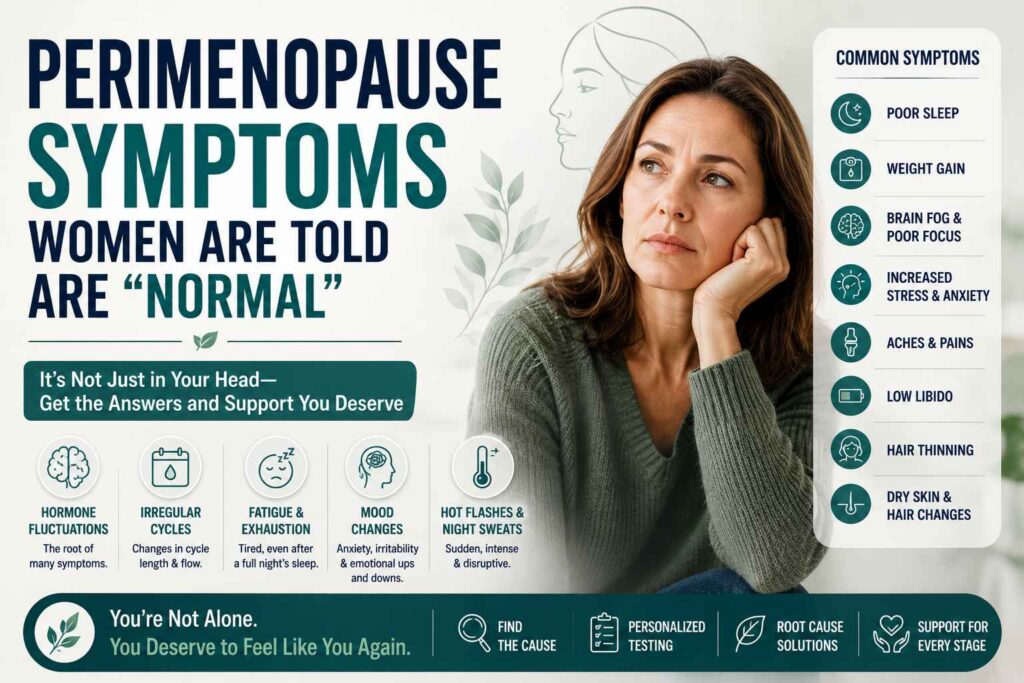
There is a particular sentence women in their forties hear a great deal: “That’s normal at your age.”
Often it is accurate. Sleep disruption, mood change, cycle irregularity, and heavier bleeding are all genuinely characteristic of perimenopause. The problem is that “normal” gets used to mean two very different things. It can mean expected, which is often true. Or it can mean nothing needs doing, which frequently is not.
Both of those can be wrong at once, too. Several conditions produce symptoms nearly identical to perimenopause, and when they are attributed to hormones without being checked, they go untreated for years.
This article separates the three categories: symptoms that are expected and treatable, symptoms that mimic perimenopause but are something else, and symptoms that should never be attributed to perimenopause without investigation.
What Is Actually Happening
Perimenopause is the transition leading to menopause. It typically begins in the mid forties, lasts four to eight years on average, and ends twelve months after the final period.
The mechanism is worth understanding because it explains the symptom pattern. As ovarian follicle numbers decline, ovulation becomes intermittent. Progesterone requires ovulation, so it becomes unreliable first. Oestrogen, meanwhile, does not decline smoothly. It fluctuates, sometimes spiking above premenopausal levels before eventually falling.
That instability, rather than low oestrogen as such, drives much of the early experience. It also explains why symptoms vary week to week and why women often feel they are being inconsistent when describing them.
Expected Symptoms That Are Still Worth Treating
Sleep Disruption
Often the first change, and one of the most consequential. The classic pattern is falling asleep normally and waking between 2am and 4am, sometimes with a racing mind, sometimes with heat.
Progesterone has sedative properties through its effect on GABA receptors, so declining progesterone plausibly contributes. Night sweats add a second mechanism later in the transition.
Chronic sleep deprivation worsens mood, cognition, insulin sensitivity, and pain perception, which means poor sleep amplifies almost everything else on this list. Treating it is not optional comfort care.
Anxiety and Mood Change
New-onset anxiety in the forties, often without a clear trigger and sometimes with physical features such as a racing heart, is a well-recognised perimenopausal presentation. Irritability and reduced stress tolerance are common.
This deserves clear statement: the perimenopausal window carries an increased risk of depressive episodes, and the risk is higher in women with a history of depression or of significant premenstrual mood symptoms. Attributing depression to hormones and leaving it untreated is a mistake. Both hormonal and psychological interventions have a role, and they are not mutually exclusive.
Cognitive Changes
Word-finding difficulty, reduced processing speed, and problems with divided attention are documented in the menopausal transition. Longitudinal research suggests these changes are largely transient rather than progressive, which is reassuring, though that is not much comfort while they are happening. Sleep quality and mood both affect cognition substantially, so treating those often improves the cognitive picture.
Hot Flushes and Night Sweats
Usually more prominent in late perimenopause. They arise from a narrowing of the thermoneutral zone in the hypothalamus, meaning small temperature changes trigger a disproportionate heat-dissipation response.
Frequency and severity vary enormously between women. When they interfere with sleep or daily function, they warrant treatment rather than endurance.
Cycle Changes
Shorter cycles early on, then increasingly long gaps. Some variation is expected. Certain patterns are not, and those are covered below.
Vaginal Dryness and Reduced Libido
Vaginal tissue is oestrogen-dependent, and dryness, discomfort with intercourse, and increased urinary tract infections often begin in late perimenopause. This one is worth naming specifically because it is progressive rather than self-limiting, and because local vaginal oestrogen is highly effective, low risk, and consistently underprescribed. Many women endure this for years without knowing an effective treatment exists.
Joint Pain and Stiffness
Oestrogen has anti-inflammatory effects and influences cartilage and connective tissue. Morning stiffness and new aching joints in the forties are common enough to have their own label in the literature. Persistent joint swelling, redness, or symmetrical small-joint involvement is a different matter and warrants investigation for inflammatory arthritis.
Conditions That Mimic Perimenopause
This is where attribution goes wrong. Each of the following overlaps heavily and each is treatable.
Thyroid Dysfunction
The overlap is nearly total: fatigue, weight change, mood change, cognitive slowing, hair thinning, cycle irregularity, cold or heat intolerance. Thyroid disease is also more common in women and increases in prevalence with age, so the two frequently coexist.
A full thyroid panel, not TSH alone, is reasonable in any woman presenting with these symptoms. Our guide to what a full thyroid panel measures explains why.
Iron Deficiency
Heavy perimenopausal bleeding is itself a common cause of iron depletion, which then produces fatigue, breathlessness on exertion, hair loss, restless legs, and poor concentration. These are then attributed to hormones, and the iron deficiency compounds.
Ferritin should be checked in any woman with heavy periods and fatigue. Haemoglobin can be normal while stores are exhausted.
Sleep Apnoea
Frequently missed in women because presentation differs from the classic picture. Women more often report fatigue, insomnia, morning headache, and mood disturbance than loud snoring and witnessed apnoeas. Risk rises after menopause. Untreated sleep apnoea carries genuine cardiovascular consequences, so this is not a minor omission.
Vitamin D and B12 Deficiency
Both produce fatigue, low mood, and cognitive complaints. Both are simple to test and correct. B12 deficiency in particular can cause neurological symptoms that become irreversible if prolonged.
Depression and Anxiety Disorders
These occur in perimenopausal women as they do in everyone else. Hormonal context does not make them not depression, and it does not make them untreatable.
Symptoms That Should Never Be Written Off
These require evaluation regardless of age or hormonal context.
- Bleeding between periods, or bleeding after intercourse
- Any bleeding after twelve months without a period. This is postmenopausal bleeding and requires prompt assessment. It is often benign, but it is the primary presenting symptom of endometrial cancer.
- Bleeding heavy enough to soak through a pad or tampon hourly, to pass clots larger than a coin, or to disrupt daily activity
- Periods lasting longer than seven days when that is new for you
- Cycles consistently shorter than 21 days
- Pelvic pain, pressure, or bloating that persists
- Unexplained weight loss
- A new breast lump or nipple change
- Severe or new headache, particularly with visual symptoms
- Menopausal symptoms before 45, and especially before 40, which requires assessment for premature ovarian insufficiency
Fibroids, endometrial polyps, adenomyosis, endometrial hyperplasia, and thyroid disease all cause abnormal bleeding and all are treatable. Attributing heavy bleeding to perimenopause without examination or imaging is where diagnoses get delayed.
What Testing Can and Cannot Do
A point of frequent confusion: there is no blood test that diagnoses perimenopause.
FSH and oestradiol fluctuate so widely from day to day and cycle to cycle that a single measurement carries little information. A normal FSH does not exclude perimenopause. A raised one on one day does not confirm it. Anti-Müllerian hormone reflects ovarian reserve but is not validated for staging the transition or predicting symptoms.
Perimenopause is a clinical diagnosis based on age, cycle pattern, and symptoms.
Testing is still useful, for a different purpose. It rules out the mimics. A reasonable initial panel includes a full thyroid assessment, complete blood count, ferritin, vitamin D, B12, and glucose or HbA1c. Under 45, FSH and oestradiol become relevant for assessing premature ovarian insufficiency. Our article on which hormone tests actually matter explains what each adds.
Treatment Options Worth Knowing About
Hormonal approaches. Cyclical progesterone is sometimes used for sleep and cycle regulation in early perimenopause. Combined hormone therapy addresses vasomotor symptoms, sleep, and mood, and current guidance generally supports it for symptomatic women under 60 or within ten years of their final period, absent contraindications. Hormonal contraception can serve dual purposes during perimenopause. Local vaginal oestrogen treats genitourinary symptoms with minimal systemic effect. Our page on bioidentical hormone replacement in Bend, OR covers our approach.
Non-hormonal medication. Certain SSRIs and SNRIs have evidence for vasomotor symptoms, as do gabapentin and, more recently, non-hormonal agents targeting the neurokinin pathway. These are genuine options for women who cannot use hormone therapy.
Lifestyle measures. Resistance training preserves muscle and bone during a period of accelerating loss. Cognitive behavioural therapy has good evidence for both insomnia and hot flush bother. Reducing alcohol often improves both sleep and vasomotor symptoms noticeably. These are worth doing regardless of whether hormone therapy is used.
Frequently Asked Questions
At what age does perimenopause start?
Most commonly in the mid forties, though onset in the late thirties occurs. Symptoms before 45 warrant a discussion with your clinician, and symptoms before 40 require assessment for premature ovarian insufficiency.
Can a blood test confirm perimenopause?
No single test confirms it, because FSH and oestradiol fluctuate too much during the transition. Diagnosis is clinical. Blood tests are valuable for excluding thyroid disease, iron deficiency, and other conditions with overlapping symptoms.
How long does perimenopause last?
Four to eight years on average. Some women pass through in under two years, others take more than a decade. It ends twelve months after the final period.
Is heavy bleeding normal in perimenopause?
Some increase in flow is common as cycles become anovulatory. Bleeding that soaks through protection hourly, involves large clots, lasts more than seven days, or causes anaemia is not something to accept without evaluation, since fibroids, polyps, and endometrial changes are all treatable causes.
Do I still need contraception?
Yes. Pregnancy remains possible until menopause is complete. Contraception is generally advised for twelve months after the final period if you are over 50, and twenty-four months if you are under 50.
The Bottom Line
Perimenopause symptoms being expected does not make them untreatable, and it does not mean they should be accepted without checking that something else is not also going on. The two useful questions are: is anything else contributing that we have not tested for, and what is available to make this better.
At Proactive Choice in Bend, Oregon, Dr. Drew Collins, ND, evaluates perimenopausal symptoms with a full workup rather than an assumption, and discusses the full range of hormonal and non-hormonal options. See our menopause specialist in Bend, Oregon page for more.
Book a hormone consultation with Proactive Choice and get your symptoms properly assessed.
This article is for general education and does not replace individual medical advice. Abnormal bleeding, postmenopausal bleeding, or any symptom that concerns you should be evaluated promptly by a qualified clinician.
For a broader look at this kind of care, see Hormone Doctor in Bend, OR.
Further reading
- Perimenopause – Symptoms and causes, Mayo Clinic. Common perimenopause symptoms, risk factors for earlier onset, and when to see a doctor.
- Perimenopause: Age, Stages, Signs, Symptoms & Treatment, Cleveland Clinic. Typical age of onset, how long perimenopause lasts, and options for easing symptoms.
- Perimenopause, Johns Hopkins Medicine. How hormone levels and ovulation change in the years leading up to menopause.
Want to talk this through for your own health? Book a visit with Dr. Drew Collins, ND at 601 NW Harmon Blvd in Bend, or call (858) 333-5196.