
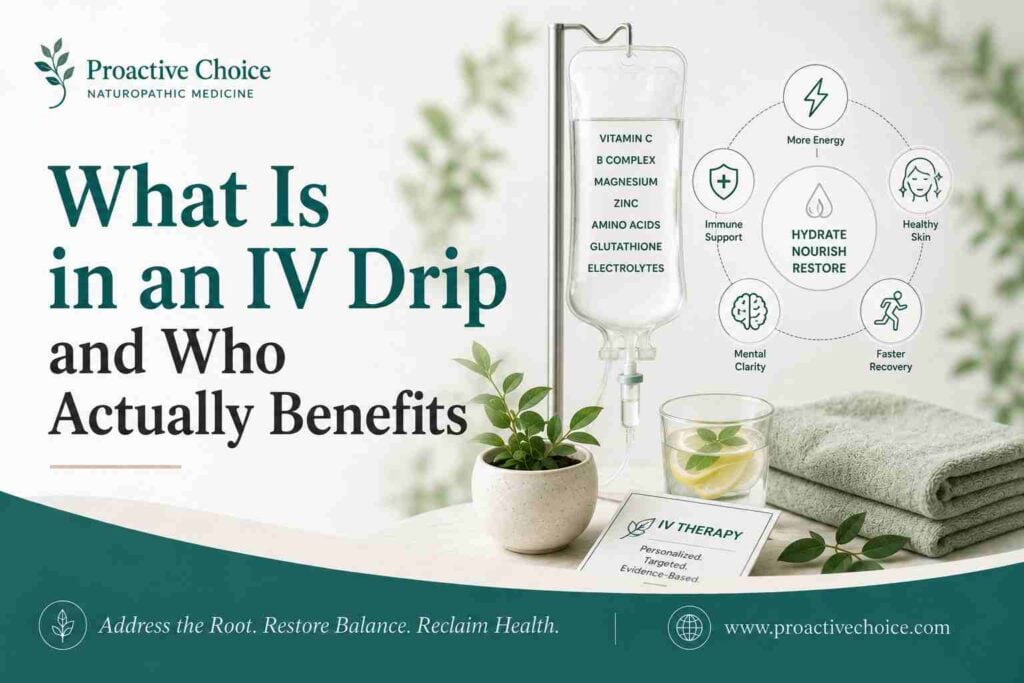
IV vitamin drips have become a fixture of wellness clinics and med spas, promising everything from hangover relief to immune support to anti-aging benefits. Some of what is in the bag has genuine evidence behind it in the right patient. A lot of the marketing outpaces what that evidence actually shows. Here is what is really in a typical drip, and who is genuinely likely to benefit.
Quick Answer: The most common IV vitamin formulation, the Myers’ cocktail, typically contains B vitamins, vitamin C, magnesium, and calcium. The clearest, most established benefit is for people with a documented nutrient deficiency or an absorption problem that prevents them from getting enough through diet or oral supplements. For generally healthy people without a deficiency, the Merck Manual and MSD Manual both note that evidence for disease treatment or general wellness benefits is limited and largely anecdotal, and the FTC has taken enforcement action against a company for making unsupported disease-treatment claims about IV vitamin therapy. IV nutrients are not inherently dangerous when properly administered, but they are also not a proven cure-all, and appropriate screening matters more than the marketing suggests.
What Is Actually in a Standard IV Drip
The Myers’ cocktail, named for Dr. John Myers, who pioneered IV nutrient therapy decades ago, is the template most modern IV drips are built from. A typical formulation includes:
- B-complex vitamins, including B12 (often as hydroxocobalamin), which bypasses the intrinsic-factor absorption pathway entirely
- Vitamin C, typically in the 5 to 10 gram range for a standard wellness formulation, distinct from high-dose vitamin C protocols that start much higher and require specific screening
- Magnesium, often the component with the most direct symptom-relief evidence, particularly for migraines
- Calcium
Many clinics offer add-ons beyond this base formula, glutathione, zinc, taurine, or NAD+, tailored to specific goals rather than included by default.
The Actual Pharmacological Argument for IV Delivery
There is a real, defensible reason IV delivery can matter for certain nutrients: oral absorption has hard limits that bypassing the gut avoids. Oral magnesium absorption sits around 30 to 40 percent and is limited by GI tolerance, since higher oral doses tend to cause diarrhea before they meaningfully raise blood levels. Oral vitamin C absorption plateaus around 200 mg per dose because the intestinal transporters that absorb it become saturated. Delivered intravenously, these nutrients bypass that gut bottleneck entirely, reaching cellular concentrations that oral dosing genuinely cannot match. This is a legitimate pharmacological point, not just marketing language, but it matters most when there is an actual reason to need those higher levels, a documented deficiency, malabsorption, or a specific, evidence-supported use like magnesium for migraine.
What the Evidence Actually Shows
This is where the honest picture gets more measured than most clinic marketing suggests. The Merck Manual states plainly that very few studies have tested the effectiveness of the Myers’ cocktail or similar high-dose IV vitamin therapy in people who do not have a documented deficiency, and that no published evidence shows this therapy is effective for any serious illness or chronic disease. The few controlled studies that exist tend to be small, sometimes lack a placebo comparison, or show the infusion performing no better than placebo. In 2018, the FTC charged a company marketing Myers’ cocktail and related IV infusions with making deceptive and unsupported claims about treating conditions including cancer, multiple sclerosis, diabetes, fibromyalgia, and heart failure.
None of this means IV nutrients are useless. Injections and infusions of individual vitamins or minerals are genuinely evidence-based treatments specifically for documented deficiencies, or for managing side effects of certain medications that deplete specific nutrients. The distinction that matters is between “this corrects a real, identified deficiency” and “this will treat or prevent a serious disease in someone without one,” a claim the current evidence does not support.
By the Numbers
- Oral magnesium absorption is limited to roughly 30 to 40%, with higher doses limited by GI tolerance.
- Oral vitamin C absorption plateaus around 200 mg per dose due to saturation of intestinal transporters.
- A standard wellness-formulation vitamin C infusion runs 5 to 10 grams, separate from high-dose protocols starting at 25 grams that require G6PD screening first.
- In 2018, the FTC took formal enforcement action against a company for unsupported disease-treatment claims tied to IV vitamin infusions.
Who Is Most Likely to Actually Benefit
| Situation | Likely Benefit From IV Nutrients |
|---|---|
| Documented nutrient deficiency (iron, B12, etc.) | Strong, evidence-based indication |
| Malabsorption condition (celiac, IBD, prior GI surgery) | Strong, since oral absorption is genuinely impaired |
| Migraine with suspected magnesium deficiency | Reasonable, with some supportive research on IV magnesium |
| Generally healthy person seeking a “wellness boost” | Limited evidence beyond correcting a subclinical deficiency, if one exists |
| Treating a serious chronic disease | Not supported by current evidence; FTC has acted against such claims |
Myth vs. Fact
Myth: “IV vitamin drips are proven to boost immunity and prevent illness in healthy people.”
Fact: The Merck Manual notes that evidence for these broader wellness claims is largely anecdotal. The clearest, best-supported use remains correcting an actual, documented deficiency or absorption problem.
Myth: “Since the ingredients are just vitamins, there is no real safety screening needed.”
Fact: IV nutrient therapy requires real screening, kidney function for magnesium load, G6PD status for high-dose vitamin C, medication interactions with diuretics, lithium, or blood pressure medications, and iron status before any iron-containing infusion, particularly in conditions like hemochromatosis.
Myth: “More vitamin C or magnesium in the IV bag means better results.”
Fact: Standard wellness-dose vitamin C (5 to 10 grams) is a different protocol from high-dose vitamin C (starting at 25 grams), which requires G6PD screening beforehand due to a real risk of hemolysis in deficient individuals. More is not automatically better or automatically safe.
What Proper Screening Looks Like
A responsible IV nutrient practice should review before infusing:
- Recent labs, particularly kidney function, a CBC, and relevant nutrient levels like ferritin or magnesium
- Full medication list, since diuretics, lithium, digoxin, certain chemotherapy agents, and blood pressure medications can all interact with the electrolyte shifts an infusion produces
- G6PD status before any high-dose vitamin C protocol
- Iron and hemochromatosis status before any iron-containing infusion specifically
If a clinic offers IV nutrient therapy without asking about any of this, that is a reasonable signal to ask more questions before proceeding.
Getting IV Therapy Done Responsibly
Our IV therapy services at Proactive Choice start with a real conversation about your specific goals, labs, and medication list, rather than defaulting to a one-size-fits-all formula. Schedule a consultation or call +1 (858) 333-5196.
Frequently Asked Questions
What is typically in a Myers’ cocktail IV drip?
A standard formulation includes B-complex vitamins, vitamin B12, vitamin C, magnesium, and calcium, with optional add-ons like glutathione, zinc, or NAD+ depending on the clinic and your specific goals.
Do IV vitamins work better than oral supplements?
For nutrients with limited oral absorption, like magnesium and vitamin C at higher doses, IV delivery does bypass real gut absorption limits. Whether that translates into a meaningful clinical benefit depends heavily on whether you actually have a deficiency or absorption problem to begin with.
Is IV vitamin therapy safe for healthy people?
Generally yes when properly screened and administered by a qualified provider, though the Merck Manual notes evidence for benefit in people without a deficiency is limited. Safety depends significantly on appropriate pre-screening for kidney function, medication interactions, and specific risk factors.
Can IV vitamin therapy treat chronic diseases like fibromyalgia or diabetes?
Current evidence does not support this claim, and the FTC has taken formal enforcement action against a company for making unsupported claims of this kind. IV nutrient therapy is best evidence-supported for correcting documented deficiencies, not treating chronic disease.
What screening should happen before I get an IV vitamin drip?
A responsible provider should review your recent labs, full medication list, and relevant risk factors like G6PD status before high-dose vitamin C or iron and hemochromatosis status before any iron-containing infusion.
Explore IV Therapy at Proactive Choice in Bend
Proactive Choice in Bend, Oregon offers individualized IV nutrient therapy under Dr. Drew Collins, ND, built around your actual labs and health goals:
- IV Therapy Bend, OR: Personalized nutrient infusions based on your specific needs
- NAD+ IV Therapy: A closer look at a specific, well-studied IV nutrient
- Functional Medicine Bend, Oregon: A root-cause approach to identifying real nutrient needs
Proactive Choice is located in Bend, Oregon and serves patients throughout Central Oregon including Redmond, Sisters, La Pine, and Sunriver. Call +1 (858) 333-5196 or schedule a consultation online.
Further reading
- Intravenous Vitamin Infusion Pros & Cons, Cleveland Clinic. Common IV ingredients, possible uses, limited evidence, and who should avoid infusions.
- IV therapy for vitamin replenishment: Health boost or expensive placebo?, Harvard Health Publishing. A look at energy and immunity claims for IV vitamins and the risks involved.
Want to talk this through for your own health? Book a visit with Dr. Drew Collins, ND at 601 NW Harmon Blvd in Bend, or call (858) 333-5196.