Does acupuncture work? For some kinds of chronic pain, yes, modestly. A 2018 analysis of 39 trials and 20,827 patients found it beat both sham needling and no acupuncture for back and neck pain, osteoarthritis, chronic headache and shoulder pain. The gap over sham was small, though, and the evidence for sleep and many other uses is weak.
Quick answer: Acupuncture has its best evidence for chronic low back pain, neck pain, knee osteoarthritis and headache prevention. The benefit over fake acupuncture is small, which suggests part of the effect is expectation and care. It usually causes little pain. Most plans run 6 to 8 sessions, once or twice a week. Serious complications are rare with a trained practitioner.
Does acupuncture work? What the research shows
The honest answer depends on two things: what you want it to treat, and what you compare it with. Against no acupuncture, it looks good for several pain conditions. Against sham acupuncture, where needles poke without going in, or go in at the “wrong” spots, the advantage shrinks to something small but real.
The biggest single piece of evidence is the 2018 individual patient data meta-analysis by Vickers and colleagues in the Journal of Pain. The Acupuncture Trialists’ Collaboration pooled raw data from 39 randomized trials covering 20,827 patients with nonspecific musculoskeletal pain, osteoarthritis, chronic headache or shoulder pain. Acupuncture beat sham for every one of those conditions, by about 0.2 standard deviations, and beat no acupuncture by about 0.5. The effect faded only about 15 percent over the following year. The authors concluded the benefit “cannot be explained solely in terms of placebo effects.”
What does 0.2 standard deviations mean in practice? A small effect. Noticeable on average across thousands of patients, not dramatic for most individuals.
Here is how the evidence stacks up by condition, using the National Center for Complementary and Integrative Health (NCCIH) summary and the Cochrane review on sleep:
| Condition | What the research found | Evidence strength |
|---|---|---|
| Chronic low back and neck pain | Better than no treatment and sham; relief similar to NSAIDs | Moderate; a first-line option in the 2017 ACP guideline |
| Knee osteoarthritis | Better than no treatment and sham in 2018 reviews | Moderate; conditionally recommended by the American College of Rheumatology |
| Migraine prevention | Fewer migraines in 22 studies of about 5,000 people; small edge over sham | Moderate |
| Tension headache | Fewer headaches in 12 studies of about 2,350 people | Moderate to low |
| Insomnia | Small, uncertain benefits; all 33 trials at high risk of bias | Weak |
| Irritable bowel syndrome | No advantage over sham in 41 studies | Negative versus sham |
| IVF success | No difference from sham in 6 studies of 2,507 people | Negative |
Migraine is worth a closer look. NCCIH reports a 2020 review of nine studies that found acupuncture slightly more effective than preventive migraine drugs, with far fewer people dropping out because of side effects. For someone who could not tolerate those medicines, that matters.
Sleep is where we would set expectations lowest. A Cochrane review by Cheuk and colleagues looked at 33 trials with 2,293 people and rated every one at high risk of bias. Its conclusion was that the evidence “is not sufficiently rigorous to support or refute acupuncture for treating insomnia.” Not disproven. Just not shown.
We offer acupuncture, and we still think this table is the fairest way to decide whether it is worth trying. It is a reasonable bet for chronic back pain, an arthritic knee or frequent headaches. For a digestive problem or fertility, the trials do not support it.
Does acupuncture help back pain?
This is where the evidence is strongest. NCCIH’s low back pain page notes that the American College of Physicians’ 2017 guideline lists acupuncture as an option for initial treatment of chronic low back pain, based on moderate-quality evidence, and as an option for acute and subacute back pain on low-quality evidence. A 2017 evaluation of 49 studies with more than 7,900 participants found a modest benefit for acute low back pain and a moderate one for chronic. A 2018 review summarized by NCCIH found relief roughly comparable to NSAIDs.
The most revealing back pain trial is an older one. In the German GERAC trial, published by Haake and colleagues in the Archives of Internal Medicine in 2007, 1,162 adults with chronic low back pain got ten 30-minute sessions, usually twice a week. At six months, 47.6 percent of the real acupuncture group had responded, against 44.2 percent with sham acupuncture and 27.4 percent with conventional care of drugs, physical therapy and exercise.
Read those three numbers again.
Both needle groups did nearly twice as well as standard care, and real acupuncture barely beat the fake version. People read that result in opposite ways. A skeptic says it proves the specific points do not matter. A pain patient might say that if something works nearly twice as often as the usual care, the reason matters less than the result. Both readings have a point, and nobody has settled which one should win.
For a fresh ski season sprain, we have not seen trial data anywhere near as strong as for chronic back pain. The Vickers analysis did include shoulder pain, and acupuncture beat sham there too. We have a separate post on natural treatments for shoulder pain.
What does acupuncture do?
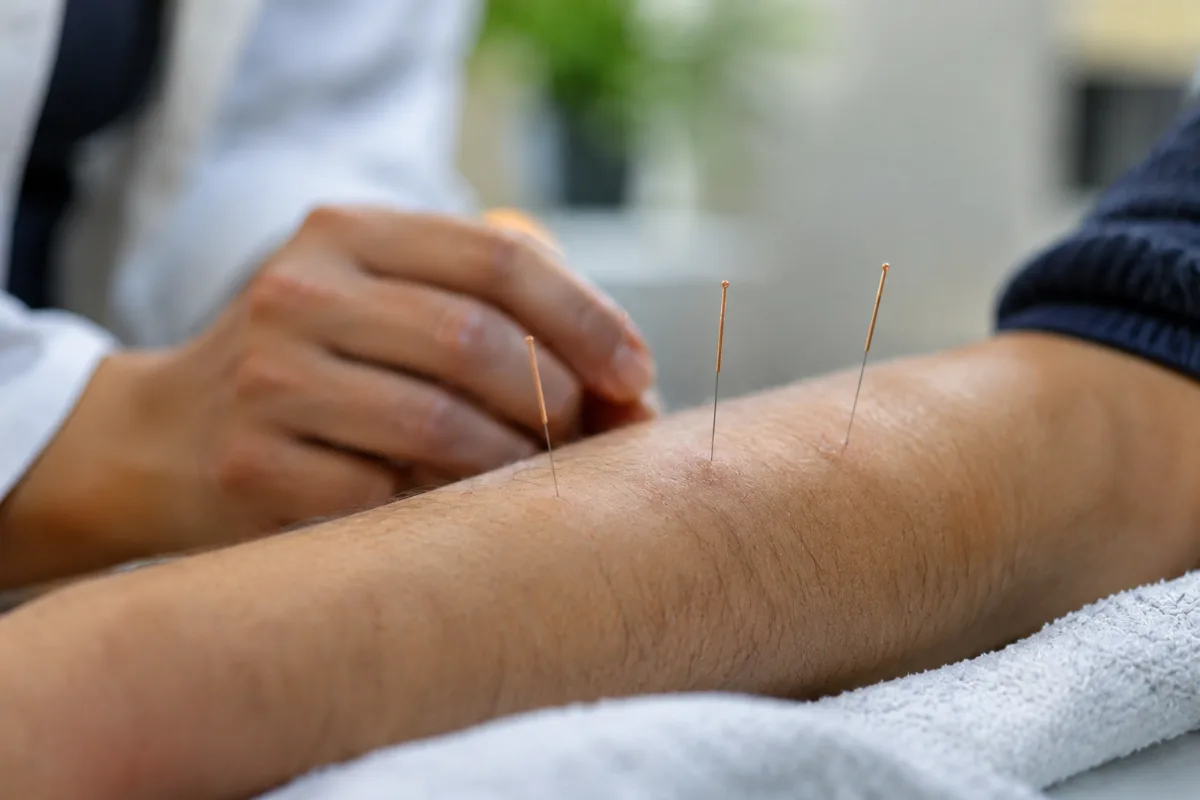
A practitioner puts fine, solid needles into the skin at specific points and leaves them in for a short time, sometimes twirling them or running a mild electrical current through them. That is the procedure. Why it helps is less clear.
NCCIH says the mechanism “is not fully understood.” The traditional Chinese explanation describes balancing the flow of qi, or life energy, along pathways called meridians. Many Western practitioners, as Mayo Clinic describes, see the points as places to stimulate nerves, muscles and connective tissue, which may boost the body’s own painkillers. NCCIH lists three working ideas: effects on the nervous system, direct effects on connective tissue, and nonspecific effects such as a patient’s belief and the relationship with the practitioner.
That third one is not an insult. NCCIH notes that acupuncture’s benefits are generally larger against no treatment than against sham, which suggests nonspecific effects are part of what people feel. Time lying still in a quiet room, attention from a clinician and the expectation of relief all count. The Vickers analysis says they are not the whole story.
Does acupuncture hurt?
Usually very little. Acupuncture needles are fine and solid, not the hollow kind used for shots or blood draws. Mayo Clinic says insertion “usually causes little discomfort” and that people often do not feel the needles go in at all. You may feel a mild ache when a needle reaches the right depth.
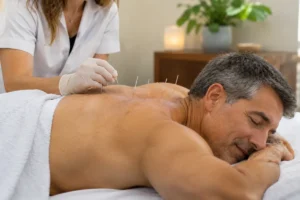
Mayo Clinic gives a typical session as 5 to 20 needles, left in for 10 to 15 minutes while you lie still, with the whole appointment taking up to an hour. Afterward, the common side effects are soreness, minor bleeding or bruising where the needles went in.
Serious problems are uncommon. NCCIH says relatively few complications have been reported, and that the ones that have occurred came from nonsterile needles or poor technique, including infections, punctured organs and nerve injuries. The FDA regulates acupuncture needles as medical devices and requires them to be sterile and labeled for single use. Choose a state-licensed practitioner and ask whether the needles are single-use. Mayo Clinic adds two cautions: electrical stimulation may interfere with a pacemaker, and some points are thought to stimulate labor, so tell your practitioner if you are pregnant. If you take a blood thinner, mention that too, since bruising is the most common side effect.
Myth: Acupuncture is just placebo.
Fact: In a pooled analysis of 20,827 patients, acupuncture beat sham needling for every chronic pain condition studied. The margin was small, so expectation is part of the effect but not all of it.
Myth: Acupuncture works for almost anything.
Fact: It showed no advantage over sham for irritable bowel syndrome or IVF success, and the evidence for insomnia is too weak to call.
Myth: Acupuncture needles hurt like a shot.
Fact: The needles are fine and solid, not hollow like a shot needle. Mayo Clinic says insertion usually causes little discomfort, and many people do not feel it at all.
How long does it take for acupuncture to work?
Expect to judge it over a course of treatment, not after one visit. One session proves little. The trials behind the evidence used a series of sessions. GERAC gave ten sessions over about five weeks, and offered five more to people who had partly responded. Mayo Clinic says it is common to get 6 to 8 treatments for a single complaint.
Some people feel looser or calmer after the first session. That early feeling is not a reliable sign of whether it will help a chronic problem. A fair test, in our view, is to agree on a goal at the start, such as fewer headache days a month or being able to sit through a work meeting, and check against it after about six sessions. If nothing has moved by then, more of the same is unlikely to change much.
Once acupuncture does help, the effect tends to last. In the Vickers analysis, about 85 percent of the benefit remained a year after treatment ended. NCCIH cites a separate analysis of 20 studies with 6,376 people in which benefits continued for a year after treatment for every condition studied except neck pain.
How often should you get acupuncture?
For a new problem, Mayo Clinic describes one or two treatments a week as typical. GERAC used two a week. After a course, there is no evidence-based rule for how often to come back, and we would be wary of anyone who sells an open-ended weekly plan without a goal to measure against.
A reasonable pattern looks something like this:
- One or two sessions a week for the first several weeks
- A check against your goal after about six sessions
- If it is helping, spacing visits out as the problem settles
- Coming back for a short series if the problem flares, which is common with back pain and headaches
That is a sensible structure, not a protocol from a trial. Your own pattern will depend on the condition and how fast you respond.
Acupuncture often gets combined with herbal medicine in Chinese medicine practice. If you are thinking about adding herbs, read our post asking is ashwagandha safe first, since herbs carry risks that needles do not.
Frequently asked questions
Is acupuncture scientifically proven?
For some uses, it has solid trial support. A 2018 analysis of 39 trials and 20,827 patients found acupuncture beat sham needling for chronic back and neck pain, osteoarthritis, chronic headache and shoulder pain, and the American College of Physicians lists it as a first-line option for chronic low back pain. For many other uses, including irritable bowel syndrome and IVF, trials found no advantage over sham.
How many acupuncture sessions do I need?
Mayo Clinic says 6 to 8 treatments for a single complaint is common, usually one or two a week. The large German GERAC trial for chronic back pain used ten 30-minute sessions over about five weeks, with five more for partial responders. A practical approach is to set a clear goal and reassess after about six sessions rather than committing to an open-ended plan.
What does acupuncture feel like?
Most people feel very little as the needles go in. Mayo Clinic says insertion usually causes little discomfort, and many people do not feel it. Once a needle reaches the right depth, you may feel a mild ache. Needles typically stay in for 10 to 15 minutes while you rest. Some soreness or a small bruise afterward is common and goes away.
Is acupuncture safe?
For most people, yes, when done by a trained practitioner with sterile, single-use needles. NCCIH says serious complications are rare, and the ones reported have mostly come from nonsterile needles or poor technique. Common side effects are soreness and minor bruising. Tell your practitioner if you have a pacemaker, are pregnant or take a blood thinner, since those can change what is appropriate.
Does acupuncture work for anxiety or depression?
The evidence is not strong. NCCIH reports a 2018 review of 64 studies with 7,104 people that suggested a moderate reduction in depression severity, but most of those studies were low or very low quality. Acupuncture should not replace proven care for depression. If you are struggling, talk to a clinician, and if you are in crisis, call or text 988.
If you have back pain, knee pain or headaches that have not responded to the usual treatments, acupuncture is a reasonable thing to try with clear goals. Proactive Choice offers acupuncture in Bend. To talk through whether it fits your situation, book a free 15-minute call with Dr. Drew Collins at +1 (858) 333-5196.
Sources
- National Center for Complementary and Integrative Health. Acupuncture: Effectiveness and Safety.
- National Center for Complementary and Integrative Health. Low-Back Pain and Complementary Health Approaches: What You Need To Know.
- Vickers AJ, et al. Acupuncture for chronic pain: update of an individual patient data meta-analysis. Journal of Pain, 2018.
- Haake M, et al. German Acupuncture Trials (GERAC) for chronic low back pain. Archives of Internal Medicine, 2007.
- Cheuk DKL, et al. Acupuncture for insomnia. Cochrane Database of Systematic Reviews.
- Mayo Clinic. Acupuncture.
- 988 Suicide and Crisis Lifeline.
Medically reviewed content from Proactive Choice. This article is for education and is not a diagnosis. Talk with a licensed clinician about your own symptoms and treatment options.
Want to talk this through for your own health? Book a visit with Dr. Drew Collins, ND at 601 NW Harmon Blvd in Bend, or call (858) 333-5196.