“Functional medicine” and “naturopathic medicine” get used almost interchangeably in casual conversation, and the overlap in philosophy is real. But they are not the same credential, and the difference matters when you are choosing a provider.
Quick Answer: A naturopathic doctor (ND) holds a specific, accredited four-year doctoral degree and, in licensing states like Oregon, a state medical license. “Functional medicine practitioner” is not a licensed medical credential on its own; it describes an approach or certification, most often through the Institute for Functional Medicine (IFM), that can be added on top of an existing license, MD, DO, ND, NP, PA, DC, and others. This means a functional medicine practitioner’s underlying training varies enormously depending on their base credential, while every licensed ND has completed the same core four-year naturopathic medical program. Many NDs, including some at Proactive Choice, incorporate functional medicine tools like advanced lab testing directly into their naturopathic practice.
What Distinguishes the Two
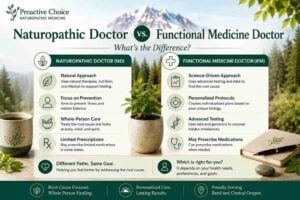
Naturopathic medicine is a distinct, licensed system of primary healthcare with roots in 19th-century natural medicine traditions, formalized into an accredited four-year doctoral program. Functional medicine is a framework, not a licensed profession: it focuses on systems biology, how different body systems interact, using comprehensive lab testing (hormone panels, stool analysis, micronutrient testing, sometimes genetics) to identify underlying imbalances. The term “functional medicine practitioner” is not regulated, meaning the person using it may have a few days of training or years of postgraduate certification, with no way to tell from the title alone.
Training Path Comparison
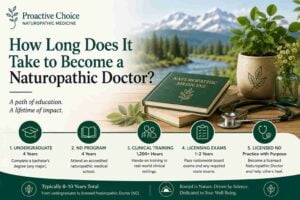
An ND completes a four-year, accredited naturopathic medical program covering conventional biomedical sciences plus clinical nutrition, botanical medicine, and physical medicine, followed by state licensing exams. A functional medicine certification, most commonly through IFM, typically involves several hundred hours of additional training and a certification exam, layered on top of whatever base license the practitioner already holds. An MD who becomes IFM-certified has deep conventional training plus a functional medicine framework; an ND who incorporates functional medicine tools has naturopathic training plus that same framework. The base credential is what differs most.
By the Numbers
- Naturopathic medical school is a 4-year, accredited doctoral program with a consistent core curriculum across accredited schools.
- IFM certification for functional medicine typically requires roughly 200 hours of additional training and passing exams.
- Functional medicine practitioners can come from a wide range of base credentials: MD, DO, DC, ND, NP, PA, and others.
- Not all functional medicine practitioners are certified, since the term itself is not legally regulated or restricted.
Comparing NDs and Functional Medicine Practitioners
| Category | Naturopathic Doctor (ND) | Functional Medicine Practitioner |
|---|---|---|
| Base credential | Specific 4-year accredited doctoral degree | Varies (MD, DO, ND, NP, PA, DC, etc.) |
| State licensure | Required in licensing states like Oregon | Not its own licensed category; regulation depends on the base credential |
| Core toolkit | Nutrition, botanical medicine, natural therapeutics, plus conventional diagnostics | Comprehensive lab testing, systems biology framework |
| Consistency across providers | Standardized curriculum across accredited schools | Varies significantly based on base training and certification status |
Myth vs. Fact
Myth: “Functional medicine and naturopathic medicine are just two names for the same thing.”
Fact: Naturopathic medicine is a specific, licensed medical credential. Functional medicine is a framework or approach that can be layered onto many different base credentials, meaning the underlying training varies considerably from one functional medicine practitioner to the next.
Myth: “A naturopathic doctor can’t practice functional medicine.”
Fact: Many NDs incorporate functional medicine tools, including comprehensive lab testing and a systems-biology approach, directly into their naturopathic practice. The two are complementary, not competing.
Myth: “Anyone calling themselves a functional medicine doctor has been through rigorous certification.”
Fact: The term is not regulated, and not every self-described functional medicine practitioner holds a formal certification like IFM’s. Asking directly about their base license and any functional medicine certification is a reasonable step.
Which Might Fit You Better
If you specifically want a provider whose entire four-year training was built around root-cause, natural-first care, an ND is the more consistent choice, since the credential itself guarantees that foundation. If you want a provider who blends deep conventional medical training (MD/DO) with a functional medicine lens, a certified functional medicine MD or DO may fit. Many patients find that a naturopathic doctor who has also incorporated functional medicine testing and frameworks, as many NDs have, offers the best of both approaches in a single, consistently trained provider.
Getting Root-Cause Care in Bend
Our functional medicine services at Proactive Choice combine Dr. Drew Collins’ naturopathic medical training with a functional, systems-based approach to testing and treatment. Schedule a consultation or call +1 (858) 333-5196.
Frequently Asked Questions
Is a naturopathic doctor more qualified than a functional medicine practitioner?
This depends on the specific functional medicine practitioner’s base credential. An ND’s four-year training is standardized and licensed; a functional medicine practitioner’s underlying qualifications vary based on their original license and whether they pursued formal functional medicine certification.
Can a naturopathic doctor also practice functional medicine?
Yes. Many NDs incorporate functional medicine testing and frameworks directly into their naturopathic practice, and the two approaches share significant philosophical overlap.
Is functional medicine a licensed medical specialty?
No. There is no single licensing body or regulated credential specifically for “functional medicine practitioner.” It is generally a certification or framework added to an existing license.
How do I know if a functional medicine practitioner is properly trained?
Ask directly about their base medical license and whether they hold a formal functional medicine certification, such as through the Institute for Functional Medicine.
Which approach is better for chronic, unexplained symptoms?
Both approaches share a root-cause philosophy well suited to chronic symptoms. The right fit often comes down to the specific provider’s training and testing approach rather than the label itself.
ProActive Choice in Bend, Oregon
Dr. Drew Collins, ND combines naturopathic training with a functional, root-cause approach:
- Functional Medicine Bend, Oregon: Comprehensive testing and root-cause evaluation
- What Is a Naturopathic Doctor?: A complete guide to training and licensing
- About Dr. Drew Collins: His background and approach to care
ProActive Choice is located in Bend, Oregon and serves patients throughout Central Oregon including Redmond, Sisters, La Pine, and Sunriver. Call +1 (858) 333-5196 or schedule a consultation online.