
Is seasonal depression real? Yes. Psychiatry recognizes it as major depression “with seasonal pattern,” a diagnosis that requires at least two years of episodes that start and lift at the same time of year. It is more than the winter blues. Most people feel a dip in energy when the days shorten. A smaller group stops functioning.
Quick answer: Seasonal affective disorder (SAD) is a real, diagnosable form of depression that usually starts in late fall and lifts in spring. It affects roughly 1 percent of people in Florida and closer to 10 percent in New Hampshire. Morning bright light, a specific form of talk therapy and some antidepressants all have trial evidence. Vitamin D on its own has mixed results.
Is seasonal affective disorder real, or just the winter blues?
It is real, and the line between SAD and ordinary winter sluggishness is drawn fairly precisely. The DSM-5-TR, the manual clinicians use to diagnose mental health conditions, does not list SAD as a separate illness. It treats it as a pattern: major depression (or a bipolar mood episode) that keeps arriving at a characteristic time of year and remits at another. According to the StatPearls review of seasonal affective disorder, the seasonal episodes have to show up for the past two years, with no non-seasonal episodes in between, and they have to outnumber any non-seasonal episodes across your lifetime.
That is a high bar. It is meant to be.
The winter blues are far more common. When Yale’s Winter Depression Research Clinic describes questionnaire surveys of the general public, about 90 percent of people report some seasonal change in energy, mood, sleep, appetite or weight. Yale treats that as normal for anyone living well away from the equator. People whose winter changes are bad enough to seek help, but who fall short of the full criteria, are described as having subsyndromal SAD.
| Winter blues | Seasonal affective disorder | |
|---|---|---|
| How common | About 90 percent notice some seasonal change | About 1 to 10 percent, depending on latitude |
| What it feels like | Lower energy, more sleep, some carb cravings, still functioning | Low or empty mood most days for at least two weeks, loss of interest, trouble working or socializing |
| Pattern | Mild, variable year to year | Episodes in the same season at least two years running |
| Usual response | Daylight, exercise, routine | Clinical treatment: light therapy, CBT, medication |
Latitude matters more than most people expect. In a questionnaire study Yale cites, roughly 1 percent of people in Florida met the criteria, about 5 percent at the latitude of New York and about 10 percent at the latitude of New Hampshire. StatPearls gives the same spread, 1.4 percent in Florida to 9.7 percent in New Hampshire, and points out that the US numbers are about two decades old. Central Oregon sits at about 44 degrees north, roughly level with southern New Hampshire.
Women are diagnosed two to four times as often as men, according to Yale, and nobody has a settled explanation for that yet.
When does seasonal depression start?
For most people with the winter pattern, symptoms start in late fall or early winter and ease in spring and summer. The National Institute of Mental Health says an episode typically lasts four to five months. Yale’s clinic describes symptoms peaking from December through February, with some patients noticing a change as early as September.
November is when many people first put a name to it. Daylight saving time ended on November 1, and in Bend the sun now sets before 5 p.m. By the winter solstice on December 21, the day here is under nine hours long, about six and a half hours shorter than late June. The clock change does not create the lost light. It just moves the dark into the commute home, and people notice.
SAD usually begins in young adulthood, though Yale reports onset in childhood and as late as the 30s and 40s. There is also a much rarer summer pattern, with insomnia, poor appetite, agitation and anxiety instead of oversleeping and overeating. StatPearls puts winter-pattern prevalence at around 3 percent and summer-pattern at around 0.1 percent.
The winter-pattern symptoms that separate SAD from other depression, per NIMH, are:
- Oversleeping
- Overeating, especially carbohydrates, with weight gain
- Pulling away from friends and family, a kind of social hibernation
Those sit on top of the usual depression symptoms: low mood, loss of interest, poor concentration, hopelessness and, in some people, thoughts of death or suicide.
Why does seasonal depression happen?
The short version is that less light throws off the systems that set your mood and your body clock, and in some people those systems do not adapt. NIMH lists the main working explanations, and it is careful to say the research is still going on:
- Serotonin. People with winter-pattern SAD appear to have lower serotonin activity, and sunlight affects the molecules that keep serotonin levels steady.
- Melatonin. Winter-pattern SAD is linked to overproduction of melatonin, the hormone that makes you sleepy, which fits the oversleeping and sluggishness.
- Circadian rhythm. Serotonin and melatonin both help run your daily clock. When day length changes and the clock does not shift with it, sleep, mood and appetite drift out of sync.
- Vitamin D. It is thought to support serotonin activity, and many people make far less of it in winter.
There is also a thinking component. Negative thoughts about winter are common in SAD, and NIMH notes it is not yet clear whether they cause the disorder or result from it. That question matters, because the talk therapy below is built around it.
Not everyone who feels flat in November has SAD, and it is worth ruling out the physical lookalikes. An underactive thyroid can cause fatigue, weight gain and low mood. So can iron deficiency and poor sleep from untreated sleep apnea. Seasonal timing does not prove the cause is seasonal. Sometimes November is just when someone finally notices how tired they have been all year.
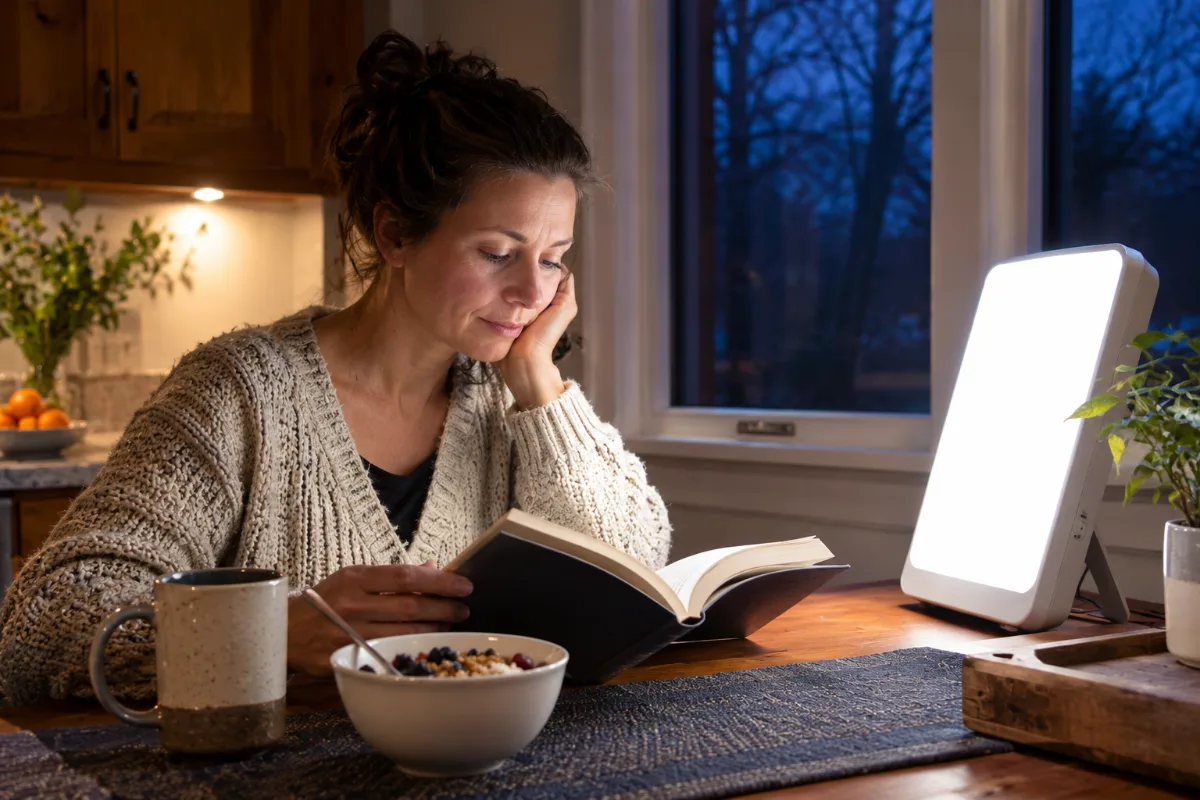
Do SAD lamps work?
Yes, for treating winter-pattern SAD, and the evidence is better than for most things sold in a box. A 2005 meta-analysis in the American Journal of Psychiatry by Golden and colleagues pooled eight trials of bright light for SAD and found an effect size of 0.84, which is a large effect by the standards of depression research. Dawn simulation, a light that brightens gradually before you wake, also helped (effect size 0.73 across five studies).
Light also held up against medication. In the CAN-SAD trial, 96 adults with winter depression got either 30 minutes of 10,000-lux light after waking or 20 mg of fluoxetine (Prozac) daily for eight weeks. Two-thirds responded in both groups. Remission was 50 percent with light and 54 percent with fluoxetine, a difference that was not statistically meaningful. The fluoxetine group reported more agitation, sleep problems and palpitations.
How you use the light decides whether it works. NIMH describes the standard approach:
- A light box rated at 10,000 lux, about 20 times brighter than ordinary indoor light, with ultraviolet filtered out
- About 30 to 45 minutes a day
- First thing in the morning
- Every day from fall into spring
A cheap desk lamp labeled “mood light” is not the same device. Check the lux rating and the distance it is rated at, because brightness drops quickly as you move away. Side effects are usually minor, such as headache or eyestrain, but StatPearls advises an eye exam first if you have an existing eye condition, and NIMH says people taking light-sensitizing medications may need medical supervision. Anyone with bipolar disorder should involve their prescriber before starting.
The weakness of light therapy is people. It works while you use it, and many people stop.
Light versus talk therapy
A form of cognitive behavioral therapy designed for SAD, called CBT-SAD, targets negative thoughts about winter and schedules activities that keep people engaged through the dark months. NIMH describes it as two group sessions a week for six weeks. In a trial led by Kelly Rohan at the University of Vermont, 177 adults received either CBT-SAD or light therapy. Both worked about equally well in the first winter. By the second winter, depression came back in 27.3 percent of the CBT group and 45.6 percent of the light group.
We think that result deserves more attention than it gets. A light box is easy to buy and easy to abandon. Six weeks of therapy is harder to start and seems to keep paying off after it ends.
Medication is the third option. NIMH notes that antidepressants usually take four to eight weeks to work. Extended-release bupropion is FDA-approved to prevent seasonal depressive episodes when taken from fall through early spring, and StatPearls cites a 2019 Cochrane review supporting starting it between September and November, before symptoms usually appear. That decision belongs with a prescriber who knows your history.
Can vitamin D help seasonal depression?
Maybe, if you are low. The evidence is genuinely mixed, and we would not lean on it alone. NIMH says many people with winter-pattern SAD are vitamin D deficient, and that study results on supplements are mixed, with some finding vitamin D as effective as light therapy and others finding no effect. StatPearls calls its value as a stand-alone treatment “inconclusive.”
One of the larger trials points the cautious way. In a randomized trial of 2,117 women aged 70 and older, 800 IU of vitamin D a day with calcium did not improve mental health scores after six months. That was a study of prevention in older women rather than treatment of diagnosed SAD, so it does not settle the question. It does undercut the idea that a vitamin D pill is a reliable fix for winter mood.
Our view: get your vitamin D level checked if you have winter symptoms, treat a real deficiency, and keep using the treatments with stronger evidence. NIMH also warns that vitamin D can interact with some medications, so mention it to whoever prescribes for you. Vitamin D comes up again in our post on why you keep getting sick in winter, where it has a different job.
Myth: Seasonal depression is just people disliking winter.
Fact: It is a recognized pattern of major depression with diagnostic criteria, including episodes in the same season for at least two consecutive years.
Myth: Any bright lamp will do.
Fact: The trials used light boxes rated around 10,000 lux, used in the morning for about 30 minutes. Brightness, distance and timing all matter.
Myth: If light therapy works, you are covered for good.
Fact: In the Rohan trial, 45.6 percent of the light therapy group had depression return by the second winter, compared with 27.3 percent after CBT-SAD.
What actually helps, and when to get checked
If your winter dip is mild, the basics have real logic behind them even where trial data are thin: get outside in daylight early, keep a fixed wake time, stay active and keep plans with people when you would rather cancel them. That last one is basically the behavioral half of CBT-SAD.
If you have felt low most days for two weeks or more, are sleeping far more than usual, have pulled away from people, or this happens every year, talk to a clinician. A workup should cover the obvious physical causes, such as thyroid function, iron and vitamin D, before anyone assumes the season is to blame. A naturopathic doctor can order those labs and work alongside a therapist or prescriber. You can read more about naturopathic support for anxiety and depression in a separate post.
If you are having thoughts of suicide or self-harm, call or text 988 to reach the 988 Suicide and Crisis Lifeline, any time of day. In an emergency, call 911.
What we still cannot tell you is why one person in a Bend household falls into a dark hole every January while the person next to them, under the same sky, barely notices. Genetics, sex and history all play a part. Nobody can predict it well yet.
Frequently asked questions
Is seasonal depression a real diagnosis?
Yes. Clinicians diagnose it as major depressive disorder, or bipolar disorder, “with seasonal pattern” under the DSM-5-TR. The criteria require mood episodes that start and remit at characteristic times of year, a two-year history of seasonal episodes without non-seasonal ones in between, and seasonal episodes that outnumber non-seasonal ones over your life. The everyday name, seasonal affective disorder, describes that pattern.
What month does seasonal depression usually start?
For the common winter pattern, symptoms usually begin in late fall or early winter, often October or November, and fade in spring. Yale’s Winter Depression Research Clinic describes a peak from December through February, and some people notice changes as early as September. NIMH says episodes typically last four to five months. A rarer summer pattern starts in spring instead.
How long do you need to use a light box each day?
NIMH describes the usual approach as 30 to 45 minutes a day in front of a 10,000-lux light box, first thing in the morning, from fall through spring. The CAN-SAD trial used 30 minutes after waking, between 7 and 8 a.m. Benefits usually depend on daily use, so a light box that sits unused in a closet will not help. Ask a clinician first if you have eye disease or bipolar disorder.
Do vitamin D supplements help seasonal depression?
The evidence is mixed. NIMH reports that some studies found vitamin D as effective as light therapy and others found no effect, and StatPearls calls it inconclusive as a stand-alone treatment. A trial of 2,117 women aged 70 and over found no mental health benefit from 800 IU a day. It makes sense to test your level and correct a deficiency, alongside better-proven treatments.
What is the difference between SAD and the winter blues?
Degree and pattern. About 90 percent of people report some winter change in energy, sleep or appetite, according to Yale, and most keep functioning normally. SAD means a full depressive episode, with low mood most days for at least two weeks and loss of interest, that returns in the same season year after year. If winter regularly affects your work or relationships, get assessed.
If this winter feels heavier than the usual slowdown, a short conversation is a reasonable first step. Dr. Drew Collins, ND, at Proactive Choice can look at the physical side, including thyroid, iron and vitamin D labs, and help you decide whether light therapy, counseling or a referral makes sense. You can read about brain and mood care at our Bend clinic, or book a free 15-minute call at +1 (858) 333-5196.
Sources
- National Institute of Mental Health. Seasonal Affective Disorder.
- StatPearls. Seasonal Affective Disorder. NCBI Bookshelf.
- Yale School of Medicine. Winter Depression Research Clinic.
- Golden RN, et al. The efficacy of light therapy in the treatment of mood disorders: a review and meta-analysis of the evidence. American Journal of Psychiatry, 2005.
- American Family Physician. Light therapy vs. fluoxetine for treatment of SAD (summary of Lam RW, et al., CAN-SAD study, American Journal of Psychiatry, 2006).
- Rohan KJ, et al. Outcomes one and two winters following cognitive-behavioral therapy or light therapy for seasonal affective disorder. American Journal of Psychiatry, 2016.
- Dumville JC, et al. Can vitamin D supplementation prevent winter-time blues? A randomised trial among older women. Journal of Nutrition, Health and Aging, 2006.
- timeanddate.com. Sunrise, sunset and day length, Bend, Oregon.
- 988 Suicide and Crisis Lifeline.
Medically reviewed content from Proactive Choice. This article is for education and is not a diagnosis. Talk with a licensed clinician about your own symptoms and treatment options.
Want to talk this through for your own health? Book a visit with Dr. Drew Collins, ND at 601 NW Harmon Blvd in Bend, or call (858) 333-5196.