
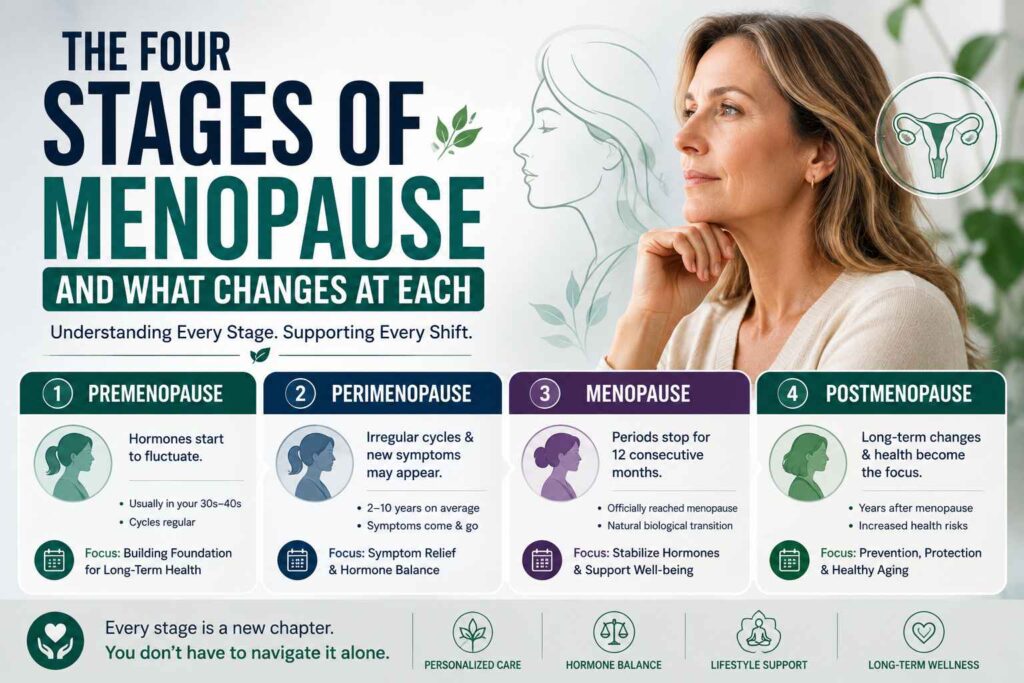
Menopause gets talked about as though it happens on a particular day. In practice it is a transition that unfolds over roughly a decade, and the symptoms that bother women most tend to arrive years before the event that gives the process its name.
Knowing which phase you are in is genuinely useful. It changes what symptoms to expect, what treatment options are appropriate, what testing will and will not tell you, and which health risks deserve attention. It also explains why so many women in their early forties are told they are “too young for menopause” when what they are experiencing is entirely characteristic of the phase before it.
This article walks through the four stages, what changes at each, and what the evidence supports at each point.
The Hormonal Background
You are born with a finite number of ovarian follicles. That number declines throughout life, with the decline accelerating from the late thirties onward.
Follicles produce oestradiol, the main form of oestrogen in reproductive years, and after ovulation the corpus luteum produces progesterone. As the follicle pool shrinks, the pituitary raises FSH in an attempt to recruit what remains. Ovulation becomes less consistent. Progesterone, which requires ovulation, is often the first hormone to become unreliable.
Oestrogen behaves less predictably than most people assume. It does not decline in a smooth line. During the transition it fluctuates, sometimes reaching levels higher than in earlier reproductive years, before eventually settling low. That volatility, rather than the low level itself, explains a great deal of what women experience in the early phase.
Stage One: Premenopause
Typically: reproductive years through the mid to late thirties
Regular ovulatory cycles, predictable hormone patterns, and normal fertility. This is the baseline.
Subtle change often begins in the late thirties without meeting the definition of perimenopause. Cycles may shorten by a day or two. Premenstrual symptoms may intensify. Sleep may become slightly less reliable in the week before a period. These reflect early declines in progesterone and are frequently dismissed, though they are worth noting as a reference point for what comes later.
What matters here: establishing bone density through weight-bearing exercise and adequate calcium and vitamin D, since peak bone mass sets the starting point for later losses. Building cardiovascular fitness. Understanding your own normal cycle pattern so that changes are recognisable.
Stage Two: Perimenopause
Typically: begins in the mid forties, though it can start in the late thirties. Lasts four to eight years on average, sometimes longer.
This is the phase where most symptoms occur, and where most women are told nothing is wrong.
Perimenopause begins when cycle length starts varying persistently, and ends twelve months after the final period. It is generally divided into two parts.
Early Perimenopause
Cycle length becomes variable, usually by seven days or more from your own established pattern. Ovulation still occurs in most cycles but less reliably.
Characteristic features:
- Cycles shortening, often to 24 or 25 days
- Heavier or longer bleeding, sometimes with clotting
- Sleep disruption, classically waking between 2am and 4am
- New or worsening anxiety, sometimes without an identifiable trigger
- Breast tenderness
- Intensified premenstrual symptoms
- Migraine onset or worsening around the period
- Difficulty with word recall and concentration
The dominant mechanism early on is often relative progesterone deficiency, since ovulation becomes intermittent while oestrogen production continues and fluctuates. This is why sleep and anxiety are frequently the first things to change.
Late Perimenopause
Defined by gaps of sixty days or more between periods. Cycles become widely spaced and unpredictable.
Vasomotor symptoms typically dominate here: hot flushes and night sweats. Vaginal dryness often begins. Sleep disruption usually intensifies. Mood symptoms can worsen, and this phase carries a documented increase in risk of depressive episodes, particularly in women with a prior history.
On testing: this is important and often misunderstood. FSH and oestradiol fluctuate so much during perimenopause that a single blood test cannot confirm or exclude it. A normal FSH on a given day means very little. Perimenopause is diagnosed clinically, from cycle pattern and symptoms, in women of the appropriate age. Testing is appropriate to rule out other conditions, particularly thyroid dysfunction, anaemia, and in younger women premature ovarian insufficiency. Our article on perimenopause symptoms that deserve investigation goes into more detail.
Fertility note: pregnancy remains possible throughout perimenopause. Contraception is still needed until twelve months after the final period, or longer if you are under fifty.
Stage Three: Menopause
A single point in time, identified retrospectively. Average age around 51.
Menopause is defined as twelve consecutive months without a period, with no other cause. It is diagnosed looking backward: you reach it a year after the fact.
Some definitions worth knowing:
- Early menopause: occurring between 40 and 45
- Premature ovarian insufficiency: occurring before 40, affecting roughly one percent of women, and warranting investigation and usually hormone therapy until the average age of natural menopause because of bone and cardiovascular risk
- Surgical menopause: following removal of both ovaries, which is abrupt rather than gradual and typically produces more intense symptoms
- Medical menopause: induced by chemotherapy, radiation, or certain medications, sometimes temporary
Any bleeding after twelve months without a period is postmenopausal bleeding and requires prompt medical evaluation. It is usually benign, but it can indicate endometrial cancer, and it should never be assumed to be a stray period.
Stage Four: Postmenopause
Everything after that twelve-month point, so roughly a third of most women’s lives.
Oestrogen settles at a consistently low level. For many women, hot flushes gradually diminish over several years, though a substantial minority continue to experience them for a decade or more, and some indefinitely.
Some symptoms improve while others emerge or worsen:
Usually improving: cycle-related unpredictability, heavy bleeding, hormonal migraine in many women, breast tenderness, and for many the intensity of hot flushes over time.
Often persisting or emerging:
- Genitourinary syndrome of menopause. Vaginal dryness, discomfort with intercourse, urinary urgency, and recurrent urinary tract infections. Unlike hot flushes, this is progressive and does not resolve on its own. It responds well to local vaginal oestrogen, which has minimal systemic absorption and is appropriate for most women, including many who cannot use systemic hormone therapy.
- Accelerated bone loss. Loss is fastest in the first several years after menopause, making this the highest-yield window for intervention.
- Changing cardiovascular risk. Lipid profile and vascular function shift, and cardiovascular disease becomes the leading cause of death in women postmenopause.
- Body composition change. Muscle mass declines and fat distribution shifts toward the abdomen, which affects metabolic health independently of total weight.
- Skin and connective tissue changes. Collagen density declines notably in the years immediately following menopause.
What Helps at Each Stage
| Stage | Priorities |
|---|---|
| Premenopause | Build bone density and muscle. Establish cardiovascular fitness. Note your baseline cycle pattern. |
| Early perimenopause | Address sleep and mood. Rule out thyroid disease and anaemia. Investigate heavy bleeding rather than tolerating it. Consider cyclical progesterone where appropriate. |
| Late perimenopause | Vasomotor symptom management. Begin addressing vaginal symptoms early. Continue contraception. Discuss hormone therapy if symptoms are affecting function. |
| Menopause | Confirm diagnosis clinically. Assess cardiovascular and bone risk. Make a considered decision about hormone therapy. |
| Postmenopause | Bone density screening. Cardiovascular risk management. Local oestrogen for genitourinary symptoms. Resistance training for muscle and bone. |
On Hormone Therapy and Timing
The evidence on menopausal hormone therapy has been reassessed substantially since the initial Women’s Health Initiative reporting in 2002, which led to a sharp drop in prescribing and a great deal of confusion that persists.
Current professional guidance generally holds that for women under 60, or within ten years of their final period, who have bothersome vasomotor symptoms and no specific contraindication, the benefits of systemic hormone therapy usually outweigh the risks. Risk profile changes when therapy is started later, which is often described as the timing hypothesis.
This is a decision that depends on individual history: personal and family history of breast cancer, cardiovascular disease, clotting disorders, and migraine with aura all matter. Local vaginal oestrogen is a separate question with a much more favourable safety profile and is appropriate for a broader group. Our overview of managing menopause without conventional HRT covers the alternatives for women who cannot or prefer not to use it.
Frequently Asked Questions
How long do the phases of menopause last?
Perimenopause averages four to eight years, though some women pass through it in under two and others take more than a decade. Menopause itself is a single retrospective point. Postmenopause continues for the rest of life.
Can a blood test tell me which stage I am in?
Not reliably during perimenopause, because FSH and oestradiol fluctuate substantially from day to day. Staging is clinical, based on cycle pattern and symptoms. Blood tests are more useful for excluding other causes and for assessing women under 45, where premature ovarian insufficiency must be considered.
Can I get pregnant during perimenopause?
Yes. Fertility declines but does not disappear until menopause is complete. Contraception is generally advised for twelve months after the final period if you are over 50, and twenty-four months if under 50.
Do hot flushes ever stop?
For most women they diminish over several years after menopause. Research following women over time has found that a substantial proportion experience them for seven years or more, and a minority continue indefinitely. Duration is longer on average when symptoms begin earlier in the transition.
Is early menopause a problem beyond symptoms?
Yes. Menopause before 45, and particularly before 40, is associated with increased long-term risk of osteoporosis and cardiovascular disease because of the longer period of low oestrogen exposure. This is why hormone therapy is usually recommended in premature ovarian insufficiency until the typical age of natural menopause.
The Bottom Line
Menopause is a staged transition, and most of what women experience happens in the years before the milestone itself. Recognising which phase you are in makes the symptoms legible, points toward the right investigations, and clarifies which treatments are appropriate now rather than later.
At Proactive Choice in Bend, Oregon, Dr. Drew Collins, ND, provides individualised care across the full transition, from early perimenopausal changes through postmenopausal bone and cardiovascular health. See our menopause specialist in Bend, Oregon page for more.
Book a menopause consultation with Proactive Choice and find out exactly where you are in the transition.
This article is for general education and does not replace individual medical advice. Postmenopausal bleeding, or any bleeding pattern that concerns you, should be evaluated promptly by a clinician.
For a broader look at this kind of care, see Hormone Doctor in Bend, OR.
Further reading
- Menopause: What It Is, Age, Stages, Signs & Side Effects, Cleveland Clinic. How perimenopause, menopause, and postmenopause are defined and what changes in each.
- What To Expect in Each Stage of Menopause, Cleveland Clinic. Symptoms and health risks to expect at each stage of the menopause transition.
- What Is Menopause?, National Institute on Aging (NIH). The basics of the menopause transition, common symptoms, and ways to manage them.
Want to talk this through for your own health? Book a visit with Dr. Drew Collins, ND at 601 NW Harmon Blvd in Bend, or call (858) 333-5196.