
If you want to know how to test testosterone levels, the answer is a blood draw from a vein, booked between 7 and 10 a.m., after an overnight fast, and repeated on a second morning. That is the whole method. What trips men up is the detail around it: a 4 p.m. appointment, a breakfast sandwich on the way to the lab, a bad cold that week, or a mailed saliva kit. Each of those can move the number enough to change what happens next.
Quick answer: Get a total testosterone blood test drawn from a vein between 7 and 10 a.m. after an overnight fast, when you are not sick. If the result comes back low, repeat it on another morning at the same lab. One reading does not confirm anything. Home saliva kits do not match serum results well, and finger-prick kits still need a lab-drawn confirmation.
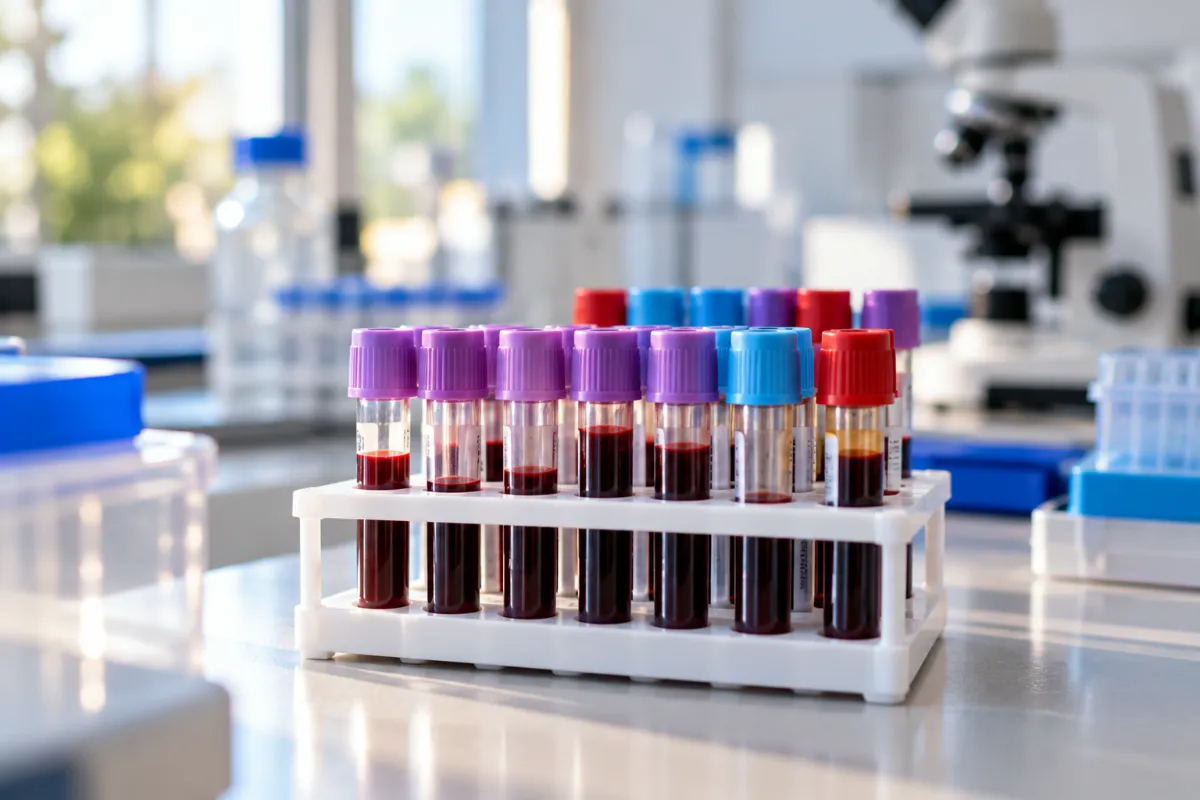
How to test testosterone levels, step by step
This is the order that matches the Endocrine Society guideline, which calls for a fasting morning total testosterone measured with an accurate assay and confirmed with a second morning measurement. It is also the practical answer to how to check testosterone levels in a way a clinician can use.
- Get a lab order for a total testosterone blood test. A clinician can order it.
- Book the draw between 7 and 10 a.m.
- Fast overnight. Eat nothing until after the draw, and ask the lab what you may drink.
- Reschedule if you are sick. The Endocrine Society advises against testing during an acute illness or while taking a short course of a drug that lowers testosterone, such as opioids.
- Tell whoever orders the test about every medication and supplement you take, including biotin.
- If the first result is low, repeat the test on a different morning at the same lab.
- Bring a written list of your symptoms to the results visit. The number is read against them.
The draw itself is short. MedlinePlus says a blood sample is taken from a vein in the arm with a small needle, it usually takes under five minutes, and the main risk is slight pain or a bruise that fades quickly.
Biotin deserves its own line. The FDA warns that biotin, often found in dietary supplements, can interfere with certain lab tests and cause incorrect results that may go undetected. Mention it before the draw and let your clinician tell you whether to pause it.
Why the time of day changes the result
Testosterone runs on a daily rhythm. It is highest in the morning and falls through the day.
The clearest numbers come from a 2009 study by Brambilla and colleagues in the Journal of Clinical Endocrinology and Metabolism, which tested 66 men aged 30 to 80 at several times of day. In men aged 30 to 40, testosterone at 4 p.m. was 20 to 25 percent lower than at 8 a.m. The gap shrank with age to about 10 percent at 70, and the authors still concluded that testosterone should be measured in the morning in both young and older men.
There is a second reason, and it is plainer. Harvard Health notes that labs build their normal values from morning blood draws, so an afternoon result gets compared against a morning yardstick. A man who works days and grabs a 3 p.m. slot because it is convenient can end up with a reading that looks low for reasons that have nothing to do with his hormones.
Not everyone agrees that older men need the early slot. A 2015 review in the Journal of Family Practice by Long, Nguyen and Stevermer argued that early-morning collection is unnecessary for men 45 and older, while still recommending that any low result be repeated before 9 a.m. Their review did not look at late afternoon or evening draws, so it leaves the question open for anyone who can only test after lunch.
Our view is simple. Book the morning draw anyway. It means an early alarm, and it removes one argument about whether your number is real.
Do you need to fast for a testosterone test?
Sources disagree on this one. Testing.com says fasting is not typically required and that doctors ask for it mainly for standardization or because other tests are drawn at the same time. MedlinePlus says that in certain cases you may need to fast for several hours. The Endocrine Society guideline specifies a fasting morning sample.
We side with the guideline, and the reason is a feeding study. In a 2018 paper in Endocrine, Gagliano-Jucá and colleagues gave 60 men aged 23 to 97, all with normal testosterone and no diabetes or prediabetes, either a glucose drink or a mixed meal. Testosterone started falling about 20 minutes in and hit its lowest point around 60 minutes. The average drop was 100 ng/dL after glucose and 123 ng/dL after the meal, and most men were still below their starting level at two hours.
The part that matters for testing is this: 11 percent of the men in the glucose test and 56 percent in the meal test dipped below the lower limit of normal for a while, even though their fasting levels were normal. The authors concluded that men being evaluated for low testosterone should be tested after an overnight fast.
So yes, fast. Eat after the draw.
What a total testosterone test measures
Testosterone travels in the blood in two states. Part of it is attached to proteins, including sex hormone binding globulin (SHBG), and part is unattached. According to MedlinePlus, a lab can report three versions:
- Total testosterone, which counts both bound and free testosterone and is the most common test.
- Free testosterone, which counts only the unattached form.
- Bioavailable testosterone, which counts free testosterone plus the testosterone attached to proteins other than SHBG.
Start with the total. The total testosterone test is where both major guidelines begin. The American Urological Association guideline says the diagnosis should be made only after two total testosterone measurements taken on separate early mornings, drawn at the same laboratory with the same assay, and only when low levels come with symptoms or signs. If testosterone is low, the AUA also calls for a luteinizing hormone (LH) test.
Free testosterone comes in when the total is borderline or when SHBG is likely to be off. The Endocrine Society lists conditions that can shift SHBG, including obesity, diabetes, aging, hypothyroidism, hyperthyroidism, cirrhosis, hepatitis, HIV, glucocorticoid use and some anticonvulsants. In those men, the guideline recommends measuring free testosterone by equilibrium dialysis or calculating it with an accurate formula. If you want the wider picture of which hormones get checked alongside testosterone, our guide to hormone panel testing covers the rest of the panel.
How to test testosterone levels at home, and where kits fall short
Home kits come in two types. One asks you to spit into a tube. The other asks you to prick a finger or use a small device on the upper arm and send dried or liquid blood to a lab. MedlinePlus lists both and adds a short instruction: talk to your provider if you think an at-home test is right for you.
Saliva is weaker. Testing.com says saliva testing is not commonly used because most clinicians prefer serum blood tests. A 2014 study by Hayes and colleagues in Endocrine tested whether salivary testosterone could pick out aging men with low serum testosterone, and the title gives the result: it does not identify biochemical hypogonadism. The authors also noted that earlier studies found anywhere from fair agreement to no relationship at all between saliva and serum values.
Dried blood spots do better, under the right conditions. A 2025 conference abstract from Olthof and colleagues found a correlation of 0.87 between self-collected blood spots and serum in men already on testosterone injections, and it said patients needed training to collect good samples. That was a monitoring study in treated men, which is a different job from diagnosing someone for the first time.
| Question | Lab draw from a vein | Home saliva kit | Home finger-prick or blood spot kit |
|---|---|---|---|
| Sample type used by the guidelines | Yes, serum | No | Blood, but not a venous serum draw |
| Agreement with serum | It is the reference | Varies, and some studies found none | Correlation of 0.87 in one 2025 study of treated men |
| Who controls timing and fasting | The lab records the draw time | You, with no record | You, with no record |
| Counts toward two readings at the same lab and assay | Yes, if both draws use one lab | No | Only if the clinician’s second test is run by the same lab and method |
| Can add LH, SHBG or free testosterone | Yes, on the same order | Depends on the kit | Depends on the kit |
Here is our position. Skip saliva kits for this question entirely. A finger-prick kit is fine as a first look if it gets you to book a real appointment, but treat its number as a reason to test properly, not as a result. Testing.com makes the same point from the other side: an abnormal home result may need to be confirmed with testing your doctor orders, so you will likely end up at a lab draw anyway.
What to do with your testosterone blood test result
Take it to the clinician who ordered it, along with your symptom list. What the number means for a man your age is its own topic, covered in our guide to testosterone levels by age. This post stops at the procedure, and the procedure after a low result is the same everywhere. Repeat it.
A single low reading is often not the final word. Harvard Health reports that about 30 percent of men with a borderline-low result come back in the normal range on a repeat test. The same article points out that results vary between tests and between laboratories, which is the reason the AUA wants both readings from one lab and one assay, and changing labs between the first and second draw makes that comparison weaker.
After a confirmed low result, the next tests usually include LH, and often SHBG and free testosterone. Those are clinician decisions, and you do not need to work out the list yourself. If you are wondering whether a naturopathic physician can place that order, our post on naturopathic doctors ordering lab tests explains what a licensed ND can request.
At Proactive Choice, the rule is the one described above. One low number is not a diagnosis, and Dr. Drew Collins, ND, works from a fasting, early-morning total testosterone test repeated on a second morning, read together with your symptoms. Patients can use a blood draw station, a mobile phlebotomist who comes to them, their primary care provider or an online lab to get the testing he needs. If you want to talk through testosterone testing in Bend before you book a draw, set up a free 10-minute call with Dr. Collins at +1 (858) 333-5196.
Frequently asked questions
What time of day should a testosterone test be done?
Book the blood draw between 7 and 10 a.m. Testosterone is highest in the morning, and labs set their normal values from morning samples. In one study of 66 men, levels at 4 p.m. were 20 to 25 percent lower than at 8 a.m. in men aged 30 to 40. An afternoon draw can make a normal level look low.
Do you need to fast for a testosterone test?
Fasting is the safer choice. The Endocrine Society guideline calls for a fasting morning sample. In a 2018 study of 60 men with normal testosterone, a mixed meal lowered levels by an average of 123 ng/dL within about an hour, and 56 percent dipped below the lower limit of normal. Skip food and eat after the draw.
What does a total testosterone test show?
A total testosterone test measures all testosterone in the blood, both the part bound to proteins and the small free part. It is the most common testosterone test and the starting point in both the Endocrine Society and American Urological Association guidelines. When SHBG may be abnormal or the total is borderline, a clinician may add free testosterone.
How reliable are at-home testosterone tests?
Saliva kits are the least reliable. A 2014 study found salivary testosterone did not identify aging men with low serum testosterone. Blood spot kits track serum better, with one 2025 study reporting a 0.87 correlation in men already on treatment. Neither kind replaces two morning lab draws at the same lab, which is what the AUA guideline requires for a diagnosis.
What should I do if my result is borderline?
Repeat the test on another morning, fasting, at the same lab. Harvard Health reports that about 30 percent of men with a borderline-low result test normal on a repeat. If the result is still borderline, the Endocrine Society guideline suggests measuring free testosterone by equilibrium dialysis or an accurate calculation, especially when SHBG may be abnormal.
Sources
- Bhasin S, et al. Testosterone Therapy in Men With Hypogonadism: An Endocrine Society Clinical Practice Guideline. J Clin Endocrinol Metab. 2018
- American Urological Association. Evaluation and Management of Testosterone Deficiency
- MedlinePlus. Testosterone Levels Test
- Harvard Health Publishing. What’s the best way to test for low testosterone? (2022)
- Brambilla DJ, et al. The effect of diurnal variation on clinical measurement of serum testosterone and other sex hormone levels in men. J Clin Endocrinol Metab. 2009
- Gagliano-Jucá T, et al. Oral glucose load and mixed meal feeding lowers testosterone levels in healthy eugonadal men. Endocrine. 2018
- Long N, Nguyen L, Stevermer J. It’s time to reconsider early-morning testosterone tests. J Fam Pract. 2015
- Hayes LD, et al. Salivary testosterone measurement does not identify biochemical hypogonadism in aging men: a ROC analysis. Endocrine. 2014
- Olthof A, et al. From venipuncture to self-sampling DBS: a shift in monitoring testosterone levels. Endocrine Abstracts, ECE-ESPE 2025
- Testing.com. Testosterone Test
- U.S. Food and Drug Administration. Biotin Interference with Troponin Lab Tests
Medically reviewed content from Proactive Choice. This article is for education and is not a diagnosis. Talk with a licensed clinician about your own labs and symptoms.
Want to talk this through for your own health? Book a visit with Dr. Drew Collins, ND at 601 NW Harmon Blvd in Bend, or call (858) 333-5196.