
PRP therapy involves concentrating platelets from your own blood—tiny cell fragments packed with healing proteins—and injecting them into targeted areas to stimulate tissue repair. Platelets release growth factors that accelerate your body’s natural regeneration process. By isolating and reintroducing them into areas of damage or degeneration, we help you heal from the inside out. At our Bend clinic, PRP is offered by Dr. Drew Collins, a trusted Naturopathic Doctor in Bend, who tailors each treatment to your unique health goals.

Personalized Assessment: We begin with a full consultation to determine if PRP is the right fit for your condition.
Safe & Sterile Procedure: Blood is drawn, processed using a high-speed centrifuge, and precisely injected by Dr. Collins.
Comprehensive Healing Plan: PRP is often paired with nutritional support, lifestyle strategies, and other regenerative therapies.
No Downtime: Most patients resume daily activities the same day, with minimal discomfort.

Knee, shoulder, or hip pain
Osteoarthritis and chronic inflammation
Tendon or ligament injuries (e.g., tennis elbow, rotator cuff issues)
Plantar fasciitis and overuse injuries
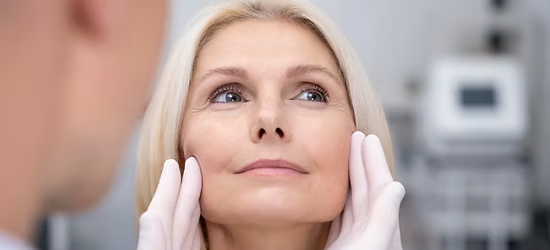
Fine lines, wrinkles, and skin laxity
Uneven texture and acne scars
“Vampire Facial” microneedling with PRP for natural glow
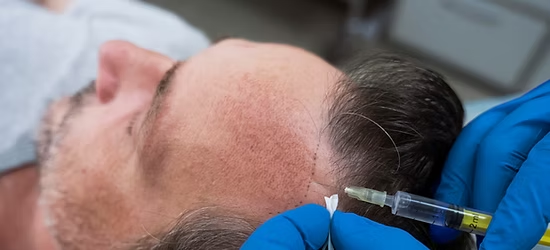
Early-stage hair thinning or pattern baldness
Strengthening hair follicles for thicker growth
Boosting scalp circulation and collagen production
For decades, cortisone injections have been the standard response to joint pain. They work — but only by suppressing inflammation, not by healing the underlying tissue. Repeated cortisone injections can actually degrade cartilage and weaken tendons over time.
PRP works differently. Rather than masking inflammation, it harnesses the body’s own healing biology to repair the damaged tissue. Patients treated with PRP frequently experience longer-lasting relief with no cartilage degradation risk. For patients in Bend who are physically active — skiers, hikers, cyclists, runners — PRP aligns with a lifestyle that values long-term tissue health, not just temporary pain relief.
PRP is not an immediate fix — it is a biological process. Most patients notice meaningful improvement between 4-8 weeks after treatment, with full benefit often taking 3-6 months to manifest. This timeline reflects the biological reality of tissue regeneration, which is slower than pharmaceutical suppression but produces lasting, structural improvement.
Some patients need 2-3 PRP sessions spaced 4-6 weeks apart for optimal results, particularly in chronic or advanced cases. Dr. Collins assesses your response at follow-up appointments and adjusts the protocol accordingly.
PRP therapy at Proactive Choice typically ranges from $400-$1,200 per session depending on the area treated, the volume of PRP used, and whether imaging guidance is required. Some cases involve a single treatment; chronic conditions may benefit from a 2-3 session protocol.
Most insurance plans do not cover PRP therapy as it is still classified as investigational for many indications. Dr. Collins discusses all costs transparently during your consultation so you can make an informed decision. For patients pursuing a comprehensive regenerative approach, Proactive Choice can combine PRP with prolotherapy, exosome therapy, or peptide protocols at a coordinated treatment plan and cost.
The best candidates for PRP therapy are patients who:
PRP is generally not appropriate for patients with active cancer, severe anemia, platelet disorders, or those on anticoagulant medications. A thorough evaluation with Dr. Collins establishes whether PRP is the right tool for your specific situation.
Complete the form below to request an appointment with Dr. Drew Collins. You can also call the clinic at (858) 333-5196.
Excellent rating
Based on 24 reviews
 After struggling with molluscum contagiosum for over a year and a half with my toddler, we finally found relief thanks to Dr. Drew Collins. I can’t recommend him enough. My son had these viral bumps for about 18 months, and they just kept spreading. We brought it up multiple times with our pediatrician and were told they would resolve on their own within a few months. Unfortunately, that never happened. Instead, the bumps continued to spread and were slowly working their way up toward his neck. They were itchy, uncomfortable, and clearly bothering him. Like many parents, I spent a lot of time searching online for solutions. The problem is that there really aren’t clear protocols—just countless suggestions from people trying anything and everything. We tried many of those approaches, but nothing helped, and some even seemed to make things worse. When we finally met with Dr. Drew Collins, the experience was completely different. He took the time to listen, understand the situation, and develop a thoughtful treatment plan. The plan was surprisingly simple—just one supplement—but within about a month we started seeing real improvement. Now, about three months later, my son only has a few small scabs left where the bumps used to be, and they’re healing up nicely. After 18 months of watching this spread and worrying about it, seeing such clear progress has been a huge relief. We’re incredibly grateful for Drew’s help and expertise. If you’re dealing with persistent molluscum or similar issues and feel like you’ve run out of options, I would absolutely recommend scheduling a visit with him.
 Lindsay JonesDr. Collins has a heart for getting you well. Having had cancer fourteen years ago, I have no thyroid gland. Many doctors have had the “well the numbers look good, you must be feeling well” approach. Dr. Collins understands many reasons why things may not be right even though tests show they should be. He is more interested in you feeling well than the numbers. His approach has revealed things about my present condition I think many doctors missed. While he had my thyroid hormone condition under control, another issue sprang up that traditional doctors approached with the usual pain medications. My gut was constantly hurting. MRIs and ultra sounds, showed nothing. No one offered any reason for my pain. Dr. Collins correctly identified pain in fatty tissues and an incorrect balance of gut microbes. More and more information is being found all the time about how important your gut health is to the rest of your body. Dr. Collins takes a great interest in this subject. He is very concerned for the health of the gut in the American diet that has been terribly broken down by pesticides typically sprayed on seed products and the toxic byproducts of seed oils (wheat, corn, rye, barley, rice and so forth). He has discovered the findings from MIT and a heart surgeon Dr. William Davis who published Super Gut, that showed there is a missing gut biome called L. Reuteri. Without this biome, all the fatty pain tissues and issues inside the gut caused my pain. Dr. Collins graciously offered a free starter of L. Reuteri and the instructions to grow a yogurt from these bacteria. I was on my way to health. Dr. Collins makes clear that you must have the desire to “follow” the treatment. For this treatment I needed to get off all seed products and take the yogurt daily. This takes some time, several months and at first it was difficult to tell if I was getting better. By the third month there was no doubt. I lost eighteen pounds of fat over my gut and the pain went away. The pain from my sciatica went away due to a reduction in inflammation. This is a side benefit I did not expect. My back hurt less, again, a reduction in inflammation. My skin started looking better. Soon, my wife started taking it because she had trouble with inflammation in her hands. Indeed, her hands and knuckles started to improve, and also her skin. Dr. Collins wants everyone to know about this, and so do I. I highly recommend this treatment and other natural approaches that Dr. Collins employs.
 Robert MehlDr. Drew is amazing! He’s kind, good at explaining everything and has wonderful bedside manner. He really knows how to make you feel comfortable. On top of all of that he is very skilled at what he does. I came to Dr. Drew for my knee which has been giving me issues for years. I had a terrible fall on the ice here in Bend, OR a few days before. Not only did he address my knee but he addressed my fractured tailbone and all the pain I was having for my fall. No joke, I had a noticeable relief by the time I was leaving his office. I experienced some pain and soreness that night from all of the injections but within two days I was sitting on my tailbone again and walking around without excruciating pain. I’m now committed to going through the process to address pain in my shoulders hip and knees. Can’t wait to keep the healing going! Thank you Dr. Drew!!
 Alice FairbairnDr Drew Collins is an Amazing naturopath. He saved me from having a knee replacement! I had 6 PRP shots and was fine! That was 14 years ago! I've also done prolotherapy for my shoulders and hands with him. He is wonderful!
 Dona DavisI have been working with Dr.Collins for close to ten years now. I first came to him because I am a Doctor of Chiropractic and needed help with staying in business. Over the years using my arms, hands , wrists, elbows and spine to treat patients with chiropractic I developed a lot of tendinitis and nerve pain that was so severe I couldn't practice. With expert clinical care and diagnosis Dr.Collins was able to use regenerative medicine to heal these injuries. I am so happy to say that I now practice pain free. Furthermore as I am in my 50's now I needed help with my diminishing hormone levels. Dr.Collins analyzed my blood work and using bioidentical hormones brought my levels up to normal and completed the healing process for me. Now my energy, mood, motivation and love for being a chiropractor are back . I come from a medical family and have worked with other doctors for 30 years, Dr.Collins is the most talented doctor I have met. He is a level above in clinical expertise and has the greatest amount of knowledge and available treatment that I have experienced.
 Patrick RardinDr. Collins is awesome and helped me when no other doctor could. I went to see Dr. Collins due to multiple medical problems due to a car accident. Dr. Collins treated my neck, shoulders, lower back and knees with tremendous success. I had seen many pain management specialists in the past who could only provide temporary pain relief with treatments and medications but Dr. Collins provided me with concrete permanent results. In addition his treatments were pain free! I had very bad knee pain due to degenerative arthritis and all pain is gone now. I had excruciating pain in my lower back and that is gone now because of Dr. Collins treatments. I had frozen muscles and tendons in my shoulders and neck and he was the only doctor that successfully gave me permanent relief. In closing, if you are really motivated to get relief from persistent pain go see Dr. Collins and you won't regret it. He specializes in ozone therapy, hormone replacement, hypothyroidism, prolotherapy, stem cell therapy, anti-aging, nutrition and offers concierge medicine. I am more than grateful that he is conveniently located in Bend so I can see him for all my medical needs in the future.
 Desiree Kerkhoff BryantDr. Collins has been my physician since 2010. He has kept me healthy with his exceptional skill set & that includes Bio-identical hormone therapy & thyroid treatment. I feel fortunate to be his patient.
 Dana SchultzThank you so much Dr. Collins for balancing my hormones and thyroid for many years. I feel great under your care. Anytime I have a question or concern you always get right back to me. I appreciate the care you take with my health.
 Sharon ReeveI have been a patient of Dr. Collins for almost 20 years and he has helped me so much with my overall health and well-being. Not only is he a brilliant doctor, he is a kind and compassionate person who truly cares for his patients. Dr. Collins helped me overcome a terrible hip injury that wasn't responding to conventional treatments. In addition, he balanced my Thyroid Hormones and has helped me with numerous other ailments. I highly recommend Dr. Collins and can't say enough good things about him. I love you Dr. Collins and will be a patient for life!
 symfit
© 2026 by Proactive Choice. Created by Visibility Protocol.