
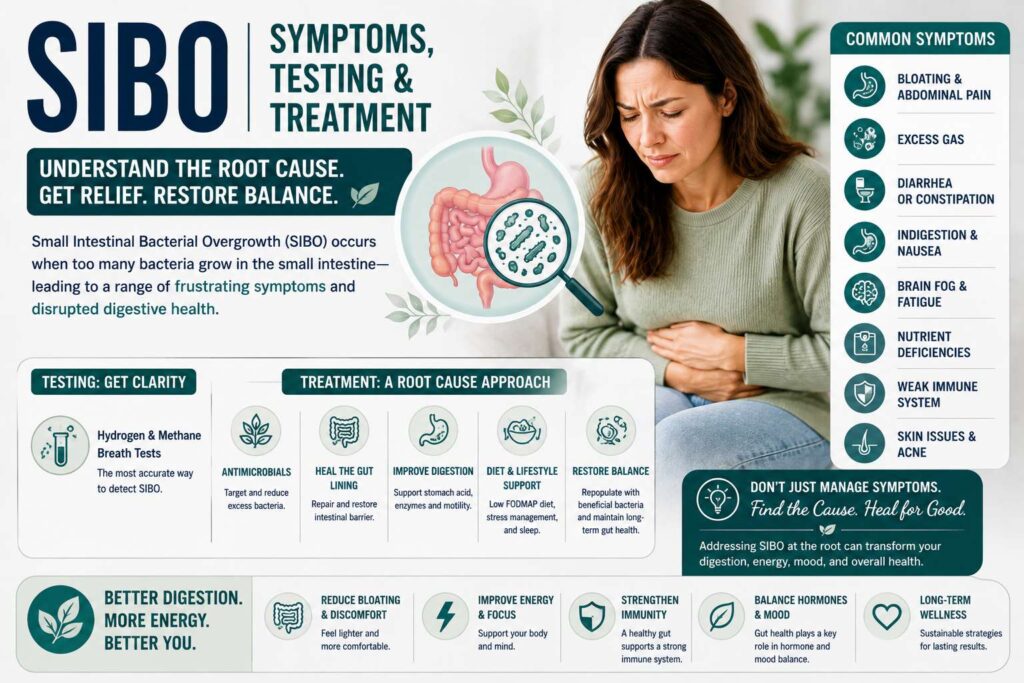
Bloating that arrives within an hour of eating and gets worse through the day. A flat stomach in the morning and a visibly distended one by evening. Reacting to foods you used to tolerate, especially healthy ones like garlic, onions, apples, and beans.
That pattern is characteristic enough to be worth investigating. Small intestinal bacterial overgrowth is one of the more common explanations, and it is also one of the more contentious topics in gastroenterology, with genuine disagreement among specialists about how often it occurs, how to test for it, and how best to treat it.
This article covers what SIBO is, how it presents, what testing can and cannot tell you, what treatment involves, and why the underlying cause matters more than the treatment itself.
What SIBO Is
The small intestine is where nutrient absorption happens. Unlike the colon, which hosts an enormous bacterial population by design, the small intestine normally maintains relatively low bacterial numbers.
Several mechanisms keep it that way: stomach acid kills much of what arrives, bile and pancreatic enzymes have antimicrobial activity, the ileocecal valve limits backflow from the colon, secretory IgA provides immune defence, and the migrating motor complex sweeps residual contents downstream between meals.
SIBO occurs when bacterial numbers in the small intestine rise excessively, or when colonic-type bacteria establish there. These bacteria ferment carbohydrates before you can absorb them, producing gas within the small intestine. Because the small intestine is not built to accommodate that volume, the result is bloating, distension, and pain.
Symptoms
The typical picture:
- Bloating and visible distension, generally worse as the day progresses and often described as looking pregnant by evening
- Onset soon after eating, often within thirty to ninety minutes, which distinguishes it from colonic fermentation that takes longer
- Excessive gas
- Abdominal pain or cramping
- Altered bowel habit, with the pattern relating to the gas produced
- Reactions to fermentable foods, including onions, garlic, apples, legumes, and wheat
- Worsening on probiotics or fibre supplements, which is a useful clue since these help most other gut complaints
- Fatigue, sometimes related to nutrient malabsorption
Bacterial gas type influences bowel habit. Hydrogen-predominant overgrowth is more often associated with diarrhoea. Methane-predominant overgrowth, which involves archaea rather than bacteria and is now more accurately termed intestinal methanogen overgrowth, is associated with constipation, since methane slows transit. A hydrogen sulfide subtype is also recognised, often accompanied by particularly offensive gas.
In more significant cases, malabsorption produces deficiencies in vitamin B12, fat-soluble vitamins A, D, E and K, and iron. Notably, folate is sometimes elevated because gut bacteria synthesise it.
Why the Overlap With IBS Matters
SIBO symptoms and IBS symptoms are close to indistinguishable clinically, and studies have found SIBO in a substantial proportion of people diagnosed with IBS, though reported rates vary enormously depending on testing method and criteria.
This is where specialists genuinely disagree. Some regard SIBO as a common and underdiagnosed driver of IBS. Others regard the association as inflated by unreliable testing. Both positions are held by serious clinicians, and it is more honest to present the disagreement than to pick a side and state it as settled.
Practically, this means a SIBO diagnosis should not be assumed from symptoms alone, and a negative test should not close the door on investigating gut symptoms further.
What Causes SIBO
This is the part that determines whether treatment holds. SIBO is usually a consequence of something else.
Impaired Motility
The most common underlying mechanism. The migrating motor complex is the cleansing wave that sweeps the small intestine between meals. When it functions poorly, bacteria are not cleared.
Causes of impaired motility include post-infectious changes following gastroenteritis, where bacterial toxins can damage the nerve cells that coordinate motility, diabetes with autonomic neuropathy, hypothyroidism, scleroderma and other connective tissue disorders, and opioid medications.
Post-infectious SIBO deserves particular attention. A significant number of people can date their symptoms to a specific episode of food poisoning, which is consistent with the proposed autoimmune mechanism affecting the interstitial cells of Cajal.
Structural Factors
Adhesions from prior abdominal surgery, small intestinal diverticula, strictures from Crohn’s disease, prior bowel resection, and removal of the ileocecal valve all predispose.
Reduced Antimicrobial Defences
Long-term proton pump inhibitor use is associated with increased SIBO risk, since gastric acid is part of the defence. Pancreatic insufficiency and reduced bile flow have similar effects.
Other
Hypothyroidism appears on this list and is worth screening for, since it slows motility broadly. Our full thyroid panel guide covers appropriate testing.
Testing
Breath Testing
The standard non-invasive approach. You drink a sugar solution, typically lactulose or glucose, and breath samples are collected at intervals for two to three hours. Humans do not produce hydrogen or methane; gut microbes do. Early gas production suggests fermentation in the small intestine.
Preparation matters and affects reliability: antibiotics avoided for several weeks, prokinetics and laxatives for a week, a restricted diet the day before, and a fast overnight.
Glucose versus lactulose: glucose is absorbed in the proximal small intestine, so it tests that region with better specificity but can miss distal overgrowth. Lactulose travels the full length, which improves sensitivity but produces more false positives, since rapid transit can deliver it to the colon within the test window and generate a rise that looks like small intestinal fermentation.
Honest limitations: breath testing has meaningful false positive and false negative rates. Consensus criteria exist but interpretation still varies between laboratories. Methane measurement should be included, as hydrogen-only testing misses methanogen overgrowth entirely. Results are best read as one input alongside symptoms rather than as a definitive answer.
Small Bowel Aspirate
Direct sampling during endoscopy with bacterial culture. More definitive in principle, but invasive, subject to contamination during sampling, and reaching only the proximal small intestine. Rarely used outside research or specific clinical situations.
Testing That Should Accompany It
Coeliac serology, faecal calprotectin, complete blood count and ferritin, B12, thyroid function, and pancreatic elastase where malabsorption is suspected. These identify conditions that mimic SIBO or coexist with it.
Treatment
Antibiotics
Rifaximin is the most studied option, and its main advantage is that it is minimally absorbed, acting largely within the gut lumen with limited systemic exposure. Trials support it for IBS with diarrhoea and for hydrogen-predominant SIBO.
For methane-predominant overgrowth, rifaximin combined with neomycin has better evidence than rifaximin alone, since archaea respond differently.
Cost and insurance coverage are practical barriers for many people in the United States, and prescribing decisions belong with your clinician.
Herbal Antimicrobials
A study from Johns Hopkins compared a herbal antimicrobial protocol with rifaximin and found broadly comparable response rates. That is a single study with limitations, and it is often cited more confidently than it warrants, but it is real evidence and it is why herbal approaches are taken seriously in this area.
Commonly used agents include berberine-containing herbs, oregano oil, neem, allicin from garlic, and wormwood. Allicin has particular support for methane-predominant cases.
These are not benign because they are botanical. Berberine interacts with several medications and is not appropriate in pregnancy. Oregano oil can be irritating. Dosing and duration should be supervised.
Elemental Diet
A pre-digested liquid formula absorbed in the proximal small intestine, providing minimal substrate for bacteria further down. Studies report high response rates over two to three weeks.
It is difficult. Palatability is poor, adherence is hard, and it is not appropriate for people with a history of disordered eating or in situations where nutritional risk is a concern. It is generally reserved for refractory cases and should be medically supervised.
Diet
Low FODMAP and similar approaches reduce fermentable substrate and often reduce symptoms substantially. Important caveats: they manage symptoms rather than resolve overgrowth, prolonged restriction reduces microbial diversity and can worsen long-term gut health, and they carry nutritional and psychological risk if extended indefinitely. Restriction should be time-limited with a structured reintroduction phase, ideally with dietitian support.
Why Relapse Happens
Recurrence rates after treatment are substantial. The reason is straightforward: killing bacteria does not fix whatever allowed them to accumulate.
Preventing relapse involves:
- Supporting motility. Prokinetic agents are commonly used after treatment. Discuss options with your clinician.
- Meal spacing. The migrating motor complex runs between meals, not during them. Constant grazing suppresses it. Leaving three to four hours between meals allows it to function.
- Treating underlying conditions. Hypothyroidism, diabetes, coeliac disease.
- Reviewing medications. Long-term proton pump inhibitor and opioid use, with your prescriber.
- Reintroducing dietary variety gradually. Staying on restriction indefinitely trades one problem for another.
Once symptoms settle, rebuilding a diverse plant intake supports the broader microbiome. Our article on the gut microbiome and whole-body health covers how to do that.
Frequently Asked Questions
What are the main symptoms of SIBO?
Bloating and visible distension worsening through the day, gas, abdominal pain, altered bowel habit, and reactions to fermentable foods such as onions, garlic, apples, and legumes. Symptoms often begin within an hour of eating, and many people notice they feel worse on probiotics or fibre supplements.
How accurate is SIBO breath testing?
Moderately accurate with meaningful false positive and false negative rates. Lactulose testing is more sensitive but produces more false positives; glucose is more specific but can miss distal overgrowth. Results should be interpreted alongside symptoms rather than in isolation.
Can SIBO be cured?
Overgrowth can be cleared, and symptoms often improve substantially. Recurrence is common when the underlying cause, most often impaired motility, is not addressed. Durable improvement usually requires treating both.
Do probiotics help or worsen SIBO?
Responses vary. Some people worsen because additional bacteria add to fermentation. Certain strains, particularly some soil-based and Saccharomyces boulardii preparations, are tolerated better by some. Worsening on probiotics is itself a clue worth mentioning to your clinician.
How long does treatment take?
Antibiotic and herbal courses typically run two to four weeks, sometimes repeated. Elemental diet is usually two to three weeks. Relapse prevention is ongoing rather than a fixed course.
The Bottom Line
SIBO is a real and treatable condition that also gets diagnosed more confidently than the testing supports. The productive approach is proper testing including methane, ruling out coeliac disease and inflammatory bowel disease, treating with an evidence-supported approach, and above all identifying what allowed the overgrowth in the first place. Treatment without that last step tends to produce temporary relief.
At Proactive Choice in Bend, Oregon, Dr. Drew Collins, ND, investigates digestive symptoms thoroughly and treats the underlying drivers rather than the overgrowth alone. Learn more about our biome restoration protocol.
Book SIBO testing with Proactive Choice and get a clear answer on what is driving your symptoms.
This article is for general education and does not replace individual medical advice. Antimicrobial and herbal treatments require clinical supervision. Persistent digestive symptoms, blood in the stool, or unexplained weight loss should be evaluated promptly.
For a broader look at this kind of care, see Naturopathic Doctor in Bend, OR.
Further reading
- SIBO: Symptoms, Diagnosis, Causes & Treatment, Cleveland Clinic. SIBO symptoms, underlying causes, breath testing, and treatment and relapse prevention.
- Small intestinal bacterial overgrowth (SIBO) – Diagnosis & treatment, Mayo Clinic. How breath tests diagnose SIBO and how antibiotics and nutrition support are used.
Want to talk this through for your own health? Book a visit with Dr. Drew Collins, ND at 601 NW Harmon Blvd in Bend, or call (858) 333-5196.