
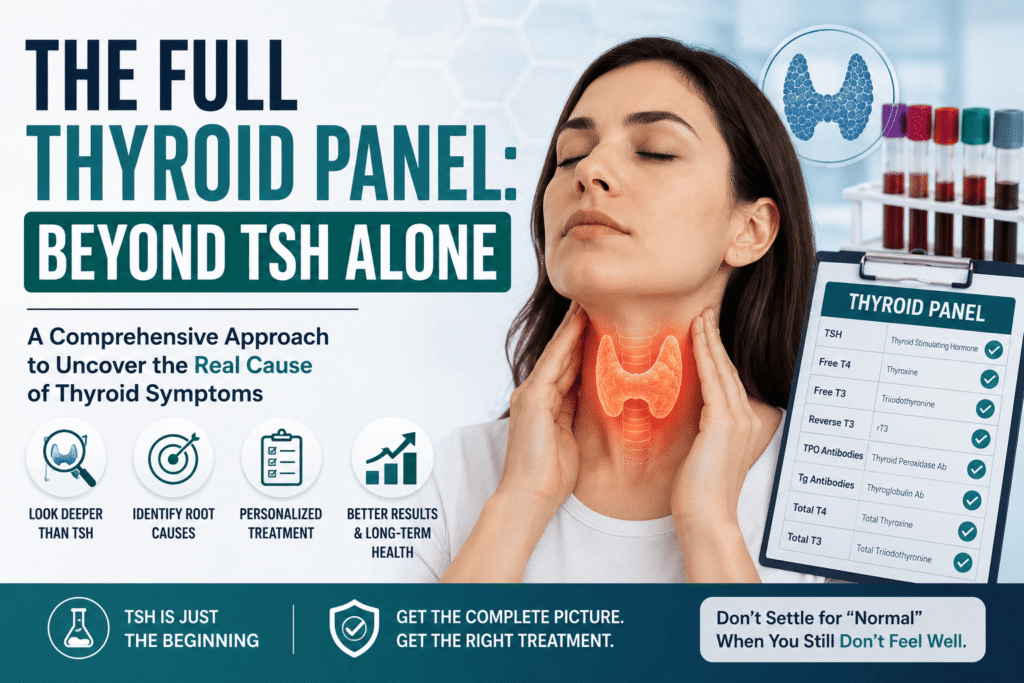
Ask for “thyroid testing” at most clinics and you will get one number back. TSH. If it falls inside the reference range, the conversation usually ends there.
That approach is defensible as a screening strategy for a general population. It is much less defensible when someone is symptomatic and the first test comes back unremarkable. A full thyroid panel measures the system at several points rather than one, and the additional markers frequently explain what a lone TSH cannot.
This guide walks through each marker in a complete panel, what it actually measures, how to interpret common combinations, and when the extra testing is worth ordering. It is written for patients, not clinicians, but without oversimplifying the parts that matter.
How the Thyroid System Actually Works
Understanding the panel requires understanding the chain it measures.
The hypothalamus releases TRH, which tells the pituitary to release TSH. TSH tells the thyroid gland to produce hormone. The thyroid produces mostly T4, roughly 80 to 90 percent of its output, along with a smaller amount of T3.
T4 is largely a storage form. It is relatively inactive at the cellular level. To do its job, it must be converted into T3, the metabolically active hormone, by enzymes called deiodinases. This conversion happens mainly in the liver, kidneys, gut, and peripheral tissues, not in the thyroid itself.
T3 then enters cells, binds nuclear receptors, and influences gene expression governing metabolic rate, mitochondrial activity, growth, and repair. When circulating hormone rises, the pituitary reduces TSH. When it falls, TSH rises. That is the feedback loop.
Two implications follow. First, TSH is a pituitary measurement, not a thyroid measurement. Second, there is a whole conversion step downstream of the thyroid that TSH cannot see directly. A panel that measures only TSH is measuring the thermostat, not the temperature in the room.
What a Full Thyroid Panel Includes
TSH (Thyroid Stimulating Hormone)
The screening standard, and genuinely useful. It is sensitive to small changes in circulating thyroid hormone because the pituitary amplifies the response. A modest drop in thyroid output produces a proportionally larger rise in TSH.
Typical reference range: approximately 0.4 to 4.5 mIU/L, varying by laboratory.
A raised TSH suggests the pituitary is pushing harder because thyroid output is insufficient. A suppressed TSH suggests too much circulating hormone. What TSH cannot tell you is whether conversion is working, whether an autoimmune process is underway, or whether the pituitary itself is functioning normally.
Practical point: TSH follows a daily rhythm, running higher in the early morning and lower in the afternoon. That variation is large enough to move a borderline result across the reference boundary, which is why consistent morning draws matter for comparison over time.
Free T4
Total T4 measures all thyroxine in the blood, but the large majority is bound to carrier proteins and biologically unavailable. Free T4 measures the unbound fraction that can actually enter tissue.
Free T4 tells you about glandular output. A low free T4 with a high TSH is the classic picture of primary hypothyroidism. A low free T4 with a low or normal TSH points toward a pituitary or hypothalamic issue rather than a thyroid one, which is a different problem requiring different management.
Free T4 is preferable to total T4 because pregnancy, oral oestrogen, and certain medications change binding protein levels and distort the total measurement while leaving the free fraction relatively intact.
Free T3
The active hormone. This is the marker most often left off standard panels and the one that most often adds information.
Free T3 reflects the combined result of glandular production and peripheral conversion. If free T4 is comfortable but free T3 sits at the bottom of the range, conversion is a reasonable thing to investigate. Conversion can be impaired by chronic illness, prolonged caloric restriction, sustained stress and elevated cortisol, low selenium or zinc, liver dysfunction, and inflammation.
A word of caution: free T3 is a less stable measurement than TSH and can fluctuate with acute illness and fasting. It informs the picture; it should not be treated as a single number to chase.
Reverse T3
T4 can be converted down two pathways. One produces T3. The other produces reverse T3, a mirror-image molecule that binds thyroid receptors without activating them.
Reverse T3 rises during acute illness, surgery, trauma, starvation, and sustained physiological stress. This is generally understood as an adaptive response, the body deliberately slowing metabolism during a period of strain.
It is worth being honest about the evidence here: reverse T3 is a genuine physiological phenomenon, but its usefulness as a routine clinical marker is debated, and major endocrinology guidelines do not recommend it for standard diagnosis. It can be informative as one input in a complex case. It should not carry a diagnosis on its own.
Thyroid Peroxidase Antibodies (TPOAb)
Thyroid peroxidase is the enzyme that attaches iodine to thyroglobulin during hormone synthesis. Antibodies against it indicate the immune system is targeting thyroid tissue.
This is arguably the most consequential addition to a standard panel. Autoimmune thyroiditis, meaning Hashimoto’s, is the most common cause of hypothyroidism in countries with adequate iodine intake. Antibodies frequently become detectable years before TSH moves outside the reference range.
Knowing antibodies are present reframes the situation. It explains fluctuating results. It raises the priority of monitoring. It matters for pregnancy planning, since positive antibodies are associated with increased miscarriage risk and with higher thyroid hormone requirements during pregnancy. And it shifts attention toward the immune drivers rather than the gland alone. Our article on Hashimoto’s thyroiditis and a root cause approach covers that in depth.
Thyroglobulin Antibodies (TgAb)
Thyroglobulin is the protein scaffold on which thyroid hormone is built. Antibodies against it are a second marker of autoimmune activity. A minority of people with autoimmune thyroid disease are TgAb positive while TPO negative, which is the main reason to run both rather than one.
Thyroid Stimulating Immunoglobulin (TSI) or TRAb
These antibodies stimulate the TSH receptor rather than attacking tissue, driving overproduction. They are relevant for Graves’ disease and hyperthyroidism, and are ordered when TSH is suppressed rather than raised. They are not part of a routine hypothyroid workup.
Supporting Markers Worth Running Alongside
Thyroid results are interpreted more accurately with context:
- Ferritin. Iron is required for thyroid peroxidase activity and for T4 to T3 conversion. Low ferritin also independently causes fatigue and hair loss, which muddies symptom interpretation.
- Vitamin D. Low levels are common in autoimmune thyroid disease, and vitamin D has recognised immune-regulatory functions.
- Vitamin B12. Deficiency is more prevalent in autoimmune thyroid disease and produces overlapping fatigue and cognitive symptoms.
- Selenium and zinc. Both are cofactors for deiodinase enzymes.
- Complete blood count and metabolic panel. To identify anaemia, liver or kidney issues, and other contributors.
- Lipid panel. Low thyroid function commonly raises LDL cholesterol, and a rise without dietary explanation is a useful clue.
Reading Common Patterns
| Pattern | Usual interpretation |
|---|---|
| High TSH, low free T4 | Overt primary hypothyroidism |
| High TSH, normal free T4 | Subclinical hypothyroidism |
| Normal TSH, normal free T4, positive TPO | Autoimmune activity without functional failure yet |
| Normal TSH and free T4, low free T3 | Possible conversion issue; investigate nutrients, stress, illness |
| Low TSH, low free T4 | Suggests central (pituitary or hypothalamic) hypothyroidism |
| Low TSH, high free T4 or free T3 | Hyperthyroidism; requires prompt evaluation |
These are starting points for a clinical conversation, not a decision tree you should apply to yourself. Overlapping conditions, medications, and recent illness all change interpretation.
How to Prepare for the Blood Draw
Small preparation details meaningfully affect results:
- Test in the morning, ideally before 10am, and keep the timing consistent across future draws.
- Delay thyroid medication until after the draw if you take it. Levothyroxine taken beforehand transiently raises free T4.
- Stop high-dose biotin for at least two days. Biotin interferes with many immunoassays and can produce falsely low TSH alongside falsely high T4 and T3, a pattern that mimics hyperthyroidism.
- Postpone testing during acute illness. Infection and severe stress alter thyroid measurements independently of thyroid disease.
- Note where you are in your cycle if you menstruate, and note any oestrogen-containing medication.
When the Full Panel Is Worth Ordering
The extra markers are not necessary for everyone. They are worth considering when:
- Symptoms persist despite a normal TSH
- You are on thyroid medication and still symptomatic at target TSH
- There is a family history of thyroid or other autoimmune disease
- You are pregnant, planning pregnancy, or experiencing recurrent pregnancy loss
- You have another autoimmune condition
- Results have been inconsistent between draws
- There is unexplained cholesterol elevation, hair loss, or menstrual change
Thyroid markers rarely tell the whole story on their own, which is why we usually assess them alongside a broader hormone picture. Our overview of which hormone tests actually matter and why explains how the pieces fit together.
What the Panel Cannot Tell You
Being clear about the limits is part of using the test well.
A blood panel measures circulating hormone. It cannot directly measure how well hormone is entering cells or binding receptors. It cannot distinguish thyroid-driven fatigue from fatigue caused by sleep apnoea, anaemia, or depression, which is why the rest of the workup matters. And it is a snapshot, not a trend. A single set of results in a borderline range often needs repeating before conclusions are drawn.
Frequently Asked Questions
What is included in a full thyroid panel?
A comprehensive panel generally includes TSH, free T4, free T3, TPO antibodies, and thyroglobulin antibodies. Reverse T3 is sometimes added in complex cases. Supporting markers such as ferritin, vitamin D, and B12 are commonly run alongside because they influence thyroid function and symptom overlap.
Why did my doctor only order TSH?
TSH is recommended as the first-line screening test by most professional guidelines because it is sensitive and inexpensive at population scale. That reasoning is sound for screening. It is a weaker fit when someone is symptomatic and the screening test comes back normal.
Do I need to fast for a thyroid panel?
Fasting is not required for thyroid markers themselves, though TSH tends to read slightly higher fasting. If other tests such as glucose or lipids are being drawn at the same time, fasting may be requested for those.
How often should thyroid levels be rechecked?
After a medication change, typically six to eight weeks, since that is roughly how long levels take to stabilise. Once stable, annually is common. More frequent testing may be appropriate during pregnancy or with active symptom change.
Can thyroid antibodies go away?
Antibody levels do fluctuate and can decline, sometimes substantially. Whether that reflects genuine change in disease activity is not fully established, and a falling antibody level should not be treated as proof of resolution.
The Bottom Line
A single TSH is a reasonable screening test and a poor complete evaluation. If you are symptomatic, measuring production, conversion, and autoimmunity together gives you something a lone number cannot: a picture of where in the chain the problem sits, or clear evidence that it sits somewhere else entirely.
At Proactive Choice in Bend, Oregon, Dr. Drew Collins, ND, runs comprehensive thyroid and functional lab testing and reviews results in the context of your symptoms and history. Learn more about our approach on the hypothyroidism care in Bend, OR page, or read about the hypothyroidism symptoms standard testing misses.
Book functional lab testing with Proactive Choice and get the full picture in one appointment.
This article is for general education and does not replace individual medical advice. Laboratory results require interpretation by a qualified clinician in the context of your full history.
For a broader look at this kind of care, see Hormone Doctor in Bend, OR.
Further reading
- Thyroid Function Tests, American Thyroid Association. What TSH, free T4, T3, and thyroid antibody results mean, plus how biotin affects tests.
- Thyroid Tests, NIDDK (NIH). Blood tests and imaging used to check thyroid function and find thyroid disorders.
- Thyroid Antibodies, MedlinePlus (NIH). Why thyroid antibody tests are ordered and how they point to Hashimoto's or Graves' disease.
Want to talk this through for your own health? Book a visit with Dr. Drew Collins, ND at 601 NW Harmon Blvd in Bend, or call (858) 333-5196.