
Most people diagnosed with Hashimoto’s thyroiditis are handed a prescription and a follow-up appointment in six weeks. Nobody explains that the condition driving their thyroid failure is an immune process, that the immune process continues regardless of the prescription, or that several things influencing that process are within their control.
This article takes the root cause view of Hashimoto’s without overstating what that view can deliver. Thyroid hormone replacement remains the appropriate treatment when the gland is no longer producing enough hormone, and nothing described here replaces it. What a root cause approach adds is attention to the immune activity itself, to the factors that modulate it, and to the symptoms that persist in some people even after their labs normalise.
What Hashimoto’s Thyroiditis Actually Is
Hashimoto’s is an autoimmune condition in which the immune system produces antibodies against thyroid tissue, primarily against thyroid peroxidase and thyroglobulin. Over time, immune-mediated inflammation damages the gland and reduces its capacity to produce hormone.
It is the most common cause of hypothyroidism in countries with adequate iodine intake, and it affects women substantially more often than men. Onset is typically gradual, which is why many people cannot identify when symptoms started.
Two features matter for how you think about it:
It is a spectrum, not a switch. Antibodies frequently appear years before thyroid function drops. During that window, TSH may sit inside the reference range while the immune process is already active. Many people are told nothing is wrong during this phase.
It fluctuates. Immune-mediated damage can transiently release stored hormone, producing brief hyperthyroid-feeling episodes: palpitations, anxiety, heat intolerance, insomnia. These alternate with hypothyroid periods. That swinging pattern is characteristic of Hashimoto’s and is often mistaken for anxiety disorder.
Symptoms Beyond the Standard List
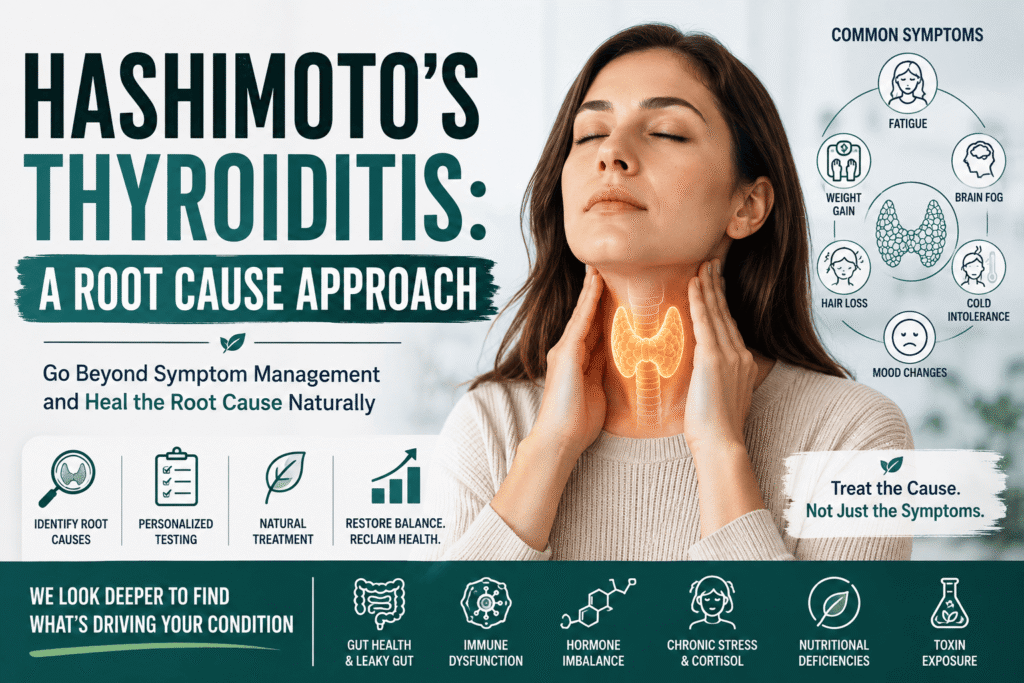
The familiar hypothyroid symptoms apply: fatigue, cold intolerance, weight change, constipation, dry skin, hair thinning, and cognitive slowing. Hashimoto’s adds some of its own:
- Symptom variability from week to week, driven by fluctuating immune activity
- Neck fullness or pressure, difficulty with high collars, or discomfort on swallowing
- Anxiety and palpitations during transient hormone-release phases
- Joint and muscle pain, which is common in autoimmune conditions generally
- Persistent symptoms despite normalised TSH, which is reported by a meaningful minority of treated patients
That last point deserves acknowledgement rather than dismissal. Studies comparing treated hypothyroid patients with matched controls have found differences in wellbeing scores even when biochemical targets are met. The reasons are not fully understood. Proposed explanations include individual variation in T4 to T3 conversion, coexisting nutrient deficiencies, other autoimmune conditions, and residual inflammation. None of these is proven as the answer, and it is reasonable for a clinician to keep investigating rather than conclude the matter is closed.
Why the Immune System Turns on the Thyroid
Autoimmunity generally requires a genetic predisposition plus environmental triggers plus a loss of immune tolerance. Nobody can change the first. The second and third are where clinical attention goes.
Genetic Susceptibility
Family history of thyroid or other autoimmune disease raises risk substantially. Specific HLA variants and genes such as CTLA-4 and PTPN22 are associated with autoimmune thyroid disease. Genetics load the gun; they do not by themselves fire it.
Iodine Intake at the Extremes
This one is counterintuitive. Iodine is required for thyroid hormone synthesis, but excess iodine is associated with increased thyroid autoimmunity, and populations show rising Hashimoto’s rates after aggressive iodine supplementation programmes. High-dose iodine supplements, kelp products, and some multivitamins can be a problem in people who are already antibody positive. Deficiency is also harmful. The target is adequacy, not maximisation.
Selenium Status
Selenium is a cofactor for glutathione peroxidase, which protects thyroid tissue from oxidative damage generated during hormone synthesis, and for the deiodinase enzymes that convert T4 to T3. Several randomised trials have found that selenium supplementation reduces TPO antibody levels in people with Hashimoto’s. What is less clear is whether that translates into improved thyroid function or fewer symptoms over the long run, and the trials are mostly small. Selenium is also toxic in excess, with a relatively narrow window, so dosing should not be improvised.
Vitamin D
Low vitamin D status is more prevalent in autoimmune thyroid disease, and vitamin D has established roles in regulating T cell activity. Whether correcting deficiency changes the disease course is not settled. Correcting a genuine deficiency is worthwhile regardless of the thyroid question.
Gut Health and Intestinal Permeability
There is a documented association between coeliac disease and autoimmune thyroid disease, strong enough that screening for coeliac is reasonable in newly diagnosed Hashimoto’s. Beyond coeliac, the broader relationship between intestinal barrier function and autoimmunity is an active research area with plausible mechanisms but limited high-quality clinical trial evidence in Hashimoto’s specifically. It is a reasonable thing to assess, and an unreasonable thing to promise results from. Our overview of what the evidence actually shows on leaky gut covers this honestly.
Chronic Stress
Sustained cortisol elevation influences immune regulation and shifts T4 conversion toward reverse T3. Many people can identify a period of significant stress preceding symptom onset. This is not a claim that stress causes Hashimoto’s; it is a recognised modulator worth addressing.
Infections and Other Exposures
Certain viral infections have been investigated as triggers, with Epstein-Barr virus receiving the most attention. Evidence remains associative. Smoking has a complex relationship with thyroid autoimmunity, and some environmental exposures have been implicated. None of these is established as a cause in individual patients.
What a Root Cause Approach Involves in Practice
1. Establish the Full Picture
Antibody levels, TSH, free T4, and free T3 together, plus ferritin, vitamin D, B12, and a coeliac screen. Ultrasound if there is neck fullness or a palpable abnormality. The point is to know what you are working with rather than to track one number. Our guide to the full thyroid panel explains what each marker adds.
2. Treat the Hormone Deficit When It Exists
If the thyroid is not producing adequate hormone, replacement is the treatment. There is no natural protocol that reliably regenerates destroyed thyroid tissue, and delaying appropriate replacement in the hope of avoiding medication causes real harm. Anyone selling you otherwise is not being straight with you.
What is worth discussing with your clinician is the specifics: dosing, timing, absorption, and whether a T4-only preparation is meeting your needs or whether combination therapy is appropriate in your case. The evidence on combination therapy is mixed, and guidelines differ, but the conversation is legitimate.
3. Address Nutrient Status
Correct measured deficiencies in ferritin, vitamin D, B12, and selenium. Avoid high-dose iodine unless there is documented deficiency. This is unglamorous and frequently the highest-yield intervention, particularly for fatigue and hair loss that persist after TSH normalises.
4. Consider Dietary Change Carefully
Gluten removal is the most discussed dietary intervention. If coeliac disease is present, it is mandatory. In non-coeliac Hashimoto’s, some small studies have reported reductions in antibody levels with gluten restriction, but the evidence base is thin and inconsistent. A structured trial with a defined endpoint is more useful than an indefinite elimination diet adopted on faith.
The autoimmune protocol diet has preliminary supportive data in inflammatory bowel disease and small pilot work in Hashimoto’s. It is restrictive, difficult to sustain, and carries nutritional risk if run long term without supervision. It can be a reasonable short-term diagnostic tool. It is not a lifelong prescription. Our article on the best diet for hypothyroidism covers the general principles.
5. Address Stress Physiology and Sleep
Not as a platitude, but as a measurable target. Sleep duration and quality, recovery between training sessions, and genuine reduction in sustained stress load all influence immune regulation and thyroid conversion.
6. Screen for Associated Conditions
Autoimmune conditions cluster. Coeliac disease, type 1 diabetes, pernicious anaemia, vitiligo, and adrenal insufficiency all occur at higher rates alongside Hashimoto’s. Symptoms that do not fit the thyroid picture deserve their own workup rather than being attributed to Hashimoto’s by default.
What to Be Sceptical Of
The Hashimoto’s space online contains a lot of confident claims that outrun the evidence. Be cautious about:
- Claims that any protocol reverses Hashimoto’s or regenerates the thyroid
- High-dose iodine protocols, which can worsen autoimmune thyroid disease
- Advice to stop prescribed thyroid medication in favour of supplements
- Expensive proprietary panels marketed as identifying root causes with no validated basis
- Indefinite restrictive diets adopted without a defined trial period and endpoint
A genuine root cause approach is more careful than the marketing version, not less.
Realistic Expectations
Antibody levels can fall, sometimes substantially, with nutrient correction and reduced inflammatory load. Symptoms frequently improve. What is not established is that antibody reduction reliably alters the long-term trajectory of thyroid failure, and it would be misleading to promise that it does.
The honest framing is this: appropriate hormone replacement handles the hormone deficit. Addressing immune and nutritional drivers gives you the best available chance of feeling well, of slowing progression, and of not accumulating additional autoimmune problems. That is a worthwhile goal even without a cure attached to it.
Frequently Asked Questions
Can Hashimoto’s be reversed naturally?
There is no established protocol that reverses Hashimoto’s or restores destroyed thyroid tissue. Antibody levels can decrease with interventions such as selenium repletion and, in some people, dietary change, and symptoms often improve. That is meaningfully different from reversal, and claims of a cure should be treated with scepticism.
Do I have to take thyroid medication if I have Hashimoto’s?
Not necessarily. If antibodies are present but thyroid hormone production is still adequate, monitoring may be appropriate rather than treatment. Once the gland cannot produce enough hormone, replacement is the standard of care and should not be delayed.
Should I stop eating gluten?
Get screened for coeliac disease first, and do that before removing gluten, since testing requires gluten in the diet to be accurate. If coeliac is present, strict avoidance is required. If not, a defined trial of several months with a clear endpoint is more useful than an open-ended elimination.
Is selenium safe to supplement?
At appropriate doses, generally yes, and there is trial evidence for antibody reduction. Selenium has a relatively narrow safety margin and excess intake causes toxicity, so dosing should be guided by a clinician rather than chosen from an internet protocol.
Why do I still feel unwell when my TSH is normal?
Several possibilities are worth working through: iron or vitamin D deficiency, inadequate T3, sleep disorder, another autoimmune condition, or a non-thyroid cause entirely. Persistent symptoms at target TSH warrant further investigation, not reassurance.
Working With Us
At Proactive Choice in Bend, Oregon, Dr. Drew Collins, ND, evaluates Hashimoto’s as an immune condition with a thyroid consequence, combining appropriate hormone management with assessment of nutrient status, gut function, and inflammatory drivers. You can read more about our thyroid work on the hypothyroidism care in Bend, OR page, and about broader immune support strategies.
Book a thyroid consultation with Proactive Choice for a complete assessment of your thyroid and immune picture.
This article is for general education and does not replace individual medical advice. Do not start, stop, or change thyroid medication without consulting your prescribing clinician.
For a broader look at this kind of care, see Hormone Doctor in Bend, OR.
Further reading
- Hashimoto's Disease, NIDDK (NIH). How this autoimmune condition damages the thyroid, who gets it, and how it is treated.
- Hashimoto's Thyroiditis, American Thyroid Association. TPO and thyroglobulin antibodies, symptoms, and when treatment is or is not needed.
- Hashimoto Thyroiditis – StatPearls, NCBI Bookshelf (NIH). A clinical review of causes, risk factors, diagnosis, and management of Hashimoto thyroiditis.
Want to talk this through for your own health? Book a visit with Dr. Drew Collins, ND at 601 NW Harmon Blvd in Bend, or call (858) 333-5196.