
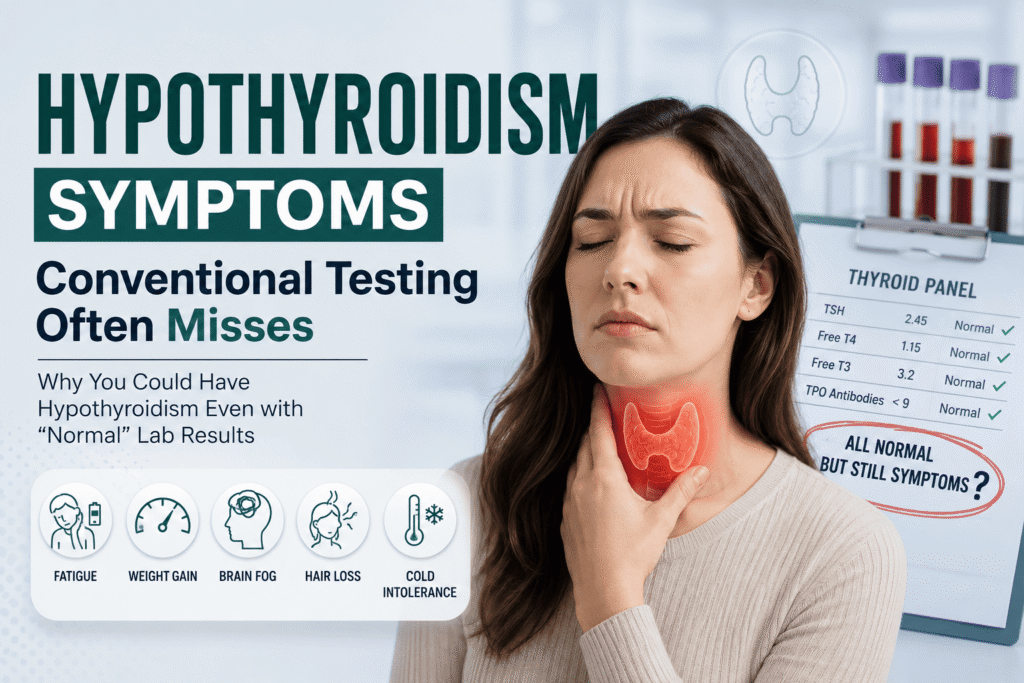
There is a specific kind of frustration that comes from being told your labs are normal when your body is telling you something else. You are exhausted in a way that sleep does not fix. Your hair is thinning. You are cold when nobody else is. And the report says one line: TSH within range.
This experience is common enough that it deserves a proper explanation rather than reassurance. Hypothyroidism symptoms do not always line up neatly with a single blood marker, and the way most primary care screening is structured means a meaningful number of people with genuine thyroid dysfunction get told nothing is wrong.
This article explains which hypothyroidism symptoms are most often overlooked, why standard screening misses them, and what a more complete evaluation involves. It is not an argument that conventional testing is useless. TSH is a genuinely good screening tool. The problem is that a screening tool and a diagnostic workup are two different things, and they are frequently treated as the same.
Why a Normal TSH Does Not Always Rule Out a Thyroid Problem
Thyroid stimulating hormone is made by the pituitary gland, not the thyroid. It is a signal, not a measurement of thyroid output. When the pituitary senses that circulating thyroid hormone is low, it raises TSH to push the thyroid harder. A high TSH therefore usually means an underactive thyroid.
That logic works well most of the time. It breaks down in several specific situations:
- Conversion problems. The thyroid mostly produces T4, a storage form. Tissues need T3, the active form, and conversion happens in the liver, gut, and peripheral tissue. If conversion is impaired, TSH and T4 can look acceptable while the tissue-level supply of active hormone is inadequate.
- Autoimmune activity before overt failure. Hashimoto’s thyroiditis can be present and symptomatic for years while TSH drifts around the upper end of normal. Antibodies are often the first thing to change and are not part of standard screening.
- Reference range versus optimal range. Population reference ranges are built from lab populations that include undiagnosed thyroid disease. A TSH of 4.2 sits inside many lab ranges, but a large share of people who feel well cluster considerably lower.
- Central hypothyroidism. Uncommon, but when the pituitary itself is underperforming, TSH can be normal or low while thyroid output is genuinely insufficient.
- Timing and medication effects. TSH follows a daily rhythm and is generally highest in the early morning. Biotin supplements, a common ingredient in hair and nail products, can also distort several thyroid assays.
None of this makes TSH a bad test. It makes it an incomplete one when someone is symptomatic.
Hypothyroidism Symptoms That Get Attributed to Something Else
The classic textbook picture, which is weight gain, cold intolerance, and fatigue, is well known. What follows are the presentations that more often get filed under stress, aging, depression, or perimenopause.
Fatigue That Sleep Does Not Resolve
Thyroid hormone sets the pace of cellular metabolism. When it is low, mitochondrial energy production slows across every tissue at once. The resulting fatigue has a particular quality: it is not sleepiness and it is not relieved by rest. People describe getting eight or nine hours and waking up feeling like they have not slept. Because it develops gradually, most people adjust their expectations rather than report it.
Cognitive Slowing and Word-Finding Difficulty
Brain fog is a vague term, but the thyroid version has recognisable features. Recall becomes effortful. You reach for a common word and it is not there. Reading the same paragraph three times becomes normal. In people over forty this is frequently attributed to hormonal transition or to aging, and in younger adults it is often attributed to stress or attention problems.
Hair Changes, Including the Outer Eyebrow
Thyroid hormone regulates the hair follicle growth cycle. When levels drop, a larger proportion of follicles shift out of the active growth phase at the same time, producing diffuse thinning across the whole scalp rather than a receding pattern. Thinning of the outer third of the eyebrows is a classic sign that is easy to notice once you know to look. Hair texture often changes too, becoming coarser, drier, or more brittle. We have covered this in depth in our guide to hypothyroidism and hair loss.
Constipation and Slow Digestion
Gut motility is thyroid-dependent. Low thyroid function slows transit time, which produces constipation, a sense of fullness long after eating, and bloating. Many people manage this with fibre and laxatives for years without anyone asking why motility slowed in the first place.
Cold Hands and Feet, and General Cold Intolerance
Reduced metabolic rate means less heat generated. People notice they need an extra layer when nobody else does, that their hands and feet stay cold indoors, or that they can no longer tolerate cold water. In Central Oregon, where winters are genuinely cold and a lot of life happens outdoors, this one tends to become obvious quickly.
Mood Changes and Low Motivation
Thyroid hormone influences serotonin and dopamine signalling. Low thyroid function can present as flat mood, reduced motivation, and anxiety. This overlaps so closely with depression that people are sometimes treated for years with antidepressants while the underlying thyroid picture goes unexamined. Thyroid screening is standard in a good depression workup for exactly this reason, though a TSH alone may not settle the question.
Menstrual Irregularity and Fertility Difficulty
Thyroid function interacts closely with the reproductive axis. Heavier or longer periods, shortened cycles, worsening premenstrual symptoms, and difficulty conceiving can all reflect thyroid involvement. Thyroid antibodies in particular have been associated with pregnancy loss even when TSH sits inside the reference range.
Musculoskeletal Symptoms
Muscle aches, cramping, stiffness in the morning, joint discomfort, and slower recovery after exercise are all documented features of low thyroid function. Carpal tunnel symptoms and plantar fasciitis that will not settle are worth mentioning to your provider as part of the wider picture.
Skin and Nail Changes
Skin becomes dry and rough, especially on the shins and elbows. Nails become brittle or develop ridges. Some people develop a yellowish tint to the palms because low thyroid function slows the conversion of beta-carotene into vitamin A.
Puffiness, Particularly Around the Eyes
Low thyroid function promotes accumulation of glycosaminoglycans in soft tissue, which holds water. The result is a puffy, slightly swollen appearance most obvious around the eyes and in the face on waking. It is often mistaken for poor sleep or salt intake.
Why Symptoms Alone Are Not Enough Either
It is worth being straightforward here. Every symptom on that list has other causes. Fatigue, low mood, cold hands, and brain fog are also produced by iron deficiency, sleep apnoea, low vitamin D, chronic stress, perimenopause, anaemia, blood sugar dysregulation, and several other conditions.
That is precisely the argument for better testing rather than for self-diagnosis. A symptom list generates a hypothesis. Laboratory work tests it. Anyone who tells you that symptoms alone are sufficient to diagnose thyroid disease, or that you should start thyroid hormone based on how you feel, is giving you bad advice. Thyroid hormone is a genuine medication with genuine risks when taken unnecessarily, including bone loss and cardiac arrhythmia.
What a More Complete Thyroid Evaluation Includes
A fuller workup measures the pathway at several points rather than at one. In practice that usually means:
| Marker | What it tells you |
|---|---|
| TSH | Pituitary signalling. The standard screening marker. |
| Free T4 | Circulating storage hormone available to tissues. |
| Free T3 | The metabolically active hormone. Reflects conversion, not just production. |
| Reverse T3 | An inactive metabolite. Can rise during illness, stress, or caloric restriction. |
| TPO antibodies | The main marker of autoimmune thyroid activity. |
| Thyroglobulin antibodies | A second autoimmune marker; sometimes positive when TPO is not. |
| Ferritin, vitamin D, B12 | Nutrient status that affects both thyroid function and symptom overlap. |
Antibodies matter more than most people realise. Autoimmune thyroid disease is the most common cause of hypothyroidism in iodine-sufficient countries, and antibodies often become detectable well before TSH moves. Knowing they are present changes the conversation from “wait and retest in a year” to “let us understand what is driving the immune activity.” Our article on what a full thyroid panel actually measures goes through each marker in more detail.
Subclinical Hypothyroidism: The Grey Zone
Subclinical hypothyroidism describes a raised TSH with normal free T4. Whether to treat it is genuinely debated in the medical literature, and it would be dishonest to present the question as settled.
Broadly, the evidence supports treatment more strongly when TSH is above 10, when thyroid antibodies are positive, when the person is pregnant or trying to conceive, and when symptoms are clearly present. It supports treatment less strongly in older adults with mild elevation and few symptoms, where several trials have found limited benefit. Reasonable clinicians weigh these factors differently. What matters is that the decision is made deliberately, with the full picture in front of you, rather than defaulted by a single number.
Factors That Influence Thyroid Function Beyond the Gland Itself
Thyroid hormone does not operate in isolation. Several inputs affect production, conversion, and tissue response:
- Nutrient status. Iodine, selenium, zinc, iron, and tyrosine all participate in thyroid hormone synthesis or conversion. Low ferritin in particular is common and frequently overlooked. Note that more iodine is not automatically better; excess iodine can worsen autoimmune thyroid disease.
- Chronic stress. Sustained cortisol elevation suppresses TSH output and shifts conversion toward reverse T3.
- Gut health. A portion of T4 to T3 conversion occurs in the gut, and intestinal inflammation is associated with autoimmune activity more broadly.
- Caloric restriction. Extended low-calorie dieting downregulates thyroid output as an adaptive response.
- Medications. Lithium, amiodarone, some immunotherapies, and high-dose biotin all affect thyroid function or thyroid testing.
Diet will not replace thyroid hormone when hormone is genuinely needed, but it does influence how well the system runs. Our guide to the best diet for hypothyroidism covers what the evidence supports and what it does not.
How to Approach the Conversation With Your Provider
If your symptoms have been dismissed once, walking in with a plan helps. A few practical steps:
- Write down your symptoms with rough start dates. Patterns over time are more persuasive than a list.
- Get copies of your actual lab values rather than accepting “normal.” The specific number matters.
- Ask directly whether free T3, free T4, and thyroid antibodies have ever been run.
- Have thyroid blood draws done in the morning and before taking any thyroid medication.
- Stop high-dose biotin supplements for several days before testing, since it can skew results.
- Ask what else on the differential is being considered, and how it will be ruled out.
Frequently Asked Questions
Can I have hypothyroidism with a normal TSH?
It is possible, though less common than the internet suggests. Central hypothyroidism, early autoimmune disease, and impaired T4 to T3 conversion can all produce symptoms alongside a TSH inside the reference range. This is why free T3, free T4, and antibodies are worth measuring when symptoms persist.
What TSH level is considered optimal?
Most laboratory reference ranges run roughly from 0.4 to 4.5 mIU/L. Many clinicians consider the lower half of that range more consistent with how people feel, but there is no universally agreed optimal number, and treatment decisions should never rest on TSH alone.
Do thyroid antibodies mean I will definitely develop hypothyroidism?
Not necessarily. Positive antibodies raise the likelihood of progressing to overt hypothyroidism over time, but many people with detectable antibodies maintain normal thyroid function for years. It is a reason for monitoring and for addressing modifiable factors, not a diagnosis in itself.
How long does it take to feel better after starting treatment?
Blood levels usually stabilise within about six weeks, which is why retesting is typically scheduled at that point. Symptom improvement often lags behind. Energy and mood tend to improve first, while hair and skin changes can take several months because those tissues turn over slowly.
Should I ask for a thyroid ultrasound?
Ultrasound is appropriate when there is a palpable nodule, goitre, or an abnormality found on examination. It is not a routine part of assessing thyroid function and does not replace blood work.
The Bottom Line
A single TSH result answers one question well. It does not answer every question. If you have persistent symptoms that fit the pattern described here, a fuller panel is a reasonable next step, and the results will either identify a treatable thyroid problem or clear the way to investigate something else. Both outcomes are useful.
At Proactive Choice in Bend, Oregon, Dr. Drew Collins, ND, evaluates thyroid symptoms with a complete panel rather than a single marker, and reviews the results alongside your history rather than in isolation. If you have been told your thyroid is fine and you are not, our hypothyroidism care in Bend, OR page explains how we approach it.
Book a full thyroid panel with Proactive Choice and get a complete picture rather than a partial one.
This article is for general education and is not a substitute for individual medical advice. Thyroid symptoms have many possible causes, and diagnosis requires assessment by a qualified clinician who can review your history and laboratory results directly.
For a broader look at this kind of care, see Hormone Doctor in Bend, OR.
Further reading
- Hypothyroidism (Underactive Thyroid), NIDDK (NIH). Symptoms, causes, diagnosis, and treatment of an underactive thyroid.
- Hypothyroidism, American Thyroid Association. Patient guide to hypothyroidism symptoms, causes, testing, and thyroid hormone treatment.
Want to talk this through for your own health? Book a visit with Dr. Drew Collins, ND at 601 NW Harmon Blvd in Bend, or call (858) 333-5196.