
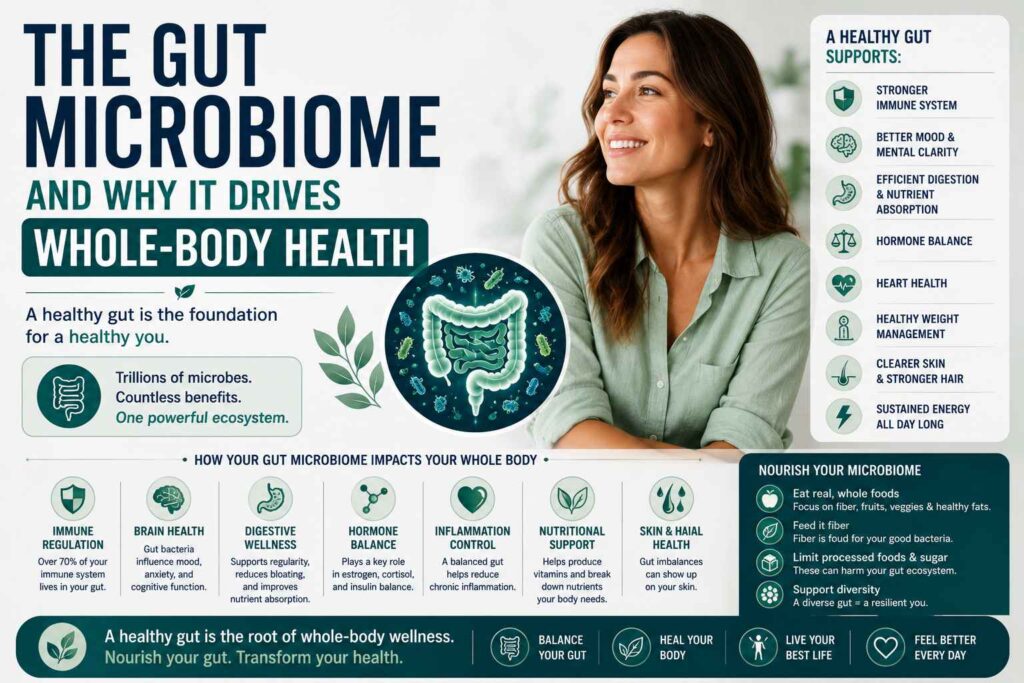
The gut microbiome has gone from an obscure research topic to a marketing category in about fifteen years. That speed has produced a strange situation: the underlying science is genuinely important, and a large share of what gets said about it is overstated.
This article aims to be useful rather than promotional. It covers what is well established about the microbiome’s influence on the rest of the body, what is plausible but not yet proven, what is being oversold, and what practical steps actually change gut composition and function.
What the Gut Microbiome Is
The human gut contains an enormous population of bacteria, along with archaea, fungi, and viruses. The bulk of them live in the colon, where conditions favour anaerobic fermentation. Collectively they carry many times more genes than the human genome, which is why the microbiome is sometimes described as a metabolic organ.
Composition is highly individual. Two healthy people can have substantially different bacterial profiles. This is one reason simplistic ideas about an ideal microbiome do not hold up: functional capacity appears to matter more than the specific species present.
The most important thing gut bacteria do for the rest of the body is fermentation. Dietary fibre and resistant starch reach the colon undigested, and bacteria ferment them into short-chain fatty acids, principally butyrate, propionate, and acetate.
Butyrate in particular is central. It is the preferred fuel for colonocytes, the cells lining the colon. It supports the integrity of the intestinal barrier. It has anti-inflammatory effects and influences regulatory T cell development. It affects gene expression through histone deacetylase inhibition. A great deal of what the microbiome does for whole-body health runs through short-chain fatty acid production, which is why fibre intake keeps appearing as the answer.
Where the Evidence Is Strongest
Immune Development and Regulation
Roughly seventy percent of immune tissue is located in and around the gut. The relationship between gut bacteria and immune function is among the best-established findings in the field.
Gut bacteria influence the development of regulatory T cells, which are central to distinguishing threat from harmless. Germ-free animals raised without any microbiome develop profoundly abnormal immune systems, and colonising them corrects much of it. Specific bacterial groups, including certain Clostridia, promote regulatory T cell development directly.
This mechanism underlies interest in the microbiome’s role in autoimmune and allergic conditions, and it is the most defensible part of the “gut health affects everything” claim.
Colonic Health and Barrier Function
Butyrate-producing bacteria maintain the intestinal barrier and the mucus layer that separates bacteria from epithelial cells. Depletion of these bacteria is consistently observed in inflammatory bowel disease. The direction of causation is not fully resolved in every case, but the association is robust.
Drug and Nutrient Metabolism
Gut bacteria metabolise medications, sometimes substantially altering their activity. The classic example involves the Parkinson’s medication levodopa, whose bioavailability is affected by bacterial metabolism. Bacteria also synthesise vitamin K and several B vitamins, and influence mineral absorption.
Response to Antibiotics
Antibiotics reduce microbial diversity, and recovery takes months. Some species do not return. Repeated courses have cumulative effects. This is well documented and is one of the clearest demonstrations that the microbiome can be meaningfully disrupted.
Where the Evidence Is Suggestive but Not Settled
The Gut-Brain Axis
Communication between gut and brain occurs through the vagus nerve, immune signalling, and bacterially produced or influenced metabolites. Gut bacteria influence the availability of tryptophan, the precursor to serotonin.
A frequently repeated claim needs correcting: it is often said that ninety percent of serotonin is made in the gut and that this explains gut-driven mood effects. The first part is roughly accurate. The second does not follow, because peripheral serotonin does not cross the blood-brain barrier. Gut serotonin primarily regulates motility. Any mood effect operates through other pathways.
Animal research in this area is striking, including studies where transferring microbiota alters behaviour. Human evidence is considerably weaker. Trials of probiotics for depression and anxiety show small and inconsistent effects. The mechanism is plausible and worth researching. It does not currently support confident claims about treating mood disorders through the gut. Our article on the gut-brain connection explores this further.
Metabolic Health
Microbiome composition differs between people with and without obesity and type 2 diabetes. Short-chain fatty acids influence appetite signalling and insulin sensitivity. Animal studies transferring microbiota between lean and obese mice produce weight changes.
Human evidence is much less clear-cut, and the causal direction is genuinely uncertain, since diet strongly shapes both microbiome and metabolic health simultaneously. Microbiome differences may be substantially a consequence of dietary patterns rather than an independent cause.
Hormone Metabolism
A subset of gut bacteria produce beta-glucuronidase, an enzyme that can deconjugate oestrogens that the liver has processed for excretion, allowing reabsorption. This collection of genes is sometimes called the oestrobolome, and it provides a plausible mechanism for gut influence on circulating oestrogen levels.
The mechanism is real. Its clinical significance in individual patients is not established, and it should not be presented as a validated explanation for hormonal symptoms. Our article on how gut health influences hormone balance covers what is and is not known.
Autoimmune Disease
Altered microbiome composition has been observed in rheumatoid arthritis, multiple sclerosis, type 1 diabetes, and autoimmune thyroid disease. Given the microbiome’s established role in immune regulation, a contributory role is plausible. Whether the changes cause disease, result from it, or both, is not resolved for most conditions.
What Actually Changes the Microbiome
Fibre Diversity, More Than Any Supplement
Different bacterial groups ferment different substrates. Eating a wide range of plant foods supports a wider range of bacteria than eating a large quantity of one fibre type.
The largest observational analysis in this area, from the American Gut Project, found that people eating more than thirty different plant types weekly had more diverse microbiomes than those eating ten or fewer. Plant types include vegetables, fruits, whole grains, legumes, nuts, seeds, herbs, and spices, so the target is more reachable than it sounds.
Particularly useful categories:
- Resistant starch, found in cooked and cooled potatoes, rice, and pasta, in green bananas, and in legumes. Preferentially fermented into butyrate.
- Inulin and fructans, in onions, garlic, leeks, asparagus, and chicory root
- Beta-glucans, in oats and barley
- Polyphenols, in berries, tea, coffee, cocoa, and olive oil, most of which reach the colon and are metabolised by bacteria
One caveat: someone with significant bloating, IBS, or suspected small intestinal bacterial overgrowth may react badly to a rapid increase in fermentable fibre. Increase gradually, and address the underlying issue first if symptoms are pronounced. Our article on SIBO symptoms, testing and treatment covers that situation.
Fermented Foods
A randomised trial from Stanford compared a high-fibre diet with a high fermented food diet and found that the fermented food arm increased microbial diversity and reduced inflammatory markers, while the fibre arm did not produce the same diversity effect over the study period. This was a small study and does not overturn the case for fibre, but it makes a reasonable argument for including both.
Relevant foods include yoghurt with live cultures, kefir, sauerkraut and kimchi that are refrigerated rather than shelf-stable, miso, tempeh, and kombucha.
Probiotic Supplements: A Measured View
Probiotics have reasonable evidence for specific, narrow indications: reducing antibiotic-associated diarrhoea, treating acute infectious diarrhoea in children, and reducing necrotising enterocolitis risk in preterm infants. Certain strains have modest evidence in IBS.
Evidence is weak for general wellness, for permanently altering microbiome composition, and for most conditions they are marketed for. Effects are strain-specific, and a product’s benefit does not transfer from one strain to another. Most probiotic organisms are transient and do not colonise.
They are not useless. They are considerably narrower in application than the market suggests.
Other Influences
- Antibiotics. Necessary when necessary, and worth avoiding when not.
- Sleep and circadian rhythm. Gut bacteria show daily oscillations, and disrupted sleep alters them.
- Exercise. Associated with greater microbial diversity, apparently independent of diet.
- Chronic stress. Alters gut motility, secretion, and barrier function through established pathways.
- Alcohol. Heavy intake reduces diversity and affects barrier function.
- Artificial sweeteners. Some evidence of effects on gut bacteria and glucose response, though findings are inconsistent and the clinical significance is unclear.
On Microbiome Testing
Stool testing is widely marketed, and honesty is warranted here.
Stool tests can reliably identify pathogens, parasites, and markers such as calprotectin, which indicates intestinal inflammation. These have genuine clinical use.
What they cannot currently do is tell you your optimal microbiome, diagnose most conditions from bacterial ratios, or generate a personalised supplement protocol with validated outcomes. Different testing platforms often produce different results from the same sample. There is no established reference standard for what a healthy microbiome looks like.
Testing can be informative as one input in a specific clinical situation, particularly where infection, inflammation, or malabsorption is suspected. It is not a general wellness screen, and results should be interpreted by a clinician alongside your symptoms rather than read as a report card.
Frequently Asked Questions
How long does it take to change the gut microbiome?
Composition begins shifting within days of a major dietary change, but those shifts are largely reversible when the old diet resumes. Durable change appears to require sustained dietary patterns over months. Recovery after antibiotics typically takes months, and is sometimes incomplete.
Are probiotics worth taking?
For specific indications, such as preventing antibiotic-associated diarrhoea or certain IBS symptoms with particular strains, yes. For general wellness there is little evidence. Effects are strain-specific, and most probiotic organisms pass through without colonising.
What is the single best food for gut health?
No single food matters as much as diversity. If one category deserves emphasis it is legumes, which provide fibre, resistant starch, and polyphenols together, and which most people eat far less of than they could.
Can the microbiome affect my mood?
Communication pathways between gut and brain are established, and the hypothesis is plausible. Human trial evidence for treating mood conditions through the microbiome is currently weak and inconsistent. It is an area to watch rather than to rely on.
Is a stool microbiome test worth doing?
It depends on the question. Testing for pathogens, parasites, or inflammatory markers has clear clinical value where symptoms warrant it. General microbiome profiling for wellness purposes lacks a validated reference standard and should be interpreted cautiously.
The Bottom Line
The microbiome genuinely influences immunity, barrier function, and metabolism, and it plausibly influences more than that. What follows from the evidence is unglamorous: eat a wide variety of plants, include fermented foods, use antibiotics only when needed, sleep and move consistently, and be sceptical of anything sold as a shortcut.
At Proactive Choice in Bend, Oregon, Dr. Drew Collins, ND, assesses gut function as part of a whole-system picture rather than in isolation. Learn more about our biome restoration protocol, our approach to immune support, or the full range of services from our naturopathic doctor in Bend, OR.
Book a GI MAP test with Proactive Choice if persistent digestive symptoms warrant a closer look.
This article is for general education and does not replace individual medical advice. Persistent digestive symptoms, unexplained weight loss, or blood in the stool should be evaluated promptly by a qualified clinician.
For a broader look at this kind of care, see Naturopathic Doctor in Bend, OR.
Further reading
- What Is Your Gut Microbiome?, Cleveland Clinic. How gut microbes support digestion, immunity, metabolism, and the gut-brain connection.
- The Microbiome, Harvard T.H. Chan School of Public Health. How fiber, prebiotic foods, and fermented foods shape the gut microbiome.
Want to talk this through for your own health? Book a visit with Dr. Drew Collins, ND at 601 NW Harmon Blvd in Bend, or call (858) 333-5196.