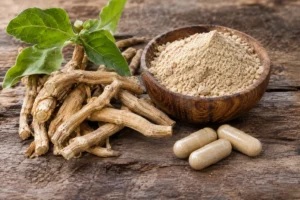
Is ashwagandha safe? For most healthy adults, short-term use of a root extract, up to about three months, looks reasonably safe in trials. It is not safe for everyone. Rare but serious liver injury has been reported, it can push thyroid levels up, and pregnant people and several other groups should avoid it entirely.
Quick answer: Ashwagandha is generally well tolerated for up to three months, with mild stomach upset and drowsiness the usual side effects. The NIH rates it a likely cause of rare liver injury, and Denmark banned it in supplements in 2023. Small trials suggest it can ease stress, lower cortisol and improve sleep. Skip it if you are pregnant, breastfeeding, have thyroid, liver or autoimmune disease, or have hormone-sensitive prostate cancer.
Is ashwagandha safe? What the safety record shows
Ashwagandha (Withania somnifera) is a shrub used in Ayurvedic medicine, and the supplements sold in the US are usually extracts of its root. The NIH Office of Dietary Supplements fact sheet, updated in May 2025, says it appears to be well tolerated for up to about three months. The side effects reported in trials are mostly mild: stomach upset, loose stools, nausea and drowsiness.
Three months matters. Almost every trial ran six to twelve weeks. The National Center for Complementary and Integrative Health says there is not enough information to draw conclusions about long-term safety, and that matters, because plenty of people take it daily for a year or more without anyone tracking what happens.
So the honest answer has two halves. For a healthy adult taking a root extract for a few weeks, the risk looks low. For someone with certain conditions or medications, or someone planning to take it indefinitely, the question is open, and in a few cases the answer is a clear no.
Product quality adds its own uncertainty. Supplements are not approved by the FDA before they go on sale, so the dose on the label and what is actually in the capsule can differ. Harvard Health suggests looking for a third-party testing seal from a group such as USP, NSF International or ConsumerLab.
Does ashwagandha cause liver damage?
It can, rarely. NIH’s LiverTox database gives ashwagandha a likelihood score of B, meaning a likely cause of clinically apparent liver injury.
The pattern is fairly consistent across reports. According to LiverTox:
- Injury usually shows up 2 to 12 weeks after starting the supplement
- The main signs are jaundice (yellow skin or eyes) and itching
- Most cases are mild to moderate and settle within 1 to 4 months of stopping
- Fatal cases have been described, mostly in people who already had liver disease or cirrhosis
How many cases are there? Lisa Forman, MD, a hepatologist at the University of Colorado, told CU Anschutz in May 2025 that more than 70 cases have been published, and that supplement-related liver injuries are likely underreported. She also said, plainly, that for the majority of people it is not harming the liver. Both statements are true at once.
The most detailed recent case series comes from Kerala, India. Philips and colleagues, writing in Hepatology Communications in 2023, reviewed 23 patients with suspected ashwagandha liver injury and kept the 8 who had taken single-ingredient products. Seven developed jaundice. Median time to symptoms was 41 days. Three died, and all three had pre-existing liver disease. The researchers tested five of the products and found no liver-toxic adulterants. Five samples is a small check, but it argues against the easy explanation that only contaminated bottles cause trouble.
Our take: if you have any liver condition, including fatty liver disease, ashwagandha is not worth the risk. If you are healthy and take it anyway, stop and get liver tests if your skin or eyes turn yellow or you start itching for no clear reason.
Who should not take ashwagandha?
The NIH fact sheet, NCCIH and Harvard Health largely agree on this list:
- People who are pregnant. Some experts advise against it because of reports linking it to miscarriage, and Denmark’s ban rested partly on that concern.
- People who are breastfeeding
- Anyone with a thyroid disorder or taking thyroid hormone
- People with autoimmune conditions
- Men with hormone-sensitive prostate cancer, because ashwagandha may raise testosterone
- Anyone scheduled for surgery, according to NCCIH
- People with existing liver disease, given where the severe cases have been concentrated
The thyroid caution has real data behind it. In a trial described by the NIH, 50 people with subclinical hypothyroidism took 600 mg a day for eight weeks, and their TSH fell while T3 and T4 rose. That sounds helpful until you are already on levothyroxine. Three case reports describe women aged 32 to 73 who developed thyrotoxicosis, an overactive thyroid state, while taking it. Their symptoms resolved after they stopped.
Medications are the other half of the list, and NCCIH says ashwagandha may interact with drugs for diabetes and high blood pressure, immunosuppressants, sedatives, anticonvulsants and thyroid hormone. If you take any of these, it is a conversation for your prescriber before the first capsule, not after.
Why European countries are restricting ashwagandha
Ashwagandha safety made headlines again this year because Europe keeps tightening the rules. The timeline, as reported by the NIH and the trade press:
- 2020: A risk assessment from the Technical University of Denmark found it could not set a safe intake level, citing possible effects on pregnancy, thyroid and sex hormones.
- 2023: Denmark banned ashwagandha in food supplements. Sweden, Finland and France opened their own reviews, according to NutraIngredients.
- 2024: France’s food safety agency, ANSES, recommended against use by pregnant and breastfeeding women and people with endocrine disorders. The UK Food Standards Agency opened a call for evidence.
- April 2026: Food Safety Magazine reported that the Dutch health ministry had told industry it intends to ban ashwagandha. No effective date was given.
Supplement companies push back hard, pointing to dozens of trials without serious harm. They are not wrong. Regulators, looking at the case reports, are not wrong either. Short trials of a few dozen people cannot detect a reaction that happens to one user in many thousands, and that gap is exactly where the disagreement between industry and regulators lives.
Does ashwagandha work?
Sometimes. The trials for stress and sleep are mostly positive and mostly short. For most other claims on the label, the evidence is thin. Harvard Health lists cognition, blood sugar, inflammation, joint health and menopause symptoms among uses with very limited research.
| Use | What the trials found | How much to trust it |
|---|---|---|
| Stress | Lower stress scores than placebo in most trials of 6 to 12 weeks | Moderate. Small, short studies, mostly in India |
| Anxiety | Lower anxiety scores in several trials; one guideline panel gives a provisional recommendation for generalized anxiety | Limited. NCCIH calls the evidence unclear |
| Cortisol | Lower blood or saliva cortisol than placebo in several trials | Moderate for the lab number, unclear what it means for health |
| Sleep | Small but significant benefit, larger in people with insomnia | Moderate. Five trials, 372 adults pooled |
| Long-term safety | Not studied past a few months | Unknown |
Sleep has some of the cleaner numbers. In a 2020 trial of 150 adults with sleep complaints, described in the NIH fact sheet, sleep quality improved by 72 percent with ashwagandha versus 29 percent with placebo over six weeks. A 2021 meta-analysis by Cheah and colleagues pooled five trials and called the benefit small but significant, with bigger effects in people with insomnia and with at least eight weeks of use.
Something to notice in the NIH tables: nearly every trial tested a specific branded extract, standardized differently and at doses from 120 mg to 1,250 mg a day. A result for one extract does not automatically carry over to another, or to a powder from a bulk bin.
Does ashwagandha help with anxiety?
Possibly, for mild anxiety and stress-related symptoms. It is not a substitute for treatment of an anxiety disorder.
The best summary is a 2021 systematic review by Lopresti and Smith, described by the NIH. It included 7 studies and 491 adults, all in India, lasting six to eight weeks. Ashwagandha lowered stress and anxiety scores more than placebo, and benefits looked larger at 500 to 600 mg a day. In 2022, a taskforce of the World Federation of Societies of Biological Psychiatry and the Canadian Network for Mood and Anxiety Treatments gave root extract a “provisional” recommendation for generalized anxiety disorder, which means promising but not proven.
Not every trial agrees. A 12-week study by Smith and colleagues in 2023, with 120 adults in their mid-50s, found no reduction in perceived stress compared with placebo, though fatigue did improve. It is one of the longer and larger trials in the NIH summary. We find that result more informative than another six-week positive study, and it gets far less attention.
Harvard Health also notes that some people feel more stimulated or anxious on it. If anxiety is getting worse, stop and talk to someone. If you are having thoughts of harming yourself, call or text 988 to reach the 988 Suicide and Crisis Lifeline at any hour.
Does ashwagandha lower cortisol?
In trials, yes. In a 2012 study by Chandrasekhar and colleagues, 64 adults with chronic stress took 300 mg of root extract twice a day or placebo for 60 days. Serum cortisol fell substantially more in the ashwagandha group, and stress scores dropped on every scale used. A 2021 trial of 130 adults by Gopukumar and colleagues also found lower serum cortisol after 90 days, according to the NIH.
One detail is odd. In a 2022 Florida trial by Remenapp and colleagues, 60 adults took either 225 mg or 400 mg a day for 30 days. Both doses improved stress scores, but only the lower dose lowered saliva cortisol. Small studies throw up results like that. It may mean nothing. It may mean cortisol is a noisy thing to measure.
We would add one caution of our own. “Lowering cortisol” has become a selling point online, but cortisol is a hormone you need, and a single morning value in a trial says little about how your stress response works across a day. Unless testing shows a real problem, cortisol is not something we would try to push down with a supplement. Feeling less stressed is the goal. Whether a lower number on a lab slip gets you there is less clear than the marketing suggests.
Supplements are also only one way to work on stress. Sleep, movement, breathing practice and time with people all have their own evidence, and we go through several holistic ways to manage stress in a separate post. The question we often hear next is does acupuncture work, and a separate post covers what that research shows.
Myth: Ashwagandha is an herb, so it is safe for everyone.
Fact: NIH’s LiverTox rates it a likely cause of rare liver injury, and it can raise thyroid hormone levels. Several groups, including pregnant people, are advised to avoid it.
Myth: Liver problems only happen with contaminated products.
Fact: In the 2023 Hepatology Communications case series, five tested products contained no liver-toxic adulterants.
Myth: If a little works, taking it for years is fine.
Fact: Most trials lasted 6 to 12 weeks. NCCIH says long-term safety has not been established.
If you are thinking about trying it
Start with whether you are in one of the groups above. If you are, the decision is made. If you are not, a few practical points from the sources we read:
- Most trials tested root extracts. India’s Ministry of Ayush advised manufacturers in 2021 to stop using ashwagandha leaves.
- Third-party testing seals check what is in the bottle. They say nothing about whether it suits you.
- Treat it as a short trial with an end date, since that is how it was studied.
- Know the warning signs: yellow skin or eyes, itching, or new symptoms of an overactive thyroid such as a racing heart or unexplained weight loss.
And if you are taking it because you feel run down, it is worth asking why first. Stress, poor sleep, low thyroid function and anemia can all feel similar from the inside, and an herb will not sort out which one you have.
Frequently asked questions
Is it safe to take ashwagandha every day?
Daily use for up to about three months appears well tolerated in healthy adults, according to the NIH Office of Dietary Supplements. Almost all trials lasted 6 to 12 weeks, and NCCIH says long-term safety is not established. Daily use for many months or years is effectively untested. If you want to keep taking it beyond a few months, discuss it with a clinician who knows your medications and health history.
What are the signs ashwagandha is hurting your liver?
The most common signs in published cases are jaundice, a yellowing of the skin or the whites of the eyes, and itching. According to NIH’s LiverTox, injury usually appears 2 to 12 weeks after starting. If you notice these signs, stop the supplement and ask for liver blood tests, and tell the clinician you were taking ashwagandha. Most cases improve within 1 to 4 months of stopping.
Can you take ashwagandha with thyroid medication?
Not without your prescriber’s input. NCCIH advises people with thyroid disorders against using it and says it may interact with thyroid hormone medication. In one trial, 600 mg a day for eight weeks raised T3 and T4 levels in people with subclinical hypothyroidism, and three case reports describe thyrotoxicosis in women taking it. Adding it to levothyroxine could push your levels too high.
Why did Denmark ban ashwagandha?
Denmark banned ashwagandha in food supplements in 2023 after a 2020 risk assessment by the Technical University of Denmark. The assessment could not establish a safe intake level and raised concerns about possible effects on pregnancy, including miscarriage, and on thyroid and sex hormones. France’s ANSES issued warnings for certain groups in 2024, and the Netherlands has signaled a ban.
How long does ashwagandha take to work for stress?
Most trials measured results after 30 to 90 days. The 2021 review described by the NIH covered studies of six to eight weeks, and a 2021 sleep meta-analysis found bigger effects after at least eight weeks. That does not mean everyone responds. One 12-week trial in 2023 found no difference from placebo for perceived stress. If nothing has changed after two months, it probably is not working for you.
If you are weighing an herb like ashwagandha against your own health history and medications, it helps to have someone check the fit first. Dr. Drew Collins, ND, at Proactive Choice reviews your health history and current medications, and explains possible interactions, before recommending any herb, and you can read how that works on our page about herbal medicine in Bend. To talk it through, book a free 15-minute call at +1 (858) 333-5196.
Sources
- NIH Office of Dietary Supplements. Ashwagandha: Fact Sheet for Health Professionals (updated May 2025).
- National Center for Complementary and Integrative Health. Ashwagandha.
- LiverTox: Clinical and Research Information on Drug-Induced Liver Injury. Ashwagandha. National Institute of Diabetes and Digestive and Kidney Diseases.
- Philips CA, et al. Ashwagandha-induced liver injury: a case series from India and literature review. Hepatology Communications, 2023.
- University of Colorado Anschutz Medical Campus. Ashwagandha and liver health (interview with Lisa Forman, MD), May 2025.
- Chandrasekhar K, Kapoor J, Anishetty S. A prospective, randomized double-blind, placebo-controlled study of safety and efficacy of a high-concentration full-spectrum extract of ashwagandha root in reducing stress and anxiety in adults. Indian Journal of Psychological Medicine, 2012.
- Harvard Health Publishing. Ashwagandha: Benefits, side effects, and safety concerns.
- NutraIngredients. Timeline: Will authorities de-throne the king of herbs? July 2026.
- Food Safety Magazine. Netherlands set to ban ashwagandha. April 2026.
- 988 Suicide and Crisis Lifeline.
Medically reviewed content from Proactive Choice. This article is for education and is not a diagnosis. Talk with a licensed clinician about your own symptoms and treatment options.
Want to talk this through for your own health? Book a visit with Dr. Drew Collins, ND at 601 NW Harmon Blvd in Bend, or call (858) 333-5196.