
You are losing more hair than you should be. It is not dramatic all at once. It is the kind of gradual, creeping change that shows up in your brush, in the shower drain, and eventually in the mirror. If you have hypothyroidism, or even if you suspect your thyroid is underperforming but your doctor told you your labs look fine, this connection is one that deserves serious attention.
The relationship between hypothyroidism hair loss and thyroid function runs deeper than most people realize, and fixing it takes more than just adjusting a medication dose. Here is what is actually happening in your body and six natural approaches that address the root of the problem.
The Hair Loss Nobody Warned You About When You Got Your Thyroid Diagnosis
Most people get a hypothyroidism diagnosis and expect to feel better once they start medication. What they do not always expect is that their hair keeps falling out anyway, sometimes for months after treatment begins. Some people notice hair thinning before any other thyroid symptom appears and spend years chasing a dermatological solution to what is fundamentally a hormonal problem.
This delay in connecting the dots costs people years of unnecessary frustration. Hair follicles are among the most metabolically sensitive structures in the human body. When the thyroid is not producing adequate hormones, hair follicles are among the first places that deficit shows up, and among the slowest to recover once the problem is addressed. Understanding why gives you a real roadmap for fixing it.
Why Hypothyroidism Causes Hair Loss in the First Place
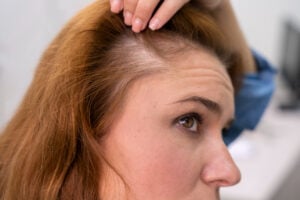
The Thyroid’s Direct Role in the Hair Growth Cycle
Every hair on your head goes through a cycle with three distinct phases: anagen, the active growth phase that lasts two to six years; catagen, a brief transitional phase; and telogen, the resting phase that ends when the hair sheds and a new one begins to grow. Under healthy thyroid function, the majority of your follicles are in anagen at any given time, actively producing hair. The minority are resting.
Thyroid hormones, specifically triiodothyronine (T3) and thyroxine (T4), directly regulate anagen duration and the cycling behavior of hair follicles. They act on receptors within the follicle itself, influencing how long the follicle stays in the growth phase before transitioning to rest. When thyroid hormone levels drop, follicles shift out of anagen prematurely and into the resting phase, triggering what is called telogen effluvium. Instead of the normal 10 to 15 percent of follicles in telogen at any moment, a much larger percentage enter rest simultaneously. The visible result is diffuse shedding across the entire scalp, often described as the hair coming out in handfuls.
How Slow Metabolism Starves Your Hair Follicles
Thyroid hormones govern metabolic rate in every cell in the body. When thyroid output drops, metabolism slows at the cellular level everywhere, including inside hair follicles. Follicles are energy-hungry structures. They are among the most rapidly dividing cells in the human body during the growth phase, which means they require a substantial and consistent energy supply to maintain that activity.
When cellular metabolism slows, follicles receive less energy, less oxygen, and fewer nutrients through reduced circulatory efficiency. It is like trying to run a high-performance engine on half the fuel it needs. The follicle does not shut down completely. It just downshifts into a lower gear, producing thinner, shorter, weaker hairs, or stopping production entirely until metabolic conditions improve.
Why Standard Thyroid Treatment Does Not Always Fix the Hair Problem
Here is something that frustrates a lot of patients. You start levothyroxine, your TSH normalizes on your lab report, your doctor says your thyroid is fine now, but your hair is still shedding. How is that possible?
The answer lies in what standard thyroid treatment does and does not address. Levothyroxine replaces T4, the storage form of thyroid hormone. But T4 must be converted to T3, the active form that cells actually use, including hair follicle cells. That conversion happens primarily in the liver, gut, and peripheral tissues and depends on a cascade of cofactors including selenium, zinc, iron, and optimal gut function. If any part of that conversion pathway is compromised, T4 levels may look fine on paper while T3 at the tissue level remains inadequate. Hair follicles keep receiving insufficient thyroid signal even while the lab values appear reassuring.
This is one of the central reasons why comprehensive thyroid evaluation and naturopathic support produces different outcomes than medication management alone.
Recognizing Thyroid Hair Loss vs. Other Types of Shedding
Pattern and Distribution: What Thyroid Hair Loss Actually Looks Like
Not all hair loss is the same, and distinguishing thyroid hair loss from androgenetic alopecia, alopecia areata, or nutritional deficiency shedding matters for choosing the right approach. Thyroid-related hair loss is characteristically diffuse. It affects the entire scalp rather than following a receding hairline or patterned thinning at the crown. The hair does not thin in one specific zone. The overall density decreases across the whole head.
Patients often describe looking in the mirror and feeling like their hair looks thinner even though they cannot point to one specific area where it is obviously gone. The parting appears wider. Ponytails feel thinner. Hats feel looser. This global, even reduction in density is a hallmark of thyroid-related shedding and differs meaningfully from the patterned loss driven by androgens.
The Outer Eyebrow Sign and Other Overlooked Clues
One of the most clinically useful signs of hypothyroidism is thinning of the outer third of the eyebrows. Hair follicles in that region are particularly sensitive to thyroid hormone levels, and their loss is often an early sign of underactive thyroid function that appears before widespread scalp shedding becomes noticeable. If your eyebrows have thinned at the outer edges and you never thought to connect that to your thyroid, it is worth mentioning to your provider.
Body hair thinning, leg hair becoming sparser, eyelash loss, and dry, brittle hair texture that breaks rather than sheds from the root are additional thyroid-connected signs that point toward the same underlying insufficiency.
When to Suspect Something Else Is Going On Alongside Thyroid Dysfunction
Thyroid dysfunction rarely occurs in isolation in patients with persistent hair loss. Low ferritin, vitamin D deficiency, elevated androgens, chronic stress, gut malabsorption, and autoimmune activity often coexist with hypothyroidism and each independently contributes to hair shedding. Treating the thyroid while leaving these other drivers unaddressed produces partial results at best. A complete picture requires looking at all of them simultaneously.
6 Natural Solutions for Hypothyroidism Hair Loss
Solution 1: Optimize Your Full Thyroid Panel, Not Just TSH
The single most important step is getting a complete thyroid evaluation rather than relying on TSH alone. A meaningful panel includes TSH, Free T3, Free T4, Reverse T3, and thyroid antibodies including TPO and anti-thyroglobulin. Free T3 tells you what active thyroid hormone is actually reaching your cells. Reverse T3 shows whether T4 is being converted efficiently or being shunted toward an inactive form. Thyroid antibodies identify autoimmune thyroid disease, which requires a different management approach than simple hypothyroidism.
Many patients discover through comprehensive testing that their TSH is technically within the reference range while their Free T3 is in the lower portion of that range and their Reverse T3 is elevated, a pattern associated with poor cellular thyroid activity despite seemingly adequate hormone levels. This is the clinical gap where most hair loss goes unexplained and untreated.
Solution 2: Address the Nutrients Your Thyroid and Hair Both Depend On
Several nutrients sit at the intersection of thyroid function and hair growth, meaning their deficiency damages both simultaneously. Selenium is required for the enzyme that converts T4 to T3 and protects thyroid tissue from oxidative damage. Zinc supports thyroid hormone receptor function and is necessary for healthy follicle cycling. Iodine is the raw material from which thyroid hormones are built, though excess iodine in the context of autoimmune thyroid disease can worsen inflammation. Vitamin D operates as a hormone throughout the body, influencing both thyroid autoimmunity and hair follicle cycling.
Targeted supplementation based on actual lab values rather than a one-size-fits-all protocol makes a meaningful difference. Supplementing nutrients you are not deficient in provides little benefit, while addressing genuine deficiencies can unlock improvements that nothing else will produce.
Solution 3: Use Herbal Medicine to Support Thyroid Function Naturally
Botanical medicine offers some of the most clinically valuable tools for thyroid support, with a long history of use and a growing evidence base. Ashwagandha, an adaptogenic herb with well-documented thyroid-supporting properties, has been shown in clinical trials to modestly increase T3 and T4 levels while reducing cortisol, which directly suppresses thyroid function. Guggul extract supports the conversion of T4 to T3 through its influence on deiodinase enzyme activity. Bladderwrack, a sea vegetable, provides natural iodine in a bioavailable form and has traditional use in thyroid support, though it requires careful dosing in autoimmune thyroid conditions.
At Proactive Choice, herbal medicine in Bend is integrated into thyroid care protocols with the same clinical rigor applied to other treatment tools. The goal is not to replace conventional thyroid management where it is needed but to address the gaps in thyroid function that medication alone does not fill and to support the conversion, receptor sensitivity, and inflammatory modulation that determine how well your cells actually respond to thyroid hormone.
Solution 4: Fix Your Iron and Ferritin Levels
This single intervention resolves a surprising number of cases where hair loss persists despite apparently adequate thyroid treatment. Ferritin, the body’s iron storage protein, is required for proper thyroid hormone synthesis and also serves as a cofactor for the enzymes that regulate hair follicle cycling. Serum ferritin below 70 nanograms per milliliter is associated with impaired hair growth even in the absence of frank iron deficiency anemia.
Many patients, particularly premenopausal women with heavy periods, have ferritin levels in the 15 to 30 range, which their doctor categorizes as technically normal but which represents genuine insufficiency for hair follicle function. Replenishing ferritin stores through dietary optimization, targeted iron supplementation, or in some cases IV iron therapy can produce visible improvements in hair density over three to six months as follicles recover the resources they need to cycle normally.
Solution 5: Reduce the Inflammatory Load That Suppresses Thyroid Activity
Chronic systemic inflammation suppresses the HPT axis, reduces TSH pulsatility, decreases T4 to T3 conversion efficiency, and increases Reverse T3 production. In other words, inflammation does to thyroid function exactly what hypothyroidism does, and the two compound each other in a downward spiral that keeps both the thyroid and the hair follicles underperforming.
Dietary anti-inflammatory strategies, including reducing or eliminating gluten in Hashimoto’s thyroiditis, optimizing omega-3 to omega-6 fatty acid ratios, reducing ultra-processed food intake, and supporting gut integrity, all meaningfully reduce the inflammatory burden on the thyroid system. This is not generic wellness advice. These are specific interventions with direct relevance to thyroid conversion efficiency and autoimmune thyroid activity.
Solution 6: Support Your Adrenal Glands to Protect Thyroid Conversion
Cortisol, the primary adrenal stress hormone, directly inhibits T4 to T3 conversion and increases Reverse T3 production. Chronically elevated cortisol from ongoing psychological stress, poor sleep, blood sugar instability, or overtraining creates a hormonal environment that suppresses thyroid activity at the peripheral level even when the thyroid gland itself is producing adequate T4.
Adaptogenic herbs including rhodiola, eleuthero, and ashwagandha support adrenal resilience and help normalize cortisol rhythm. Sleep optimization protects the overnight cortisol reset that is essential for healthy HPA axis function. Blood sugar stability throughout the day reduces the cortisol spikes associated with hypoglycemic dips. Supporting adrenal health is not a separate track from thyroid care. It is part of the same interconnected hormonal conversation.
Why Doing These Together Works Better Than Any Single Approach
Each of these six solutions addresses a different contributing mechanism. Thyroid optimization fixes the hormone signal. Nutrient repletion provides the cofactors for conversion and follicle function. Herbal support bridges the conversion gap. Iron rebuilds ferritin reserves. Inflammation reduction removes a systemic suppressor. Adrenal support protects peripheral thyroid conversion. Any one of these alone may produce modest improvement. Together, they address the full architecture of why thyroid-related hair loss happens and give the follicles everything they need to resume healthy cycling.
When Natural Solutions Need Clinical Support
The Role of Naturopathic Thyroid Care in Hair Recovery

For some patients, natural solutions implemented consistently over three to six months produce meaningful hair recovery without any change to their thyroid medication. For others, the degree of thyroid insufficiency, the presence of Hashimoto’s autoimmunity, or the severity of conversion impairment means that naturopathic support alone needs to be combined with properly calibrated thyroid medication to achieve adequate hormone levels at the tissue level.
A naturopathic approach to thyroid care works alongside conventional management rather than in opposition to it. The goal is to create the hormonal and metabolic conditions where treatment works as well as it possibly can and where the body’s own capacity to produce and respond to thyroid hormone is supported as fully as possible.
What Comprehensive Thyroid Testing Actually Reveals
In clinical practice at Proactive Choice, comprehensive thyroid evaluation consistently reveals patterns that standard TSH-only monitoring misses. Elevated Reverse T3 in patients on levothyroxine who still feel hypothyroid explains symptoms that medication adjustment alone does not resolve. High TPO antibodies in patients never diagnosed with Hashimoto’s explain why their thyroid function continues to decline despite treatment. Low Free T3 in patients with normal TSH explains why their hair keeps shedding, their fatigue persists, and their metabolism stays slow regardless of what the lab report says is normal.
This is the difference between managing a lab value and actually treating a patient.
A Note on How This Article Was Created
This article was created to help people dealing with thyroid-related hair loss understand what is happening in their body and what evidence-informed options exist beyond the standard prescription and wait approach. The clinical perspectives throughout reflect Dr. Drew Collins’ direct patient care experience working with thyroid dysfunction over more than four decades of naturopathic practice. This content is educational and does not substitute for an individualized clinical evaluation. For guidance specific to your thyroid health and hair loss, a direct consultation with Dr. Collins or another qualified practitioner is the appropriate next step.
Conclusion
Hypothyroidism hair loss is not a cosmetic side effect you just have to live with. It is a signal from your body that something in the thyroid hormone system is not working properly, and it deserves the same clinical attention as any other thyroid symptom. The six natural solutions outlined here address the most common mechanisms driving hair loss in thyroid patients, from conversion efficiency and nutrient status to inflammation and adrenal function, and together they create the conditions where real recovery is possible.
Getting your hair back takes time. Follicles that have been in a resting state for months do not spring back overnight. But with the right clinical support, the right testing, and a protocol that addresses the full picture of what is suppressing your thyroid and your follicles, most people see meaningful improvement within three to six months and significant recovery within a year.
If you have been managing thyroid disease and still losing hair, the answer is not to accept it. It is to look deeper.
Frequently Asked Questions
How long does it take for hair to grow back after hypothyroidism is treated?
Hair recovery after addressing hypothyroidism is one of the slower wins in thyroid treatment. Even once thyroid hormone levels are optimized, follicles that have been in the resting phase need to complete a full growth cycle before new hair is visibly apparent. Most patients begin noticing reduced shedding within two to three months of proper thyroid optimization and see meaningful density improvement within six to twelve months. Addressing contributing factors like ferritin deficiency, nutrient depletion, and inflammation alongside thyroid treatment accelerates the timeline significantly.
Can my thyroid cause hair loss even if my TSH is normal?
Yes, and this is one of the most clinically important points in this article. A normal TSH tells you that the pituitary is not detecting severe thyroid insufficiency, but it says nothing about Free T3 levels at the tissue level, Reverse T3 elevation blocking thyroid receptors, or autoimmune activity quietly damaging the thyroid gland. Many patients with persistent hair loss and a normal TSH have significant thyroid dysfunction when a complete panel is evaluated. Standard TSH testing alone misses a meaningful proportion of the patients whose hair loss has a thyroid root cause.
Is Hashimoto’s thyroiditis a common cause of hair loss, and how is it managed differently?
Hashimoto’s is the most common cause of hypothyroidism in developed countries and is an autoimmune condition in which the immune system attacks thyroid tissue. It absolutely causes hair loss through the same thyroid hormone insufficiency mechanism, but it also adds an autoimmune inflammatory component that needs to be addressed specifically. Gluten elimination has meaningful evidence in Hashimoto’s for reducing TPO antibody levels. Selenium supplementation reduces autoimmune thyroid inflammation. Gut health optimization is directly relevant to autoimmune thyroid activity. Managing Hashimoto’s requires addressing the immune dysregulation driving the disease, not just replacing the hormone output the gland is losing.
Does thyroid medication help with hair loss, and why might it not be working for me?
Thyroid medication helps when it successfully restores adequate Free T3 levels at the tissue level. For many patients on levothyroxine (T4 only), conversion to active T3 remains suboptimal due to nutrient deficiencies, high Reverse T3, or gut absorption issues, and hair loss continues despite medication. Adding T3 directly through combination T4/T3 therapy or natural desiccated thyroid in some cases, alongside nutritional support for conversion, often produces better hair outcomes than T4 alone. This is a clinical conversation that requires comprehensive testing and individual assessment to navigate well.
Can I use minoxidil or other hair loss treatments alongside thyroid treatment?
Minoxidil is compatible with thyroid treatment and can help support follicular blood flow and extend the growth phase of affected follicles while thyroid optimization is underway. It works through a different mechanism than thyroid hormone, so the two approaches complement rather than interfere with each other. That said, minoxidil addresses the symptom rather than the cause, and it works best as a supportive bridge during the months it takes for thyroid optimization to produce its full effect on follicle cycling rather than as a long-term standalone solution. The goal is always to restore the conditions in which follicles can function normally on their own.
For a broader look at this kind of care, see Hormone Doctor in Bend, OR.
Further reading
- Is My Thyroid Condition To Blame for My Hair Loss?, Cleveland Clinic. Explains thyroid-related hair shedding, how it looks, and why it usually reverses with treatment.
- Hypothyroidism (Underactive Thyroid), NIDDK (NIH). NIH overview of hypothyroidism symptoms, including dry, thinning hair, plus causes and treatment.
Want to talk this through for your own health? Book a visit with Dr. Drew Collins, ND at 601 NW Harmon Blvd in Bend, or call (858) 333-5196.