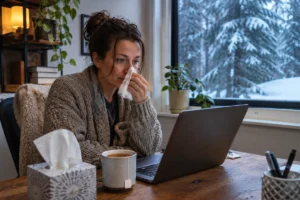
Why do I keep getting sick? For most adults it comes down to heavy exposure to germs plus things that blunt the immune response: short sleep, long-running stress, low iron, unsteady blood sugar, heavy drinking and too little movement. Two or three colds a year is normal. Frequent serious infections are not.
Quick answer: The CDC says adults average two to three colds a year. If you get more, the usual causes are exposure (kids, crowded rooms, unwashed hands), sleeping under six hours, chronic stress lasting a month or more, iron deficiency, high or unstable blood sugar and heavy drinking. Vitamin D pills help less than once thought. Repeated pneumonia, sinus infections or antibiotics that do not work call for an immune workup.

Why am I always sick, or does it just feel that way?
Start with the baseline, because it is higher than most people think. According to the CDC’s common cold page, adults in the United States average two to three colds a year, and children often have more. A cold usually lasts less than a week, with symptoms peaking two or three days in.
Winter stacks the odds. Dr. Melanie Raffoul, chief medical officer of Yale New Haven Health Urgent Care, told NBC Connecticut in January 2026 that repeat illness is “all about exposures,” and that in winter “the volume of these viruses goes up and we’re not often in greatly well-ventilated spaces.” She also noted that one infection can open the door to a bacterial one on top of it.
Our honest view: if you have young kids at home and catch three or four colds between November and March, your immune system is probably doing its job under heavy fire. If you are getting sick every few weeks, recovering slowly, or landing on antibiotics more than once a year, something else may be going on, and that is worth looking into.
8 reasons you keep getting sick
These are the causes with the clearest evidence, roughly in the order we would look at them. The first three decide how much virus reaches you and how ready your defenses are. The rest can turn up on a blood test or in a frank conversation.
| Reason | What the research found | What to check |
|---|---|---|
| 1. Heavy exposure | Community handwashing education cut colds and other respiratory illness 16 to 21 percent (CDC) | Kids in daycare or school, shared offices, frequent flights |
| 2. Short sleep | People sleeping six hours or less were about 4.2 times as likely to catch a cold after virus exposure | Hours actually asleep, snoring, waking unrefreshed |
| 3. Chronic stress | Severe stress lasting a month or more roughly doubled cold risk; short stressful events did not | Job loss, ongoing conflict at home or with friends |
| 4. Low vitamin D | A 2017 analysis found benefit, mostly in people who were very low; a 2025 update of 61,589 people found no significant effect overall | 25-hydroxy vitamin D blood level |
| 5. Iron deficiency | People with iron deficiency anemia are less able to fight off infections (NIH) | Heavy periods, plant-only diet, gut conditions, frequent blood donation |
| 6. High or unsteady blood sugar | Even prediabetes carried a 35 percent higher risk of infections treated by a family doctor | Fasting glucose, A1c |
| 7. Heavy drinking | One heavy session slows infection defenses for up to 24 hours (NIAAA) | Drinks per week, binge nights |
| 8. Too little movement | Adults doing aerobic exercise five or more days a week had 43 percent fewer days with colds | Active days per week |
Exposure is the boring answer and often the right one. The CDC’s handwashing data estimate that handwashing prevents about 20 percent of respiratory infections. That leaves most colds untouched. Hands are only one route in.
Sleep is the one people underrate. In a study led by Aric Prather at UC San Francisco, published in the journal Sleep in 2015, 164 healthy volunteers had their sleep tracked and were then given cold virus through nasal drops. Those sleeping six hours or less a night were about 4.2 times as likely to come down with a cold as those sleeping more than seven. Under five hours, the figure was about 4.5. Short sleep predicted colds better than age, stress or smoking did.
Can you get sick from stress?
Not from stress alone. You still need to meet a virus, but stress changes the odds once you do, and the best evidence comes from the lab of Sheldon Cohen at Carnegie Mellon, which has spent decades dripping cold viruses into volunteers’ noses and watching who falls ill.
The detail that matters is how long the stress lasts. In a 1998 study in Health Psychology, Cohen’s team interviewed 276 healthy adults about their lives, then quarantined them and exposed them to a cold virus. Stressful events lasting under a month did not raise the risk. Severe chronic stressors lasting a month or longer raised the odds about 2.2-fold, and the odds were higher still (about 2.9-fold) for stress lasting three months. Two kinds stood out: work problems, mainly unemployment or underemployment, and ongoing conflict with family or friends.
That fits what most people notice. A rough week before a deadline rarely knocks you out. A winter of money worries or a marriage that is coming apart is a different story.
Can stress weaken your immune system?
Yes, and researchers now have a fairly specific idea of how. Cortisol, the main stress hormone, normally acts as a brake on inflammation. In a 2012 pair of studies published in PNAS, Cohen’s group found that prolonged stress made immune cells less sensitive to that brake. In the first study, 276 adults were exposed to a cold virus. People under long-running stress had immune cells that responded poorly to cortisol, and they were more likely to develop colds. In the second, 79 people were exposed, and those less able to regulate inflammation produced more inflammatory chemicals once infected.
“When under stress, cells of the immune system are unable to respond to hormonal control,” Cohen said at the time. Many cold symptoms come from your own inflammatory response rather than from the virus doing direct damage, which helps explain why a person who has been stressed for months can feel flattened by the same bug that gives a coworker a mild sniffle. The brake fails.
Cleveland Clinic family physician Dr. Neha Vyas makes a related point in Cleveland Clinic’s guide to frequent colds: short-term stress may actually boost immunity, while chronic stress weakens it. Fixing the source, where that is possible, beats any supplement we know of.
What weakens the immune system?
Beyond sleep and stress, these are the causes we look for most often. They are common, and most show up on basic labs.
Iron deficiency. The NIH Office of Dietary Supplements states that “people with iron deficiency anemia are less able to fight off germs and infections.” The groups most likely to run low are women with heavy periods, pregnant women, frequent blood donors, people with gut conditions that hurt absorption and people who eat no meat, poultry or seafood.
Blood sugar. In a study of more than 800,000 people in England presented at the American Diabetes Association meeting in June 2026, researchers at City St George’s, University of London found that people with type 2 diabetes had a 51 percent higher risk of infections managed by a family doctor than matched controls. People with prediabetes, who mostly do not know they have it, had a 35 percent higher risk. In type 2 diabetes, big swings in blood sugar between visits were tied to serious infections, even when the average looked fine.
That prediabetes number is the one we would underline. A fasting glucose or A1c test is cheap, and many adults who feel “always sick” have never had one.
Alcohol. The National Institute on Alcohol Abuse and Alcoholism says drinking a lot on one occasion slows the body’s ability to ward off infections for up to 24 hours, and frequent heavy drinkers are more prone to pneumonia. Holiday parties fall right in cold season. Draw your own conclusions.
Inactivity. In a 12-week study of 1,002 adults aged 18 to 85, led by David Nieman and published in the British Journal of Sports Medicine in 2011, people who did aerobic exercise five or more days a week had 43 percent fewer days with upper respiratory infections than people active one day a week or less. Their colds were also milder. It was observational, so fitter people may differ in other ways. Still, the gap is large.
Age and medications matter too. Immunity declines as we get older, and Dr. Vyas points out that the steroids and other immune-suppressing drugs used for autoimmune disease raise infection risk more than the disease itself. For the everyday habits that support immune health, such as gut health and diet, see our guide to ways to strengthen your immune system naturally.
Does vitamin D help the immune system?
Less than the supplement aisle suggests. The story changed between 2017 and 2025, and most articles have not caught up.
In 2017, a BMJ meta-analysis led by Adrian Martineau pooled 25 trials and 11,321 participants and found that vitamin D lowered the odds of acute respiratory infection by about 12 percent. The effect was concentrated in people taking it daily or weekly, and it was largest in people whose starting blood level was very low, under 25 nmol/L, where the odds fell by about 70 percent. Large one-off doses did not seem to help.
The same research group updated the analysis in 2025 in The Lancet Diabetes and Endocrinology, adding newer, larger trials for a total of 61,589 participants. This time vitamin D did not significantly reduce respiratory infections (odds ratio 0.94, with a confidence interval touching 1.00), and the benefit no longer differed by baseline vitamin D level, age or dosing pattern. The authors suspect small studies inflated the earlier result.
Our take: test your level, especially after a dark Central Oregon fall, and correct a real deficiency with your clinician. Do not count on it to stop colds. If your winter problem is more about mood than sniffles, vitamin D comes up again in our post on why seasonal depression starts in November.
Myth: Getting sick a lot means your immune system is weak.
Fact: Adults average two to three colds a year, according to the CDC, and more with heavy exposure. The pattern that points to a real immune problem is serious, recurrent bacterial infections, not ordinary colds.
Myth: Any stress will make you sick.
Fact: In a 276-person viral challenge study, stressful events lasting under a month did not raise cold risk. Severe stress lasting a month or more about doubled it.
Myth: Vitamin D is proven to prevent colds.
Fact: A 2025 meta-analysis of 61,589 people found no statistically significant protection against respiratory infections overall.
When frequent infections need testing
Ordinary colds rarely need lab work. Repeated serious infections do. The Jeffrey Modell Foundation’s 10 warning signs of primary immunodeficiency include these, among others:
- Two or more serious sinus infections within one year
- Two or more pneumonias within one year
- Two or more months on antibiotics with little effect
- Needing intravenous antibiotics to clear infections
- Recurrent deep skin or organ abscesses, or persistent thrush
- A family history of primary immunodeficiency
If any of those fit, the workup is fairly standard. The Immune Deficiency Foundation describes a complete blood count with differential as a common starting point, since it can show low white cell counts, and serum immunoglobulin levels (IgG, IgA and IgM) as the first test for antibody problems. A vaccine challenge, which checks whether your body makes antibodies after a vaccine, often comes next.
For the far larger group who simply get sick more than they should, we would start with ordinary labs: a complete blood count, ferritin and iron, vitamin D, fasting glucose or A1c, and thyroid function. Add an honest look at sleep, alcohol and stress. It is less exciting than an immune “booster,” and far more likely to find something.
There is one group we still do not have a good answer for: healthy people with normal labs, decent sleep and no obvious stress who catch everything going around. Genetics and the particular viruses in their community probably explain some of it. Nobody can yet say how much.
Frequently asked questions
How many colds a year is normal for an adult?
The CDC says adults in the United States average two to three colds a year, and children often have more. Parents of young children and people who work in schools or clinics may catch more and still have a normal immune system. A cold usually lasts under a week. If yours drag on for weeks or turn into sinus infections or pneumonia repeatedly, talk to a clinician.
Why do I keep getting sick every few weeks?
Often it is back-to-back infections with different viruses, since several circulate in winter and recovering from one gives no protection against the next. Short sleep, chronic stress, iron deficiency and high blood sugar can make each one more likely. If you are sick every few weeks for months, get basic labs, including a blood count, iron, vitamin D, glucose and thyroid tests.
Can lack of sleep make you sick?
Yes. In a 2015 UC San Francisco study of 164 healthy adults given cold virus, people who slept six hours or less a night were about 4.2 times as likely to catch a cold as those who slept more than seven hours. Under five hours, the risk was about 4.5 times higher. Sleep was a stronger predictor than age, stress or smoking in that study.
Does vitamin D prevent colds?
The evidence has weakened. A 2017 BMJ meta-analysis found a modest benefit, mainly in people with very low levels taking it daily or weekly. A 2025 update with 61,589 participants found no statistically significant reduction in respiratory infections, and no stronger effect in people who started out low. Testing and correcting a true deficiency still makes sense for other reasons.
When should I see a doctor about getting sick often?
See a clinician if you have two or more pneumonias or serious sinus infections in a year, need repeated antibiotics that do not work, or get abscesses or persistent thrush. Those are warning signs of an immune deficiency. Also book a visit if frequent colds come with fatigue, weight change or heavy periods, which can point to iron deficiency, thyroid problems or blood sugar issues.
If you are tired of losing every winter to one cold after another, a short conversation is a sensible place to start. At Proactive Choice, Dr. Drew Collins, ND, reviews lab results alongside your sleep, stress and health history to look for the reasons your defenses keep slipping. You can read about immune support treatment in Bend, or book a free 15-minute call at +1 (858) 333-5196.
Sources
- Centers for Disease Control and Prevention. About Common Cold.
- Centers for Disease Control and Prevention. Clean Hands: Facts and Stats.
- NBC Connecticut, sponsored by Yale New Haven Hospital. Wondering why you keep getting sick? (interview with Dr. Melanie Raffoul), January 2026.
- Cleveland Clinic. Why am I always sick? (Dr. Neha Vyas).
- UCSF. Short sleepers are four times more likely to catch a cold (Prather AA, et al., Sleep, 2015).
- Cohen S, et al. Types of stressors that increase susceptibility to the common cold in healthy adults. Health Psychology, 1998.
- Carnegie Mellon University. How stress influences disease (Cohen S, et al., Chronic stress, glucocorticoid receptor resistance, inflammation, and disease risk, PNAS, 2012).
- NIH Office of Dietary Supplements. Iron fact sheet for consumers.
- City St George’s, University of London. Infections are a major health hazard for people with diabetes, June 2026.
- National Institute on Alcohol Abuse and Alcoholism. Alcohol’s effects on the body.
- Nieman DC, et al. Upper respiratory tract infection is reduced in physically fit and active adults. British Journal of Sports Medicine, 2011.
- Martineau AR, et al. Vitamin D supplementation to prevent acute respiratory tract infections: systematic review and meta-analysis of individual participant data. BMJ, 2017.
- Jolliffe DA, et al. Vitamin D supplementation to prevent acute respiratory infections: systematic review and meta-analysis of stratified aggregate data. The Lancet Diabetes and Endocrinology, 2025.
- Jeffrey Modell Foundation. 10 warning signs of primary immunodeficiency.
- Immune Deficiency Foundation. Laboratory tests.
Medically reviewed content from Proactive Choice. This article is for education and is not a diagnosis. Talk with a licensed clinician about your own symptoms and lab results.
Want to talk this through for your own health? Book a visit with Dr. Drew Collins, ND at 601 NW Harmon Blvd in Bend, or call (858) 333-5196.