
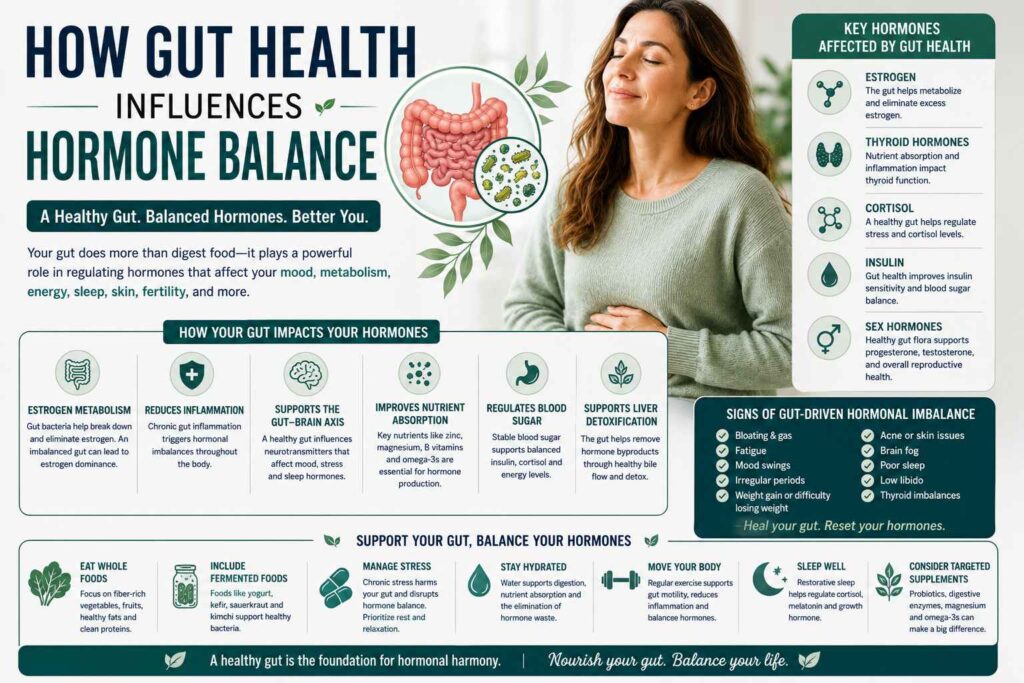
The link between gut health and hormones is one of the more interesting areas in current physiology research, and also one of the most oversimplified in health marketing. “Fix your gut to fix your hormones” is a claim that contains something true and a great deal that is not yet established.
The genuine connections are specific and mechanistic. Gut bacteria influence how oestrogen is recycled. A portion of thyroid hormone conversion happens in the gut. Gut-derived signals affect insulin sensitivity and appetite hormones. Intestinal inflammation influences the stress axis.
What follows sets out each pathway, how strong the evidence is for each, and what practical steps follow.
Oestrogen and the Oestrobolome
This is the best-characterised connection, and it explains why the topic gets attention.
Oestrogen circulates, does its work, and is then processed by the liver through conjugation, meaning glucuronic acid or sulfate groups are attached. Conjugation makes oestrogen water-soluble and inactive so it can be excreted, and a significant portion leaves via bile into the intestine.
Here is where gut bacteria enter. Some bacteria produce an enzyme called beta-glucuronidase, which removes the glucuronic acid group. This deconjugates the oestrogen, restoring its activity and allowing it to be reabsorbed into circulation rather than excreted. This is enterohepatic recirculation.
The collection of gut bacterial genes capable of metabolising oestrogen has been named the oestrobolome. Higher beta-glucuronidase activity means more oestrogen recycled back into circulation. Lower activity means more excreted.
What is established: the enzyme exists, the mechanism is real, and beta-glucuronidase activity varies between individuals.
What is not established: that variation in this activity is a major determinant of hormonal symptoms in individual patients, or that modifying it produces predictable clinical outcomes. Research has examined associations with hormone-sensitive conditions, but this remains an area of active investigation rather than settled clinical practice.
The honest position is that this is a plausible and interesting mechanism that has been oversold as an explanation for hormonal symptoms. It is worth understanding. It is not worth treating as a diagnosis.
What does influence it, in the direction most people want: dietary fibre binds conjugated oestrogen in the intestine and promotes excretion. Higher fibre intake is associated with lower circulating oestrogen in observational research. This is one of several reasons fibre keeps appearing as the practical answer.
Thyroid Hormone Conversion
The thyroid mainly produces T4, a relatively inactive storage form that must be converted into T3, the active hormone. Conversion happens in peripheral tissues, and the gut contributes.
Two mechanisms are relevant:
Deiodinase activity. Intestinal tissue expresses deiodinase enzymes, and gut bacteria appear to influence deiodinase activity. Some conversion occurs here.
Sulfate recycling. A portion of T4 and T3 is sulfated by the liver and excreted into the intestine. Bacterial sulfatase enzymes can deconjugate these, allowing reabsorption of active hormone. Reduced bacterial sulfatase activity, such as after antibiotics, may reduce this recycling.
Beyond conversion, the gut affects thyroid function in more straightforward ways. Nutrient absorption matters: iron, selenium, zinc, and iodine are all required for thyroid hormone production or conversion, and malabsorption from coeliac disease, inflammatory bowel disease, or SIBO reduces availability. Levothyroxine absorption is also affected by gut conditions, and coeliac disease in particular is a recognised cause of unexpectedly high dose requirements.
The autoimmune connection is well documented too. Coeliac disease and autoimmune thyroid disease co-occur at rates well above chance, strong enough that screening for coeliac in newly diagnosed Hashimoto’s is a reasonable step. Our article on Hashimoto’s and a root cause approach covers this.
Insulin and Metabolic Hormones
Several established mechanisms here.
Short-chain fatty acids. Bacterial fermentation of fibre produces butyrate, propionate, and acetate. These bind receptors on intestinal cells that trigger release of GLP-1 and PYY, hormones that influence insulin secretion, appetite, and gastric emptying. GLP-1 is the same pathway targeted by a well-known class of diabetes and weight medications, which gives some indication of how consequential it is.
Metabolic endotoxaemia. Bacterial lipopolysaccharide entering circulation triggers low-grade inflammatory signalling, which interferes with insulin signalling. Elevated circulating LPS has been documented in insulin resistance and obesity. The direction of causation remains debated.
Bile acid signalling. Gut bacteria modify bile acids, which act as signalling molecules through FXR and TGR5 receptors affecting glucose and lipid metabolism.
Evidence that microbiome differences accompany metabolic disease is strong. Evidence that manipulating the microbiome reliably improves metabolic outcomes in humans is considerably weaker, and diet confounds the picture substantially since it shapes both.
Cortisol and the Stress Axis
Bidirectional, and the direction that runs from stress to gut is better established than the reverse.
Stress affects the gut through documented pathways: corticotropin-releasing hormone increases intestinal permeability and activates mast cells, motility changes, and secretory IgA declines with chronic stress.
The reverse direction, gut bacteria influencing the stress axis, has substantial animal evidence. Germ-free mice show exaggerated stress responses that partially normalise with colonisation. Human evidence is much more limited, and trials of probiotics for stress and anxiety outcomes show small and inconsistent effects.
Practically, the more useful direction is the established one: chronic stress affects gut function, and gut symptoms create stress, which forms a loop worth interrupting from whichever side is more accessible.
Androgens and Other Hormones
Gut bacteria can deconjugate androgens through the same beta-glucuronidase mechanism that affects oestrogen, and research has documented substantial free testosterone in intestinal contents. Whether this meaningfully affects circulating levels is not established.
PCOS has been associated with reduced gut microbial diversity in several studies. Given that insulin resistance is central to PCOS in many women, and that the microbiome influences insulin sensitivity, a contributory role is plausible. It has not been demonstrated as causal.
Melatonin production also involves the gut, which contains considerably more melatonin than the pineal gland, though gut melatonin appears to serve primarily local functions rather than driving sleep.
What Actually Helps
The interventions that follow from all of this are less exotic than the mechanisms suggest, and they overlap heavily with general gut health.
Fibre, in Variety and Quantity
This does the most work across pathways. It binds conjugated oestrogen for excretion, feeds short-chain fatty acid production affecting insulin and appetite hormones, and supports the bacterial populations involved in thyroid hormone recycling.
Practical targets: a wide range of plant foods rather than a single fibre supplement, deliberate inclusion of legumes, resistant starch from cooled cooked potatoes and rice, and cruciferous vegetables, which additionally provide compounds involved in oestrogen metabolism pathways.
Address Constipation
Slow transit means longer contact time between conjugated hormones and bacterial enzymes, increasing the opportunity for deconjugation and reabsorption. Regular bowel movements support hormone clearance through a simple mechanism that requires no supplement.
Correct Nutrient Deficiencies
Iron, selenium, zinc, vitamin D, and B12 all affect hormone production or conversion. Malabsorption is a common and correctable cause of deficiency. Testing is more useful than guessing.
Treat Underlying Gut Conditions
Coeliac disease, inflammatory bowel disease, and SIBO all impair absorption and increase inflammation. Identifying and treating them addresses hormonal consequences more effectively than any supplement aimed at the gut-hormone axis directly. Our article on SIBO symptoms, testing and treatment covers one of the more commonly missed.
Limit Unnecessary Antibiotics and Alcohol
Both reduce microbial diversity, and both affect the enzyme systems described above.
Manage Sleep and Stress
The stress-to-gut pathway is the best-established part of the gut-brain relationship, and it is actionable.
What to Be Sceptical Of
- Tests claiming to measure your oestrobolome and generate a personalised protocol. No validated clinical test currently does this.
- Supplements marketed as lowering beta-glucuronidase to fix hormonal symptoms. Calcium D-glucarate is the usual example; evidence in humans is limited.
- Claims that gut treatment can replace hormone therapy. If the thyroid cannot produce adequate hormone, or oestrogen has fallen at menopause, gut work does not substitute for replacement.
- Any protocol promising to balance hormones through the gut. “Hormone balance” is not a measurable clinical endpoint, and the phrase does more marketing work than clinical work.
Frequently Asked Questions
Can gut problems cause hormone imbalance?
Gut function influences hormone metabolism through documented mechanisms, particularly oestrogen recycling, thyroid hormone conversion, and insulin-related signalling. Malabsorption from gut disease also reduces nutrients required for hormone production. Whether gut issues are the primary driver of symptoms in an individual is a clinical question requiring proper assessment.
What is the oestrobolome?
A term for the collection of gut bacterial genes capable of metabolising oestrogen, principally through beta-glucuronidase, which can deconjugate oestrogen destined for excretion and allow it to be reabsorbed. The mechanism is real; its clinical significance in individual patients is not established.
Does fixing my gut improve my thyroid?
Treating coeliac disease, SIBO, or inflammation can improve nutrient absorption, medication absorption, and inflammatory load, all of which affect thyroid function. It does not restore a thyroid gland that has been damaged, and it does not replace thyroid hormone where replacement is needed.
Will probiotics balance my hormones?
There is no good evidence that probiotic supplements meaningfully alter hormone levels or resolve hormonal symptoms. Some strains have modest evidence for specific gut conditions, but the leap to hormonal effects is not supported.
Does constipation raise oestrogen?
Slower transit increases the time available for bacterial deconjugation and reabsorption of oestrogen, which is a plausible mechanism. Observational research has linked bowel frequency with oestrogen levels. Treating constipation is worthwhile regardless.
The Bottom Line
The gut genuinely participates in hormone metabolism, through specific and interesting mechanisms. What follows practically is not exotic: eat a wide range of fibre-containing plants, keep bowels moving, correct nutrient deficiencies, treat any gut condition that is actually present, and be sceptical of protocols promising hormonal balance through the gut alone.
Where genuine hormone deficiency exists, gut work supports treatment rather than replacing it.
At Proactive Choice in Bend, Oregon, Dr. Drew Collins, ND, assesses gut and hormonal function together, since the two are frequently connected and rarely evaluated in the same appointment. Learn more about our biome restoration protocol or our approach to bioidentical hormone replacement in Bend, OR.
Book a consultation with Proactive Choice for an assessment that looks at both.
This article is for general education and does not replace individual medical advice. Do not stop or change hormone medication without consulting your prescribing clinician.
For a broader look at this kind of care, see Hormone Doctor in Bend, OR.
Further reading
- Estrogen-gut microbiome axis: Physiological and clinical implications, PubMed (NIH). A review of how gut bacteria help regulate circulating estrogen and related health conditions.
- The Gut Microbiome and Sex Hormone-Related Diseases, PubMed Central (NIH). A research review linking gut microbes to estrogen, testosterone, and hormone-related disorders.
- What Is Your Gut Microbiome?, Cleveland Clinic. How gut microbes interact with the endocrine system, immunity, and metabolism.
Want to talk this through for your own health? Book a visit with Dr. Drew Collins, ND at 601 NW Harmon Blvd in Bend, or call (858) 333-5196.