
Echinacea is everywhere during cold season, teas, tinctures, capsules, gummies, but the label rarely tells you what actually matters: which species, which plant part, how much, and for how long. Using it well is less about the brand you grab and more about understanding a few basics the research is actually clear on.
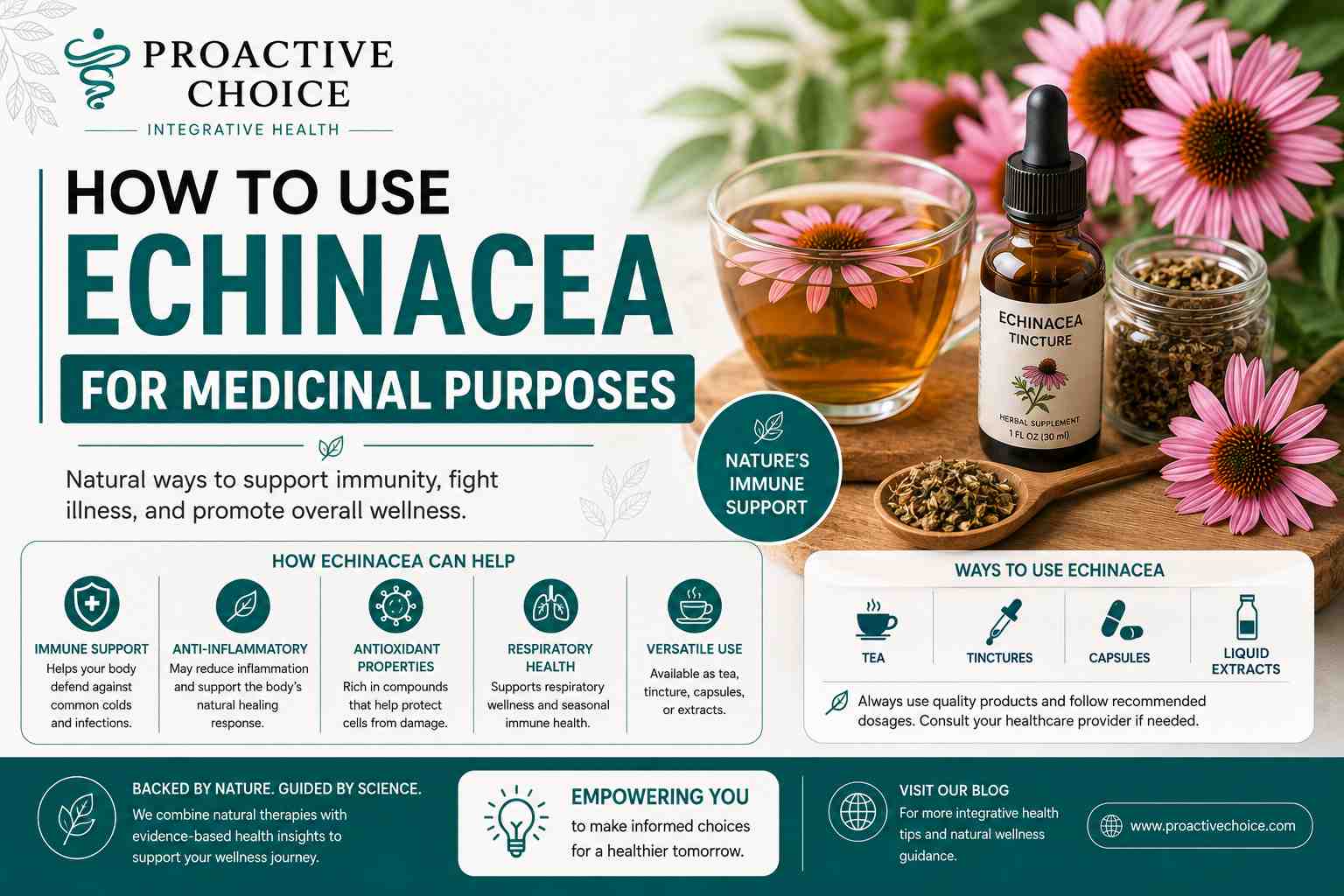
Quick Answer: Echinacea is most commonly used at the first sign of a cold, in short courses of 7 to 14 days rather than continuously. Typical adult dosing runs about 300 to 500 mg of dried extract two to three times daily, 1 to 3 cups of tea daily, or tincture drops per the product label, usually a few times a day. Species and plant part change the chemical profile significantly, so consistency in product matters more than most labels suggest. Anyone with an autoimmune condition, on immunosuppressant medication, pregnant, or considering use for a child should check with a provider first.
Which Species and Plant Part Actually Matter
Three echinacea species show up in supplements: Echinacea purpurea, Echinacea angustifolia, and Echinacea pallida. They are not interchangeable. Different species concentrate different active compounds, alkamides, polysaccharides, and phenolic acids like cichoric and caftaric acid, in different ratios. The root and rhizome generally carry the highest concentration of alkamides, the compounds most associated with immune-modulating activity, while the aerial parts (leaves and flowers) contribute a broader but less concentrated mix. Many quality products blend root with aerial parts specifically to balance potency and breadth. Recent NCCIH-sponsored research has even found that the activity of echinacea extracts is influenced by the soil conditions the plant was grown in, which helps explain why clinical trial results have been so inconsistent across different products and studies.
The practical takeaway: a “300 mg echinacea capsule” from one brand is not chemically equivalent to a 300 mg capsule from another. If a product worked for you before, that specific brand and species combination is worth sticking with rather than assuming any echinacea product is the same.
Forms of Echinacea and How to Use Each
Tea
Steep 1 to 2 teaspoons of dried echinacea root, leaf, or flower in freshly boiled water for 10 to 15 minutes, covered, to retain the volatile compounds. Most people drink 1 to 3 cups a day at the first sign of illness. Tea delivers the gentlest concentration of active compounds compared with tinctures or standardized extracts, which makes it a reasonable starting point if you are new to echinacea. Our full guide to echinacea tea covers brewing, taste, and specific benefits in more depth.
Tincture (Liquid Extract)
Tinctures are alcohol- or glycerin-based liquid extracts, generally the fastest-absorbing form since the compounds are already in solution. Dosing is drop-based and varies significantly by product concentration, a common pattern is a measured dropper amount in water two to three times daily at the first sign of a cold, but always defer to your specific product’s label rather than a generic number, since concentration varies so much between manufacturers.
Capsules and Tablets
Capsules typically supply 300 to 500 mg of dried extract or up to around 1,000 mg of dried herb powder per serving, taken two to three times daily. Dried extract powders are generally several times more concentrated than dried herb powders, so a 1,000 mg herb powder capsule is not necessarily stronger than a 300 mg standardized extract capsule. Read the label for “extract” versus “herb powder” designations rather than comparing milligram numbers alone.
Standardized Extracts
Some products are standardized to a specific marker compound, most often cichoric acid, to guarantee a consistent dose from batch to batch. These tend to have the most reproducible clinical trial data behind them, since researchers can control for potency more precisely than with whole dried herb.
By the Numbers
- Common clinical dosing for dried extract powder capsules runs around 900 mg per day, typically split across 2 to 3 doses.
- Standard tea dosing is 1 to 3 cups daily, brewed for 10 to 15 minutes in freshly boiled water.
- Most safety guidance caps continuous use at 7 to 14 days, based on limited data on longer-term use rather than a proven risk at longer durations.
- Some research suggests echinacea may reduce the odds of catching a cold and may modestly shorten the length of a cold when taken at the first sign of symptoms, though results vary by study and product.
Comparing the Main Forms
| Form | Typical Use | Absorption Speed | Best For |
|---|---|---|---|
| Tea | 1 to 3 cups daily | Slower, gentler | Beginners, hydration plus mild support |
| Tincture | Drops per label, several times daily | Fastest | Quick response at first symptoms |
| Capsules | 300 to 500 mg, 2 to 3 times daily | Moderate | Consistent, measured dosing |
| Standardized extract | Per label, marker-compound dosed | Moderate | Reproducible, research-backed potency |
When to Start and How Long to Continue
The evidence base consistently points to one timing pattern: start at the very first sign of a cold, sore throat, or seasonal illness, not as a daily year-round supplement. Continuous long-term use beyond about 8 weeks is generally discouraged, partly due to a lack of long-term safety data and some theoretical concern that continuous immune stimulation may become less effective over time. A short course of 7 to 14 days, then stopping, aligns with how nearly every major source discusses safe use.
Pros and Cons of Adding Echinacea to Your Routine
Pros
- Multiple accessible forms to match your routine and comfort level
- Generally well tolerated for short-term use in healthy adults
- Reasonable safety data compared with many other herbal supplements
- Caffeine-free and widely available
Cons
- Product quality and potency vary widely between brands
- Not appropriate for autoimmune conditions or with immunosuppressant medications
- Allergy risk for anyone sensitive to ragweed, marigolds, or chrysanthemums
- Evidence for cold prevention and duration is modest, not dramatic
Myth vs. Fact
Myth: “More echinacea means faster results.”
Fact: Studies do not show a clear dose-response benefit beyond standard ranges, and higher doses mainly raise the risk of digestive upset. Stick to labeled amounts.
Myth: “Taking echinacea every day year-round keeps your immune system strong.”
Fact: Nearly every safety source recommends short, intermittent courses rather than continuous daily use, both because long-term safety data is limited and because starting at the first sign of illness is when the evidence is strongest.
Myth: “All echinacea products are basically the same.”
Fact: Species, plant part, extraction method, and even the soil the plant grew in all measurably change the chemical profile. This is a major reason clinical trial results have been inconsistent across studies.
Who Should Avoid Echinacea or Check with a Provider First
- People with autoimmune conditions such as lupus, rheumatoid arthritis, or multiple sclerosis
- Anyone taking immunosuppressant medication
- People allergic to ragweed, marigolds, chrysanthemums, or other daisy-family plants
- Pregnant or breastfeeding individuals, who should check our guide on echinacea tea during pregnancy and speak with their provider
- Parents considering echinacea for a young child, since most guidance advises against oral use under age 12 without a pediatrician’s direction
- Anyone on medications metabolized heavily by the liver, or anyone wondering whether it affects blood pressure specifically
Getting Personalized Guidance
The general dosing ranges above are a solid starting point, but the right approach for you depends on your health history, current medications, and goals. Our herbal medicine consultations at Proactive Choice are built around exactly this kind of individualized guidance, helping you choose the right species, form, and dose rather than guessing from a label. Schedule a consultation or call (858) 333-5196.
Frequently Asked Questions
What is the best form of echinacea to use, tea, tincture, or capsules?
There is no single best form, tinctures absorb fastest, capsules offer the most measured dosing, and tea is the gentlest option. The right choice depends on how quickly you want an effect and how precisely you want to dose.
How long does it take echinacea to work for a cold?
Most guidance recommends starting at the very first sign of symptoms, since that is when the available research shows the most consistent, if modest, benefit. Waiting several days into an illness to start is less supported by the evidence.
Can I take echinacea every day for general immune support?
Continuous daily use beyond about 8 weeks is generally discouraged due to limited long-term safety data. Short, intermittent courses of 7 to 14 days are the more commonly recommended pattern.
Does the part of the plant used, root versus leaf, actually matter?
Yes. Roots and rhizomes generally carry higher concentrations of alkamides, the compounds most linked to immune-modulating activity, while aerial parts contribute a broader but less concentrated mix of compounds.
Is echinacea a substitute for antibiotics or antiviral medication?
No. Echinacea is not a natural antibiotic and has only mild antiviral properties. Its main proposed mechanism is stimulating your own immune response, not directly killing pathogens, which is a meaningfully different role than prescription antimicrobial medication.
Related Reading
- Can You Drink Echinacea Tea While Pregnant?
- Does Echinacea Raise Blood Pressure?
- Can 2-Year-Olds Have Echinacea Tea?
Explore Integrative Health Services at Proactive Choice in Bend
Want a personalized plan for using herbal remedies like echinacea safely and effectively? Proactive Choice in Bend, Oregon offers evidence-based integrative therapies under the care of Dr. Drew Collins, ND:
- Herbal Medicine Bend, OR: Guidance on which herbal remedies fit your specific health picture
- Immune Enhancement Therapy: Evidence-based strategies to support natural immune defenses
- IV Therapy Bend, OR: Nutrient infusions including Vitamin C, glutathione, and immune support blends
Proactive Choice is located in Bend, Oregon and serves patients throughout Central Oregon including Redmond, Sisters, La Pine, and Sunriver. Call (858) 333-5196 or schedule a consultation online.
Further reading
- Echinacea: Usefulness and Safety, NCCIH (NIH). Research on echinacea for colds, the forms studied, and safety information.
- Echinacea, Memorial Sloan Kettering Cancer Center (About Herbs). Available forms, reported uses, side effects, and interactions with medications.
Want to talk this through for your own health? Book a visit with Dr. Drew Collins, ND at 601 NW Harmon Blvd in Bend, or call (858) 333-5196.