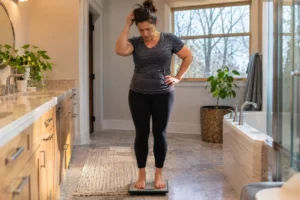
What causes insulin resistance? Mostly excess body fat, especially fat packed around the organs and inside the liver and muscles, combined with inactivity, age and the genes you inherit. Some medicines, such as steroids, and conditions such as PCOS and sleep apnea also cause it. For most people it can be improved a great deal.
Quick answer: Insulin resistance is mainly acquired, driven by excess fat (especially visceral and liver fat) and too little movement, with genes, aging and some medicines adding to it. It usually has no symptoms. A1c, fasting glucose, triglycerides and fasting insulin can point to it. Losing 7 percent of body weight cut diabetes risk 58 percent in the Diabetes Prevention Program, and one exercise session improves insulin sensitivity for at least 16 hours.

What causes insulin resistance?
Insulin’s job is to move sugar out of the blood and into muscle, fat and liver cells. In insulin resistance those cells respond weakly, so the pancreas makes more insulin to get the same result. For years that extra insulin keeps blood sugar normal, which is why so many people have it and do not know.
The StatPearls review of insulin resistance calls it “primarily an acquired condition related to excess body fat.” Its list of acquired causes includes visceral fat (the fat around your organs), aging, physical inactivity, poor diet, high-sodium eating and certain medications. Genetic causes exist, but they are rare.
Where the fat sits matters more than the number on the scale. Dr. Gerald Shulman, an endocrinologist at Yale School of Medicine who has studied this for decades, ties insulin resistance in the liver and muscle to “ectopic lipid accumulation,” meaning fat stored inside liver and muscle cells where it does not belong. He describes it as an old survival response, useful during starvation, that is now set off by overeating in what he calls a “toxic food environment.”
Other known causes, according to the National Institute of Diabetes and Digestive and Kidney Diseases (NIDDK):
- A family history of diabetes
- Long-term use of glucocorticoids (steroids), some antipsychotics and some HIV medicines
- Polycystic ovary syndrome, Cushing’s syndrome and acromegaly
- Sleep apnea
Cleveland Clinic adds an underactive thyroid to the list of hormone problems that can drive it, which we cover in our post on how hypothyroidism affects weight. NIDDK is also candid that “researchers don’t fully understand what causes insulin resistance and prediabetes.” That honesty is worth keeping in mind when someone sells you a single cause.
It is common. StatPearls cites a 2021 national survey analysis that found about 40 percent of US adults aged 18 to 44 met a standard measure of insulin resistance. NIDDK puts prediabetes at about 97.6 million US adults as of 2021.
How to know if you have insulin resistance
Usually you cannot tell by how you feel. NIDDK says plainly that people with insulin resistance and prediabetes “usually have no symptoms.” The American Diabetes Association says the same, and adds that doctors don’t usually test for insulin resistance itself as part of standard care.
There are a few physical clues. Cleveland Clinic lists darkened, velvety skin in the armpits or on the back and sides of the neck (acanthosis nigricans) and skin tags. A thick waist is another, since belly fat is the type most linked to the condition. None of these are proof.
Blood tests are more useful. No single one diagnoses insulin resistance, but together they build a picture.
| Test | What it shows | Level that raises concern | Limits |
|---|---|---|---|
| A1c | Average blood sugar over about three months | 5.7 to 6.4 percent is prediabetes (NIDDK) | Rises late, after the pancreas starts losing ground |
| Fasting glucose | Blood sugar after an overnight fast | 100 to 125 mg/dL is prediabetes (NIDDK) | Can stay normal for years while insulin climbs |
| Triglyceride to HDL ratio | A surrogate from a standard lipid panel | Above 3.0 is generally linked to insulin resistance (StatPearls) | StatPearls notes it does not hold in people who identify as Black |
| Fasting insulin | How hard the pancreas is working at rest | Above the lab’s range (2.6 to 24.9 mcIU/mL at Mayo Clinic Laboratories) | Results vary between lab assays |
| HOMA-IR | An index calculated from fasting glucose and fasting insulin | No single agreed cut-off | Built for research; inherits the insulin assay’s error |
The gold standard is the hyperinsulinemic-euglycemic clamp, a research test where insulin and glucose are infused for hours to measure how much sugar your body can absorb. Nobody gets that at a checkup.
Our view is that fasting insulin is worth adding when glucose and A1c still look normal but the waist, the triglycerides or the family history say otherwise. It tends to rise before glucose does, because the pancreas compensates first.
What is a normal fasting insulin level?
There is no universal answer, and that surprises people. Mayo Clinic Laboratories lists a reference range of 2.6 to 24.9 mcIU/mL for its serum insulin test, drawn after an eight-hour fast. Other labs use other ranges.
The reason is technical but matters for you. In a 2025 study in Clinical Chemistry and Laboratory Medicine, Rohlfing and colleagues ran the same 40 blood samples through 12 commercial insulin tests from nine manufacturers and compared them with a reference method. Only one assay fully agreed with the reference. Several read high at low insulin levels and low at high levels, even though all of them claim to follow the same World Health Organization standard. The authors called for “urgent” standardization.
Two practical points follow. First, a lab’s “normal” range is wide, and a fasting insulin near its top end is not reassuring just because it lacks a red flag. Second, the HOMA-IR cut-offs you see online were set in particular populations using particular assays, so they may not transfer to your lab. We prefer to compare your own results over time from the same lab. Change from your own baseline tells you more than a borrowed cut-off.
Does insulin resistance cause weight gain?
The relationship runs in both directions, but the stronger arrow points from fat to insulin resistance, not the other way round. That is how StatPearls, NIDDK and the ADA all frame it: excess fat, and visceral fat in particular, raises the risk. The ADA notes that extra fat tissue may cause inflammation and other changes in cells that make them respond poorly to insulin.
The reverse idea, that high insulin drives fat storage and hunger, is known as the carbohydrate-insulin model. It has been tested. In a 2021 study published in Nature Medicine, Kevin Hall’s team at the NIH housed 20 adults in a metabolic ward for four weeks, two weeks on a high-carbohydrate, low-fat diet and two weeks on a low-carbohydrate ketogenic diet, letting them eat as much as they wanted. On the high-carb diet, which produced “very high levels of insulin after meals,” people ate about 689 fewer calories a day. “Our data clearly don’t support the carbohydrate-insulin model,” Hall said.
Two weeks is short, and the debate is not settled. But if you are insulin resistant and gaining weight, the practical answer does not change: reducing excess fat, especially liver and belly fat, is what improves insulin sensitivity. Whether the extra insulin is also making the weight harder to lose for some people is an open question that we do not think anyone has nailed down.
Can you reverse insulin resistance?
For most people, a large part of it, yes. The ADA is more cautious and says it “may not be possible to defeat insulin resistance entirely,” but there are reliable ways to make cells more responsive. The evidence is strongest for these:
Weight loss. In the Diabetes Prevention Program, described in StatPearls, people at high risk who lost 7 percent of their body weight and stayed active cut their chance of developing type 2 diabetes by 58 percent. Metformin cut it by 31 percent. Dr. Shulman says “a 10% weight reduction can make a big difference,” and in his group’s research a diet of about 1,200 calories a day reduced liver fat and reversed liver insulin resistance.
Exercise. Dr. Shulman explains that exercise helps muscle take up sugar even when insulin resistance is present, which leaves less for the liver to turn into fat. A 2013 review in the Journal of Clinical and Diagnostic Research reports that a single bout of moderate exercise can raise glucose uptake by at least 40 percent. Dr. Shulman’s advice is simple: find an activity you like and do it every day.
Moving after meals. A 2022 meta-analysis in Sports Medicine by researchers at the University of Limerick pooled seven studies and found that light walking breaks improved blood sugar and insulin after meals compared with sitting, and did better than standing. The breaks were short, two to five minutes every 20 to 30 minutes.
Medicine. No drug is approved specifically for insulin resistance, according to both the ADA and StatPearls. Metformin and some other diabetes drugs reduce it, and Dr. Shulman suspects GLP-1 drugs work mainly through weight loss. Whether any of these fit you is a conversation for a clinician who has your labs. For how a root-cause evaluation looks at thyroid, hormones and gut health alongside blood sugar, see the naturopathic approach to weight loss.
What does not reliably reverse it: a supplement. We would put money into walking shoes before any “insulin support” capsule.
How long does it take to reverse insulin resistance?
Faster than most people expect for the first changes, and slower than they hope for the full picture.
Within a day. The same 2013 review notes that insulin sensitivity stays raised for at least 16 hours after exercise. That is why daily movement matters more than one hard weekend workout.
Within a week or two. In a small 2011 Newcastle University study in Diabetologia, led by Roy Taylor, 11 people with type 2 diabetes went on a 600-calorie-a-day diet. Their fasting blood sugar fell from 9.2 to 5.9 mmol/L within one week. By eight weeks, liver fat had dropped from 12.8 percent to 2.9 percent, and the liver’s response to insulin was close to that of people without diabetes. This was an extreme, supervised diet, not something to try alone.
Within months to a year. In the larger DiRECT trial that followed, published in The Lancet, 46 percent of people with type 2 diabetes on a supervised weight-loss program were in remission at one year, against 4 percent in the control group. Among those who lost 15 kg (about 33 pounds) or more, 86 percent were in remission.
Those studies were in people who already had diabetes. If you have insulin resistance without it, you are starting from a better place, and the same levers apply. A realistic plan is to recheck labs about three months after you change your habits, since that matches the window A1c reflects.
Myth: If your fasting blood sugar is normal, you do not have insulin resistance.
Fact: The pancreas can hold blood sugar normal for years by making more insulin. NIDDK notes that insulin resistance usually causes no symptoms, and glucose and A1c are often the last numbers to move.
Myth: Insulin resistance is caused by eating carbohydrates.
Fact: StatPearls describes it as mainly an acquired condition related to excess body fat. In an NIH metabolic ward study, people on a high-carb diet with high insulin after meals ate about 689 fewer calories a day than on a ketogenic diet.
Myth: Once you have it, it is permanent.
Fact: Weight loss and exercise improve insulin sensitivity, and a single exercise session raises it for at least 16 hours.
Frequently asked questions
What is the main cause of insulin resistance?
Excess body fat, especially visceral fat around the organs and fat stored inside the liver and muscle cells, is the main driver. StatPearls calls insulin resistance “primarily an acquired condition related to excess body fat.” Physical inactivity, aging and genes add to the risk, and some medicines, including long-term steroids, and conditions such as PCOS and sleep apnea can cause it too.
What are the signs of insulin resistance?
Most people have none. The American Diabetes Association says insulin resistance alone will not cause symptoms at first. Possible clues include darkened, velvety skin on the neck or in the armpits, skin tags and a large waist. Blood tests are more reliable: a rising A1c or fasting glucose, high triglycerides with low HDL, or a fasting insulin near the top of the lab range.
Can you reverse insulin resistance without medication?
Often, yes. In the Diabetes Prevention Program, losing 7 percent of body weight and staying active cut the risk of type 2 diabetes by 58 percent, more than metformin’s 31 percent. Regular exercise and short walks after meals improve insulin sensitivity. Some people still need medication, and the ADA notes that no drug is approved specifically for insulin resistance.
What is a normal fasting insulin level?
Ranges vary by laboratory. Mayo Clinic Laboratories lists 2.6 to 24.9 mcIU/mL after an eight-hour fast. A 2025 study found large differences between 12 commercial insulin tests, so a result from one lab may not match another. It is best to compare your results over time at the same lab and read them alongside glucose, A1c and triglycerides.
How fast can insulin resistance improve?
Some changes start within a day. Insulin sensitivity stays raised for at least 16 hours after one exercise session. In a small 2011 Newcastle study, a strict 600-calorie diet normalized fasting blood sugar within a week in people with type 2 diabetes. Bigger shifts in liver fat and A1c take weeks to months, so recheck your labs after about three months.
If your weight will not move and your labs keep creeping up, testing is the next step rather than another diet. At Proactive Choice, Dr. Drew Collins, ND, checks fasting insulin alongside glucose or A1c, a lipid panel and thyroid and hormone labs to find what is getting in the way. Learn more about medical weight loss in Bend, or book a free 15-minute call at +1 (858) 333-5196.
Sources
- Freeman AM, Acevedo LA, Pennings N. Insulin Resistance. StatPearls, NCBI Bookshelf, updated 2023.
- Yale School of Medicine. How to reverse insulin resistance (interview with Gerald I. Shulman, MD, PhD), April 2024.
- National Institute of Diabetes and Digestive and Kidney Diseases. Insulin resistance and prediabetes.
- American Diabetes Association. Understanding insulin resistance.
- Cleveland Clinic. Insulin resistance.
- Mayo Clinic Laboratories test INS, Insulin, Serum (reference values, via NYU Langone Health test catalog).
- Rohlfing C, et al. The current status of serum insulin measurements and the need for standardization. Clinical Chemistry and Laboratory Medicine, 2025.
- Healio. Lower energy intake observed in low-fat vegan vs. low-carb ketogenic diet (Hall KD, et al., Nature Medicine, 2021).
- Venkatasamy VV, et al. Effect of physical activity on insulin resistance, inflammation and oxidative stress in diabetes mellitus. Journal of Clinical and Diagnostic Research, 2013.
- Buffey AJ, et al. The acute effects of interrupting prolonged sitting time in adults with standing and light-intensity walking on biomarkers of cardiometabolic health: a systematic review and meta-analysis. Sports Medicine, 2022.
- Lim EL, et al. Reversal of type 2 diabetes: normalisation of beta cell function in association with decreased pancreas and liver triacylglycerol. Diabetologia, 2011.
- Diabetes and Primary Care. DiRECT low-calorie formula diet increases remission at 1 year (Lean MEJ, et al., The Lancet, 2018).
Medically reviewed content from Proactive Choice. This article is for education and is not a diagnosis. Talk with a licensed clinician about your own labs and treatment options.
Want to talk this through for your own health? Book a visit with Dr. Drew Collins, ND at 601 NW Harmon Blvd in Bend, or call (858) 333-5196.